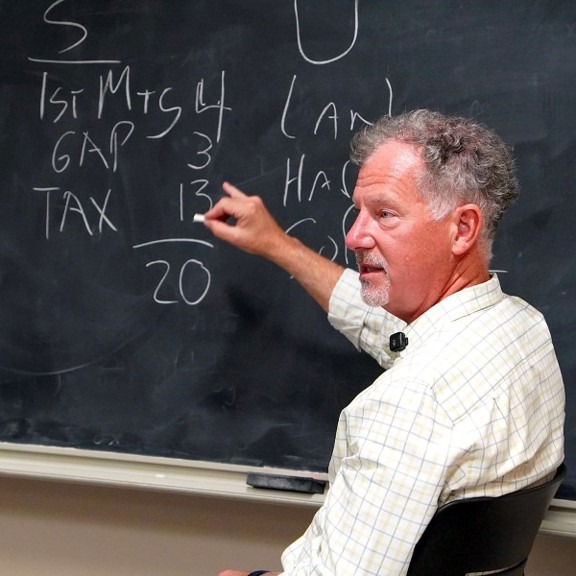
David Weiss of General Capital Group breaks down an affordable housing capital stack for Paul Aylesworth’s REAL EST 560 Affordable Housing class.
Four industry leaders brought their work into real estate classrooms at the Wisconsin School of Business at the University of Wisconsin–Madison this fall, giving students an inside look at the Empire State Building’s net-zero retrofit, private equity investing in a difficult market, affordable housing finance, and real estate investment trust (REIT) portfolio strategy.
The sessions reached three of the Wisconsin Real Estate Program’s four graduate tracks: the Real Estate Private Equity (REPE) Track, the Affordable and Sustainable Housing Development (ASHD) Track, and the
Applied Real Estate Investment Track (AREIT). Each speaker walked through real decisions, including some that did not go to plan, and tied them to the work students are doing now.
Sustainability as an investment decision
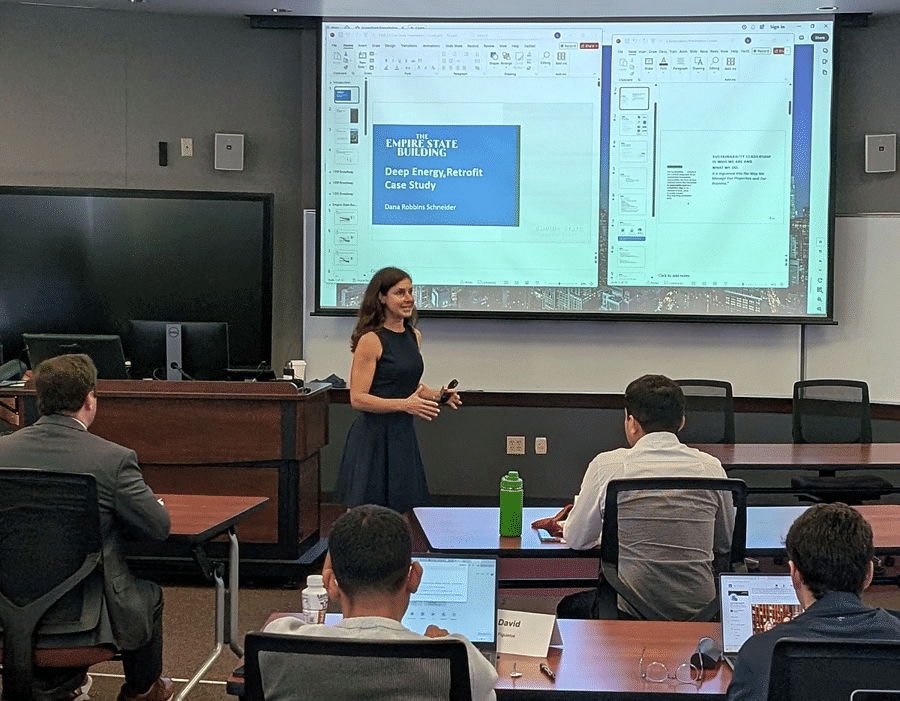
Dana Robbins Schneider presents the Empire State Building deep energy retrofit case study to Jon Lulu’s Contemporary Topics seminar.
Dana Robbins Schneider, senior vice president and director of energy and sustainability at Empire State Realty Trust (ESRT), spoke to the Contemporary Topics seminar taught by Jon Lulu, associate director of real estate graduate programs at the James A. Graaskamp Center for Real Estate.
Robbins Schneider walked students through the Empire State Building’s deep energy retrofit, which is driving the building toward net zero by 2030, and showed how ESRT makes sustainability decisions as investment decisions. She also shared her career path, from mechanical engineer to leading JLL’s Americas sustainability projects across more than 250 million square feet before joining ESRT.
Private equity in a difficult market
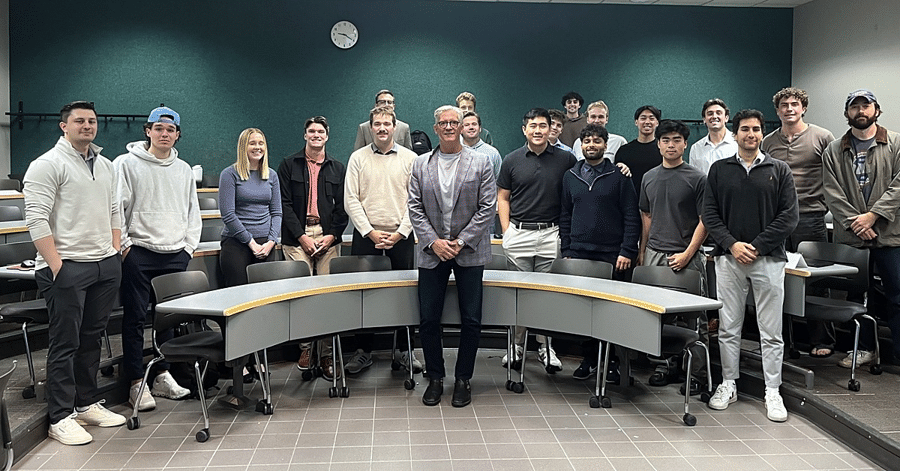
Scott McKibben with Paul Melkus’ REAL EST 851 students
Scott McKibben, founder and CEO of Chicago-based Matterhorn Venture Partners and an alumnus of WSB and UW Law School, spoke to REAL EST 851 students Oct. 8. The course is taught by Paul Melkus (MS ’95), director of the Real Estate Private Equity Track and a former classmate of McKibben’s. Drawing on years of industrial deals across market cycles, McKibben walked students through deals that worked, some that didn’t, and the lessons behind each.
Those lessons apply directly on the REPE Track, where a student and alumni investment board manages outside capital. In the 2025-26 academic year, REPE students evaluated about 65 deals and invested in developments in Southern California and Washington, D.C.
The capital stack behind affordable housing
David Weiss of Milwaukee-based General Capital Group, a longtime friend of the program and mentor to its students, joined REAL EST 560 Affordable Housing, taught by Paul Aylesworth, director of the Affordable and Sustainable Housing Development Track.
At the chalkboard, Weiss broke down a project’s capital stack, from a first mortgage to gap financing and tax credits. He discussed what makes affordable housing hard to deliver, from layering tax incentives and grant funding to partnering with nonprofits to bring large projects to life. For ASHD students, whose coursework covers low-income housing tax credits (LIHTC), the session showed how those pieces fit together in practice.
Building a REIT portfolio, sector by sector
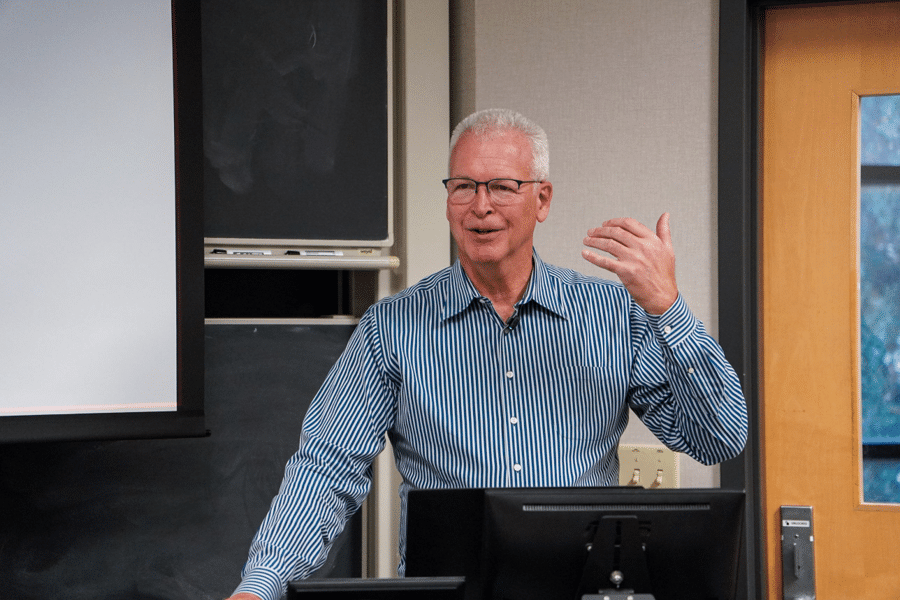
Joseph R. Betlej explains how to choose REIT stocks, sectors, and markets to students in Jay Rosenberg’s AREIT course.
Joseph R. Betlej, CFA (MS ’85), retired vice president and portfolio manager at Securian Asset Management and a member of the AREIT Advisory Board, spoke to students in the AREIT course Oct. 7. The course is taught by Jay Rosenberg (BS ’95), director of the Applied Real Estate Investment Track.
Drawing on four decades of real estate investing, Betlej walked students through how to approach their REIT portfolio project, avoid common pitfalls, and choose stocks, sectors, and markets. AREIT students make those calls with real money, managing a live $2.2 million portfolio and pitching each idea to a board of industry practitioners.
“I’ll guarantee you, board members wouldn’t put the time in if they didn’t see the students working as hard as they are,” said Betlej.
A network that teaches
Hands-on, experiential learning at Wisconsin depends on practitioners willing to bring real deals into the classroom. Two of this fall’s speakers, McKibben and Betlej, are Wisconsin alumni, and the Wisconsin Real Estate Alumni Association (WREAA) extends that network to more than 2,000 members. Learn more about the REPE Track, the ASHD Track, and AREIT.
“The Wisconsin Real Estate Program has always benefited from its industry partners, and visits like these show that community at work. Dana, Scott, David, and Joe brought real deals, real decisions, and hard-won lessons into the classroom, and our students met them with energy and curiosity. When industry leaders and alumni come to campus, our students hear about real-world examples that are not found in any textbook. That culture of giving back is what makes Wisconsin Real Estate distinctive, and we are grateful to every partner who helps build it,” said Jacques Gordon, director of the Graaskamp Center.
What’s next
Industry speakers will continue to visit Wisconsin Real Estate courses through the fall semester. Alumni and industry partners interested in speaking to a class or mentoring students can contact the Graaskamp Center to get involved.
Thank you to Dana Robbins Schneider, Scott McKibben, David Weiss, and Joseph R. Betlej for sharing their time and expertise with our students.
Media contact: Brian Becker, Associate Director of Outreach, Graaskamp Center, bbecker25@wisc.edu
About the Graaskamp Center
The James A. Graaskamp Center for Real Estate at the Wisconsin School of Business connects students, faculty, alumni, and industry partners through applied real estate education, research, and outreach. Wisconsin Real Estate’s undergraduate program has been ranked #1 by U.S. News & World Report for five consecutive years, and its master’s program ranks #3 nationally.