
Certificate in Consulting
Develop critical skills used in the consulting field
Project management + business communication
- Take your business ideas and put them into action
- Think critically to improve business processes
- Convert information into business decisions
- Develop communication skills consultants use when interacting and presenting to clients
Strategic thinking + advanced analytics
- Benefit from a curriculum steeped in creativity and innovation
- Find answers to questions in order to define the problem
- Apply your skills to business situations through case-based learning
- Customize your certificate by choosing courses that match your interests and goals
Program overview
Who is the certificate for?
Open to undergraduate students currently enrolled at UW–Madison
Additional admissions requirements
- 24 credits in residence (12 credits for transfer students)
- Minimum 3.0 cumulative GPA
13 total credits
- 10 credits of required courses
- 3 credits of electives
Certificate completion
“Awarded Certificate in Consulting” will be notated on your official transcripts
Average starting salary in consulting
Companies that hire Wisconsin consulting students





What are popular consulting jobs?
- Business analyst
- Consulting analyst
- Management analyst
- Management consultant
- Organizational development consultant
- Strategy analyst
- Technology analyst
Common consulting career paths
Management consultants help organizations improve operations and solve problems to increase performance and productivity. They provide advice and guidance in areas such as strategy, operations, finance, and marketing.
Many consulting firms hire management or strategy consultants as generalists early in their careers, giving them exposure to different industries, clients, and projects. As consultants gain experience, they often specialize in areas that match their interests and strengths.
Management consultants advise people working in professional or technical fields. They examine organizations, identify areas for improvement, and propose ways to create change. Both large and boutique consulting firms hire specialists who focus on specific practice areas or industries. These niche areas require a higher level of expertise, and people in these roles are often referred to as subject matter experts. Consultants in this pathway follow a more focused and specialized track while still serving a variety of clients.
- Consumer insights and research consultant: Help companies or organizations understand customer needs, behaviors, and preferences. Projects may include customer feedback studies on new or existing products, market research, and new product development.
- Human capital consultant: Advise organizations on workplace policies, employee retention, and performance. Projects may include organizational design, performance management, total rewards, change management, people analytics, and more. Human capital consultants work across departments to implement new strategies, processes, and technologies that impact employees.
- Operations and process consultant: Improve efficiencies across organizational operations. Projects may include reducing costs, optimizing technology or processes, and more.
- Real estate consultant: Advise investors and other stakeholders in commercial real estate. Work includes everything from market analysis to investment strategy to due diligence.
- Risk consultant: Work with brokers to obtain insurance coverage for clients. Risk consultants determine potential loss exposures, identify existing controls, and recommend additional loss control programs and activities that help clients increase their safety awareness and maintain or improve their ability to reduce or prevent losses.
- Supply chain management consultant: Optimize how products and services move from suppliers to customers. Projects traditionally focus on a part of the supply chain such as logistics and inventory management.
Technology consultants help organizations use information technology to solve business problems and achieve their goals. They also recommend, implement, and manage IT systems. Areas of technology consulting can include enterprise reporting platforms, cloud, and systems design and implementation.
Applied learning opportunities
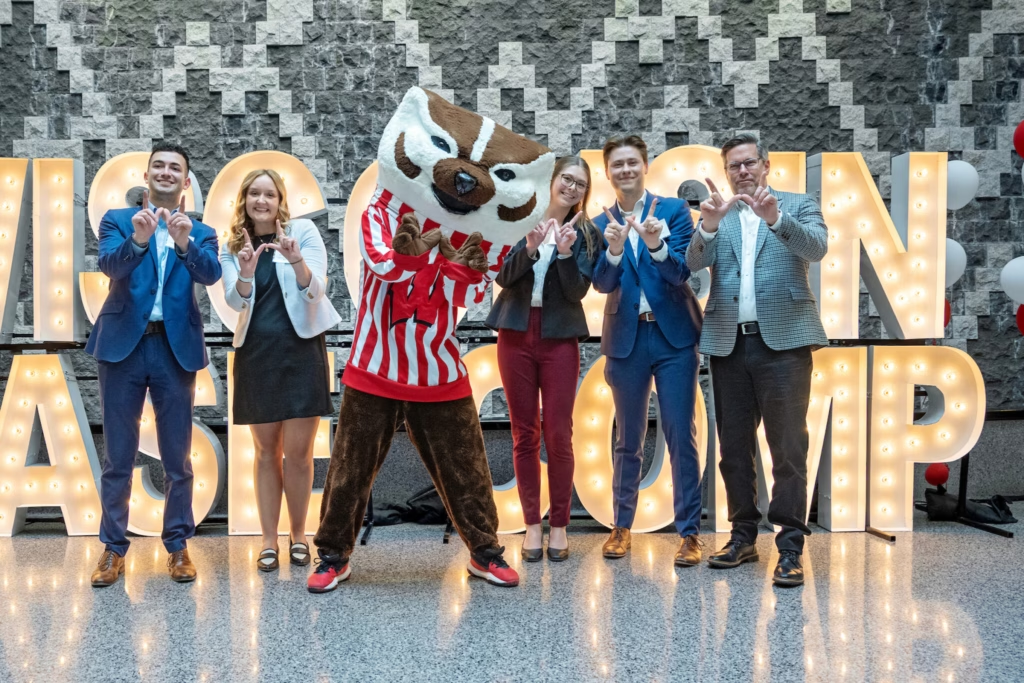
Case competitions
Put your business skills to the test in national case competitions where you solve real-world challenges or case studies. Showcase your analytical, problem-solving, and presentation skills. Competitions have been sponsored by the Wisconsin Consulting Club and the Wisconsin School of Business and have included the Wisconsin Invitational Consulting Case Competition.

Career treks
Visit between five and eight companies over two to three days in cities across the U.S. Past locations include Chicago and New York. Past employers include Accenture, Bain & Company, Gallagher, and INSIGHT2PROFIT, PwC. Twenty undergraduate business students go on each trek. The school covers the cost of lodging and part of your travel.

Job shadows
Experience a company’s day-to-day operations, tour facilities, network, and more through half- or full-day site visits. Past employer participants include Brillect, EY, INSIGHT2PROFIT, Procter & Gamble, Spaulding Ridge, Wakely, and WTW. Employers host between five and 20 undergraduate business students at a time.
Consulting student organizations
- Badger Consulting
- Ethical and Responsible Business Network
- TAMID at UW–Madison
- Wisconsin Consulting Club
- Wisconsin Marketing Organization
- Wisconsin Sports Consulting Club
Meet the consulting team
Use Starfish to make an appointment with your career coach. Students are encouraged to self-enroll in the Consulting Resources Canvas course.


Contact us
Advising
Students who declare the certificate are assigned a Wisconsin School of Business academic advisor and career coach.
Questions?
If you have questions about undergraduate certificates, email the undergraduate advising center at wibbaadvising@wsb.wisc.edu or call 608-262-0471.