
In 2022, Dr. Wendy Ledesma, a physician executive with Sauk Prairie Healthcare in Prairie du Sac, Wisconsin, enrolled in the inaugural cohort of a new healthcare leadership program. It proved to be a pivotal career turning point, inspiring her to earn an MBA from the Wisconsin School of Business this past May.
“I realized that to create meaningful and sustainable impact in healthcare leadership, I wanted a stronger foundation in business and organizational leadership,” Ledesma (MBA ’26) says. “The experience helped me recognize that physician leadership is not only about caring for patients, but also about helping shape systems that support caregivers, improve quality, and strengthen communities.”
Now in its fifth year, the Wisconsin Hospital Association Health Care Leadership Academy will launch its 2027 cohort in January. A partnership between the Wisconsin School of Business Center for Professional and Executive Development (CPED) and the Wisconsin Hospital Association (WHA), the five-month program is designed to develop healthcare leaders. The academy is open to WHA members—in clinical and nonclinical roles—who aspire to the C-Suite or wish to advance within executive leadership.
“It’s the business of healthcare,” says Leigh Ann Larson, vice president of education and corporate partnerships with WHA. “It’s really meant for that executive level or prospective executive level. It’s for the people who are going to be making the decisions integral to a hospital staying viable and providing the services necessary to care for the community.”
Identifying the Skill Gap
Mark Seifert, CPED’s senior director of business and talent development, says the idea originated seven or eight years ago during a discussion on how to better support healthcare systems and hospitals. Through its existing relationships with several Wisconsin health systems, CPED observed a recurring pattern.
“They know their patients, they know what they need to know about their disciplines, but from a business perspective and running a business, there was a big gap,” Seifert says. “So, we looked at putting a program together to elevate some of those skill sets.”
After partnering with WHA, the center developed a comprehensive program to benefit leaders within hospitals.
“It’s a broad, comprehensive look at ‘this is how organizations are run well,’” says Seifert. “These are the things you need to consider, the areas you need to strengthen yourself or the organization, the financial metrics you’re going to want to look at. It doesn’t matter what part of the organization you are coming from; the idea is to roll in the same direction.”
A Flexible Path to Executive Growth
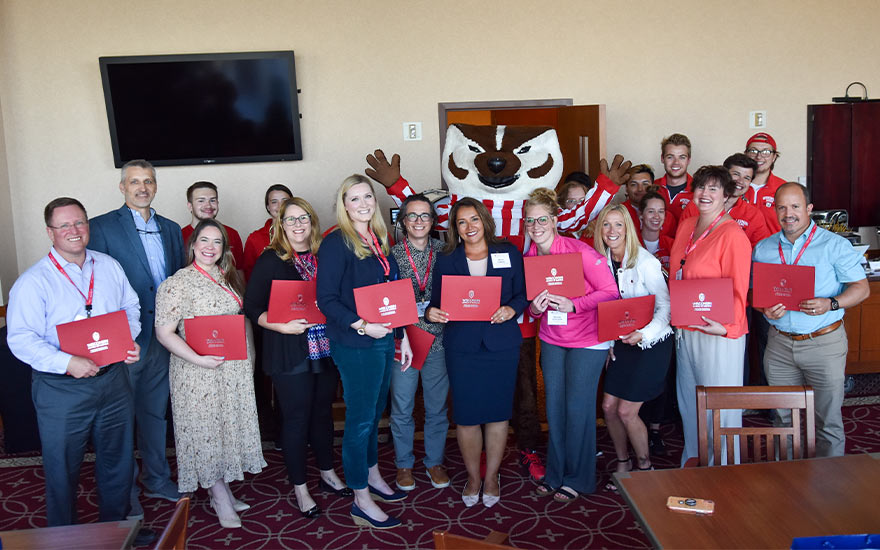
The upcoming academy cohort runs from January through June, typically averaging 10-12 participants. The hybrid format kicks off virtually in January, followed by two-day in-person sessions at the Fluno Center on the University of Wisconsin–Madison campus in February and June. At the June gathering, participants receive a graduation certificate—and a celebratory visit from Bucky—and earn priority consideration for admission to WSB’s professional MBA program. Between virtual and on-campus sessions, participants complete self-directed learning assignments.
Taught by CPED and WHA instructors, the academy’s core topics include strategic leadership, healthcare fundamentals, ethics, artificial intelligence, leading organizational project management, and conflict resolution.
During on-campus sessions, participants complete an intensive 360-degree assessment, paired with on-site executive coaching. The assessment asks, “’How am I impacting my direct reports? How are my behaviors impacting the rest of the organization?’” says Seifert. “It’s an eye-opening exercise in emotional intelligence.”
During the graduation ceremony, participants are asked what element of the program was most impactful for them and why.

“To hear them talk about these life-changing experiences or career-changing experiences they’ve had is so powerful,” says Larson. “There’s a level of confidentiality and it allows people to be very vulnerable and honest. I’ve also had natural competitors say it’s great to be in a space where it’s safe to talk about our similarities and differences and bounce ideas off each other. We have groups that still meet to this day.”
Since its inception, several academy alumni have been promoted to CEO, while others have gone back to school for master’s and doctoral degrees.
“It’s inspired participants to keep learning and know that they have resources not only in WHA but in their fellow cohort members,” Larson says.
Calibrating to the Future
As the partnership evolves, Seifert foresees expanding AI integration and refining coursework to ensure the program delivers the specific expertise healthcare leaders need most.
Hannah Young, a 2023 graduate, credits the academy with providing practical leadership experience beyond what a traditional classroom can offer.
“Rural hospitals are small and agile organizations where new ideas can be piloted, and the impact can be seen and felt by those you serve,” says Young, who recently accepted an administrator role at Emplify Health by Gundersen Hillsboro Area in Hillsboro, Wisconsin.
“In my new role, I’ll use those lessons to help guide thoughtful decision-making, support our people, leverage relationships and navigate challenges with a systems-level perspective—helping me connect my new rural community with the greater health system.”
Tags: