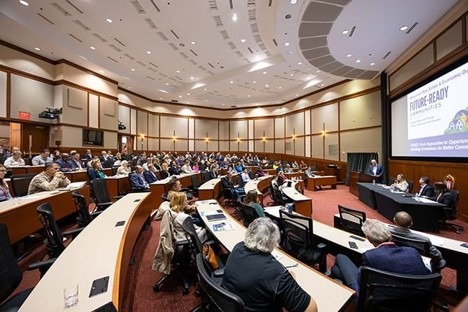
Housing affordability, new state housing laws, and how to turn community opposition into opportunity led the 2026 Wisconsin Real Estate & Economic Outlook Conference, held Oct. 2 at the Fluno Center in Madison.
Hosted by the James A. Graaskamp Center for Real Estate at the Wisconsin School of Business, the conference drew a full house from banking, development, government, and nonprofit housing under the theme “Future-Ready Communities.”
A national view of housing costs
Keynote speaker Morris Davis, former academic director of the Graaskamp Center, returned to Madison from Rutgers Business School, where he holds the Paul V. Profeta Chair in Real Estate.
Drawing on the 2026 Economic Report of the President, Davis showed how far home prices have outrun incomes. From 2000 to 2023, inflation-adjusted house prices for median-income homeowners rose more than 80%, while their incomes rose about 12%. The typical home now costs more than four times the typical homeowner’s income, up from two and a half. New single-family construction per person, he noted, has fallen by half since 2007.
New tools from Washington to Wisconsin
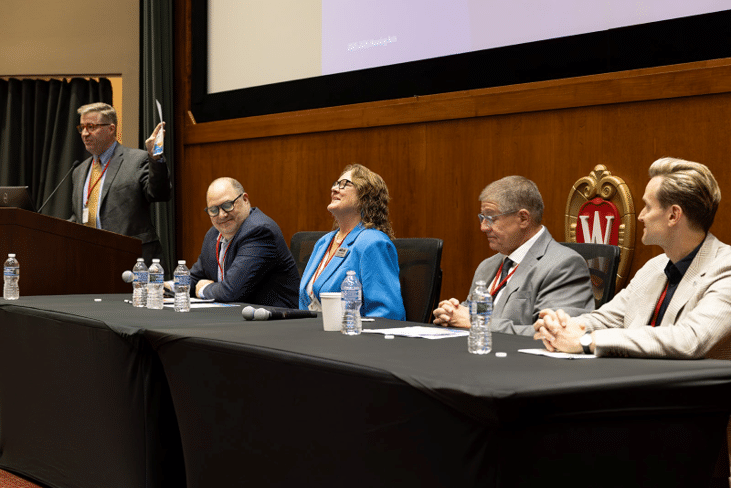
Kurt Paulsen, professor of urban planning at UW–Madison, moderated a panel on practical tools to expand housing supply. Wisconsin State Rep. Dave Armstrong, who also leads the Barron County Economic Development Corporation, joined Amy Bliss, executive director of the Wisconsin Housing Alliance; Robert Procter, partner at Axley Law; and Jon Searles, community and economic development director at the Wisconsin Housing and Economic Development Authority (WHEDA).
Paulsen opened with Wisconsin permit data: the state now issues about half as many single-family building permits a year as it did before the Great Recession, while multifamily permits are back to pre-recession levels, about 9,000 a year.
Searles outlined WHEDA’s expanded financing tools, from loans that convert vacant commercial buildings into housing to a $1.5 million line of credit for nonprofit single-family developers, including a Habitat for Humanity La Crosse pilot that finances manufactured homes on permanent basements. Bliss showed how factory-built homes made in Wisconsin plants can deliver quality housing at lower cost, citing a 2024 Federal Housing Finance Agency study that found manufactured homes appreciate much like site-built homes.
The center also shared a resource sheet summarizing five new Wisconsin housing laws, from subdivision approvals to workforce housing tax incremental districts.
The power of manufactured housing
Lesli Gooch, CEO of the Manufactured Housing Institute, the national trade association for the manufactured housing industry, delivered the second keynote, “Unlocking Housing Opportunity: The Power of Manufactured Housing to Build More Homes.”
Gooch explained that today’s manufactured homes are built entirely in a factory to a single federal code set by the U.S. Department of Housing and Urban Development (HUD). A new one costs less than a third as much as a new site-built home, excluding land, yet manufactured homes account for less than 10% of single-family home starts.
In Wisconsin, nearly 65,000 manufactured homes house more than 125,000 people, about 2% of the state’s housing units compared with 5% nationwide.
From opposition to opportunity
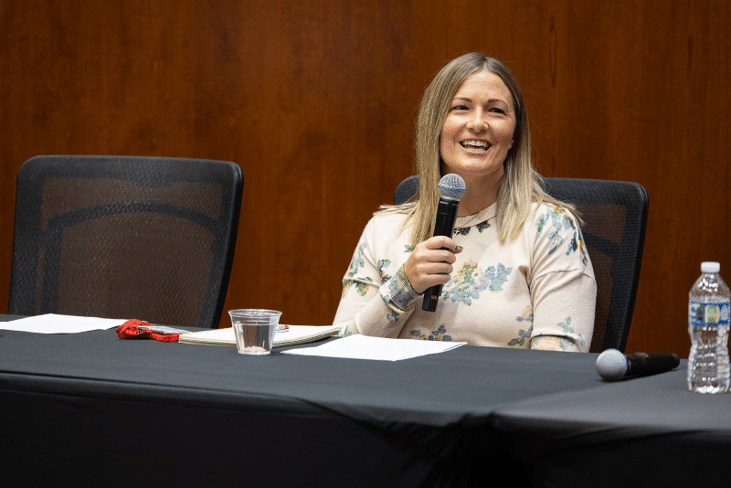
The afternoon panel tackled community opposition to housing, infrastructure, and economic development. Jerry Deschane, former executive director of the League of Wisconsin Municipalities, moderated a conversation with Nicole Solheim, vice president of development at Wisconsin Housing Preservation Corp.; Emily McFarland, executive director of the League of Wisconsin Municipalities and former mayor of Watertown; and Mike White, team leader of local relations at the American Transmission Company. Panelists shared strategies for engaging stakeholders early, addressing concerns with transparency, and building partnerships that move projects forward.
What’s next
Presenter slides, shared with each speaker’s permission, and the conference resource sheet are available in the conference supplementary materials. Attendees can still share feedback through the post-conference survey. Planning for the 2027 conference is underway.
Thank you to the conference sponsors and to the Graaskamp Center board members whose support makes the conference possible, and to every speaker and moderator who shared their expertise.
Media contact: Brian Becker, associate director of outreach, Graaskamp Center, bbecker25@wisc.edu
About the Graaskamp Center
The James A. Graaskamp Center for Real Estate at the Wisconsin School of Business connects students, faculty, alumni, and industry partners through applied real estate education, research, and outreach. Wisconsin Real Estate’s undergraduate program has been ranked #1 by U.S. News & World Report for five consecutive years, and its master’s program ranks #3 nationally.