Beyond the Balance Sheet: Inside Chicago’s Corporate Landscape
As part of the Nicholas Center for Corporate Finance and Investment Banking’s Fall 2026 programming, MBA students traveled to Chicago on October 1 for a career trek focused on exploring how finance supports decision-making across very different organizations. Over the course of the trip, we visited United Airlines, Prudential Private Capital, Relativity, and the Federal Reserve Bank of Chicago, gaining exposure to perspectives ranging from corporate FP&A and private capital to technology and economic policy.
United Airlines: Finance Inside Operations
Our first stop brought us to one of Chicago’s most recognizable landmarks, Willis Tower, for a visit with United Airlines. After taking in the views from the upper floors, we were welcomed by Jordan Ross, Financial Analyst; Sean Gilmore, Senior Manager of Flight Operations Finance; and Benjamin Markell, Lead Analyst, FP&A Clubs & Lounges.
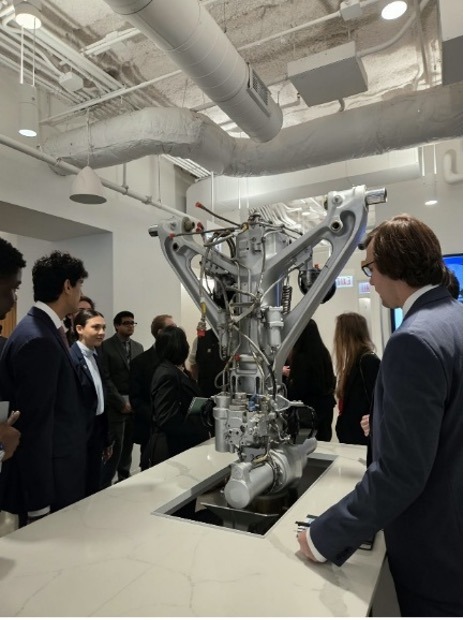
The conversation began with an overview of United’s MBA internship and full-time opportunities, particularly within FP&A and other finance functions. Technical financial knowledge remains essential, but at the MBA level, employees are increasingly expected to combine that knowledge with judgment and the ability to challenge assumptions.
One message stood out throughout the discussion: an internship should be approached as an extended interview for a full-time role. Success depends not only on completing the analysis assigned to you, but also on demonstrating business acumen, integrating effectively within a team, and contributing perspectives that move the conversation forward.
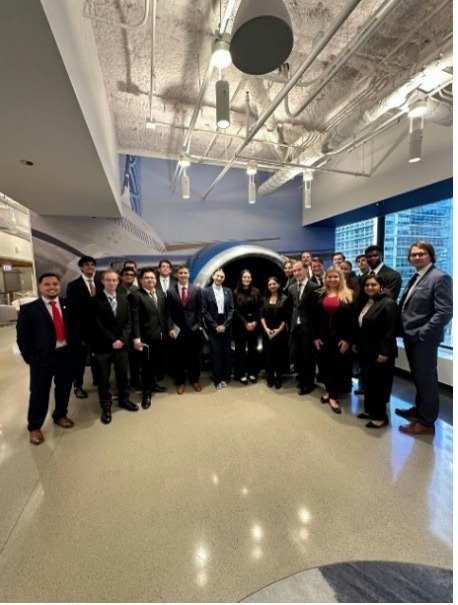
The panel highlighted several questions that finance professionals should continually ask themselves: Can you go beyond the initial “why”? Can you communicate your analysis clearly? Can you connect the numbers to what is actually happening in the business? Producing the correct answer is valuable, but understanding the reasoning behind it and explaining it effectively is just as important.
The discussion around artificial intelligence reinforced the same lesson. AI may help build a model or accelerate an analysis, but the professional is still responsible for its assumptions and formatting. Eventually, someone will ask you to explain your work, and at that point, there is no substitute for truly understanding it.
Prudential Private Capital: Capital Allocation and Risk
Our second stop took us to Riverside Plaza to visit Prudential Private Capital, where we were welcomed by Dave Quackenbush, Managing Director, and Tom Molzahn, Principal. Their Chicago team focuses on providing private credit to middle-market companies throughout the Midwest, giving us a very different perspective on finance from the corporate FP&A environment we had experienced earlier at United.
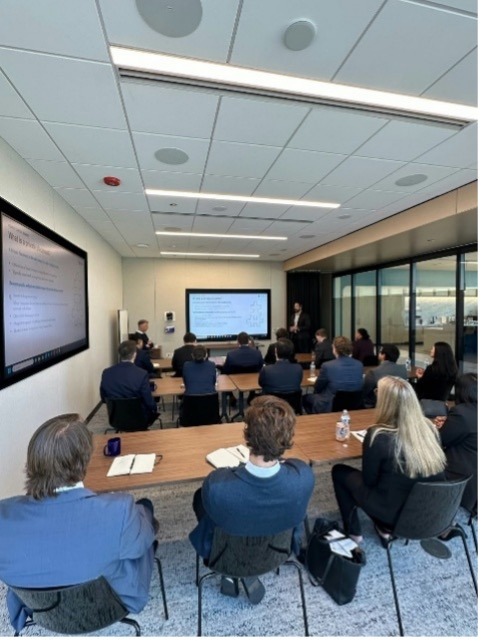
Dave and Tom broke the private credit investment process into four core responsibilities: originating transactions, analyzing companies, selecting investments, and managing the portfolio after capital has been deployed. Although each step requires significant financial analysis, much of the discussion came back to one fundamental question: Is the risk worth the return?
One of the most interesting parts of the conversation was the challenge of investing across many industries. Private credit professionals must understand companies well enough to evaluate their ability to repay debt, yet it is nearly impossible to become a technical expert in every sector. Instead, investors develop frameworks for assessing businesses, industries, cash flows, capital structures, and risk. As the team explained, the cost of capital and expected return should ultimately reflect the level of risk being taken.
One aspect that makes Prudential Private Capital’s approach particularly interesting is that the same team is involved throughout the entire investment process, from originating transactions and evaluating companies to selecting investments and managing the portfolio. This allows the team to develop a deeper understanding of the companies they invest in while remaining involved long after the initial investment decision.
Relativity: Navigating Growth and Uncertainty
Our third visit shifted the conversation toward one of the fastest-changing areas of business: technology and artificial intelligence. At Relativity, we were welcomed by Chief Financial Officer Kirk Larsen, who combined an overview of the company with a candid discussion about career decisions, leadership, and what it takes to succeed in an environment defined by constant change.
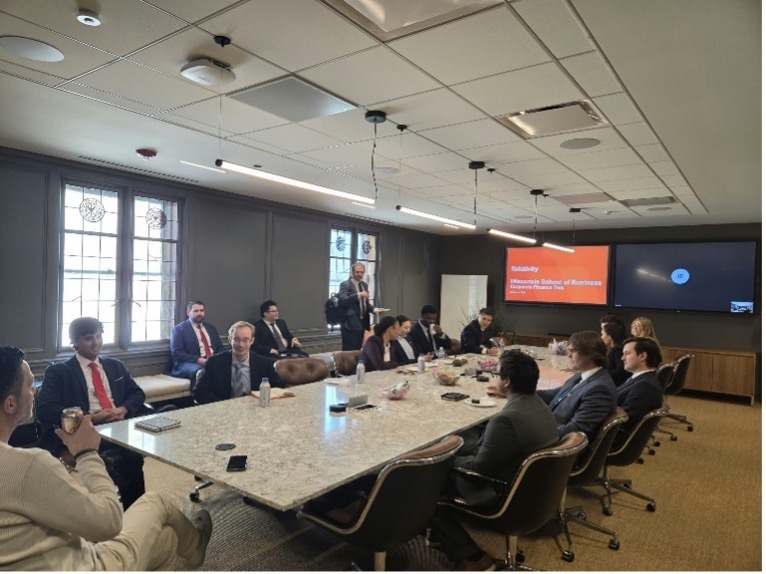
One of his most valuable messages was that career decisions should involve more than compensation or title. When evaluating opportunities, Kirk considers factors such as the CEO, company culture, the people he will work with, and whether the organization is positioned to win. Additionally, family was an important consideration in his decisions, as Kirk always wanted to remain at least a flight away from home. He also recognized that a career change would not only affect his own professional path, but could also bring opportunities and challenges for his wife’s career. His broader recommendation was to identify companies where you can continue growing and to develop a clear understanding of which risks are worth taking in your career.
The conversation then turned to Relativity itself and how artificial intelligence may disrupt software platforms. Kirk argued that platforms become more defensible when they do more than simply store information. A platform that helps users analyze information, make decisions, and complete meaningful work creates considerably more value.
Despite all of that technological change, Kirk’s description of the CFO role remained grounded in fundamentals: growth, profitability, cash flow, and capital structure. His most memorable point was that strong CFOs should approach decisions by first considering the desired business outcome rather than immediately focusing on individual dollars and cents.
Chicago Federal Reserve Bank: The Economic and Financial Landscape
Our final stop brought us to one of the institutions operating at the center of the U.S. financial system: the Federal Reserve Bank of Chicago. As one of the twelve regional Federal Reserve Banks, the Chicago Fed gave us an opportunity to step away from individual companies and consider the broader economic environment in which businesses, lenders, and investors make decisions.
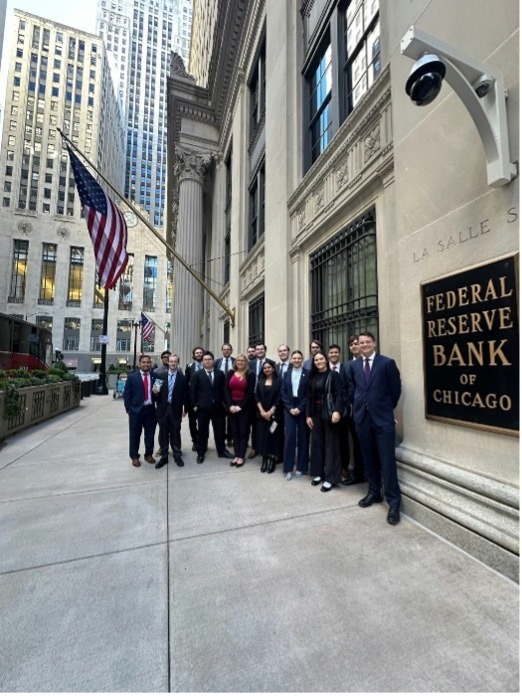
The conversation turned to the Federal Open Market Committee and the process behind U.S. monetary policy. Rather than decisions being made by one individual, monetary policy is shaped through discussion among the Board of Governors and Reserve Bank presidents.
Central to those decisions is the Federal Reserve’s dual mandate: maximum employment and price stability. The discussion helped illustrate how achieving those objectives requires looking far beyond national headline statistics. Regional economic conditions also matter, particularly industries such as automotive manufacturing and agriculture within the Chicago Fed’s district.
One tool used to develop that understanding is the Beige Book, a public report that gathers qualitative information from businesses and other contacts across all twelve Federal Reserve districts. In simple terms, it attempts to answer a very large question: How is the economy actually doing?
Connecting the Dots: Key Takeaways
Reflecting on this experience, we are grateful for the opportunity to meet and engage with industry leaders. Each company brought its own values and expertise, ultimately strengthening our financial acumen, expanding our professional networks, and sparking greater curiosity about potential career paths. United showed us the importance of the numbers behind operations, Prudential demonstrated the depth of financial expertise required in private investments, Relativity offered a different perspective on financial decision-making and personal career choices, and lastly, the Federal Reserve provided a broader view of the financial world we hope to become part of.
Special thanks to Jordan Ross, Sean Gilmore, and Benjamin Markell from United Airlines; Dave Quackenbush and Tom Molzahn from Prudential Private Capital; Kirk Larsen from Relativity; and the Federal Reserve Bank of Chicago for their hospitality. We would also like to thank Andrea Sorenson and Ashley Farrell, whose efforts in organizing the trip helped make this experience possible and everything run smoothly.
Ultimately, the experience reminded us that while finance takes many forms across industries, the ability to ask the right questions, understand risk, and make informed decisions remains at the center of it all.