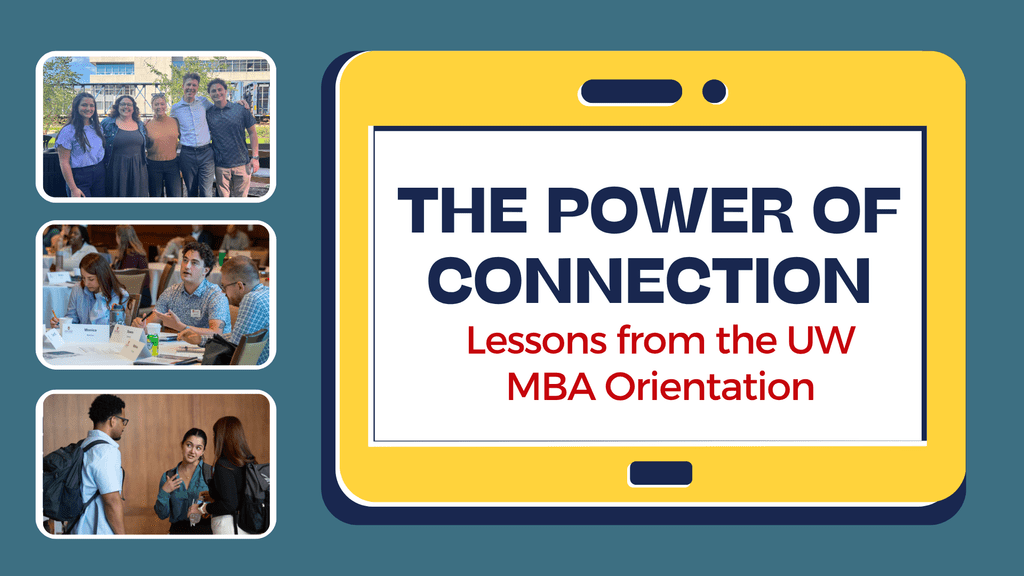

Belief is the word that comes to mind. As each of us stepped foot into the UW MBA Orientation we all held beliefs that those first steps would be the beginning of our journey; and that this program would help illuminate the future we were walking toward. The future we create through this program will look different for each of us, but as we take our first steps forward, our paths are connected.
I remember walking into the orientation room early and being greeted by name. I was welcomed not as a student number, but as Alex Connelly. That intentional effort to know each member of our class as an individual immediately set the tone for the environment we were entering.
From the beginning, we were encouraged to bring our true selves to the program and to build the relationships and trust that strong teams need to be successful. When that foundation is established, it becomes easier to be vulnerable, take risks, learn from one another, and grow, not only as students, but as people.
The first thing we did when we arrived at orientation was to meet our core teams. We learned that these would be the people we would be working on projects with throughout the first semester. The teams represented another aspect of intentionality. They were created to bring together different skills, backgrounds, strengths, and weaknesses.
Difference is a strength. This idea feels central to how the UW has positioned its MBA program. I believe in this idea, that the differences we bring to a team or company can be the key to unlocking the strongest potential in an organization’s success. The challenge is how to balance differences to create strength. One of the best ways to do this is to pair it alongside culture. Our orientation was indicative of how these two values can be aligned in a business setting to establish the groundwork for success.
Balance is another word that comes to mind when I think back on my orientation experience. Throughout the day, we met students, learned more about the program, and heard from alumni and current students about their experiences. It is an overwhelming time for many students, myself included, and the programming was set up in a way to balance the necessity of communicating the information we needed with more informal activities and sessions that connected us back to the UW culture. Both of these elements are needed for a successful navigation of this program, and they were presented to our class of 2028 with professionalism and intention.
This strong start was needed to move students into a more vulnerable day which is what we experienced on day 2 with the Gallup CliftonStrengths session. Prior to orientation, we each took our CliftonStrengths test to better understand our talents and how they contribute to teams. This required us to learn about our strengths but also to acknowledge our weaknesses, something that cannot be done unless there is a safe culture for this vulnerability. The framing of our strengths and weaknesses felt purposeful, encouraging us to support one another while also embracing the opportunity to grow into who we are, rather than who we think we should be. When we tap into the core of who we are, we are able to provide something special in our school, community, and the companies we work for. This idea comes back to the notion that difference is good. In fact, difference on teams is essential for success because strength balances weakness. When we have different strengths on a team, we have balance in how we approach projects which allows us to present a stronger outcome.
The concepts of difference, culture, intentionality, and balance were cemented as core values in the program during our Center and Specialization Day. At this point of our orientation, we had started to feel some sense of comfort with the familiar faces and places. Center Day allowed us to focus on our specialization and how we would show up for ourselves and our cohort. Charlie Trevor and Tanya Hubanks provided overviews of the SHR Center and connected our current experience to those who had completed the program in past years. We were given an opportunity to learn about each other and hear from alumni of the program. In the late afternoon we were treated to a social hour with students, alumni, and faculty. I quickly realized how comfortable I already felt around my peers, even finding a shared connection with a faculty member who had been married at the same venue where my wife and I were married, in the foothills of Mount Rainier, Washington.
When I think back on orientation, I am struck by how quickly a group of individuals began to feel like a community. What started with belief in the possibilities ahead became something more tangible through intentionality, culture, difference, and balance. We each arrived with our own experiences, strengths, and aspirations for the future, but orientation showed us that we do not have to navigate to that future alone. Our paths will take us in different directions, but the connections we build here will shape how we each move forward. Thank you to everyone who provided those first guiding steps.