

This summer, I interned at Citi’s global headquarters in New York, where I was assigned to Employee Relations (ER) & Policy. My team was responsible for managing the global disciplinary process for employees who commit violations of policy related to retaliation, harassment, or discrimination. Due to ER’s significant overlap with employment law matters, everything we worked on was dual-routed to managers in both the Human Resources (HR) and Legal functions for approval. My placement on this team complemented my previous work experience handling criminal investigations at the U.S. Department of Justice, whilst simultaneously challenging me to think about how to systematically apply standardized processes at global scale.
My primary project entailed surveying ER investigators and analysts about their experience interacting with the Global ER & HR Policy Hub—an internal database that housed all policy materials needed to thoroughly conduct an employee investigation—and proposing
recommendations for improvement across three timelines: immediate, near-term, and long-term. After weighing the pros and cons of different feedback mechanisms, I decided to conduct oneon-one interviews; in my opinion, interviews were the best way to obtain candid responses, and they also allowed me to communicate the New York team’s willingness to receive and incorporate feedback from around the world. In total, I conducted approximately 22 interviews across North America, Europe and the Middle East, Asia, and Latin America. I deliberately
selected interviewees who had varied levels of experience in order to ensure the sample population was representative of the broader investigator and analyst cadre. Once all of my interviews were completed, I aggregated the responses and looked for trends. The most common issue interviewees cited had to do with regional differences in the investigative process; for many investigators and analysts outside of North America, the Global ER & HR Policy Hub did not sufficiently meet their needs because of country-specific nuances. I quickly realized the difficulty of deploying a standardized investigation structure across the world.

Citi’s global reach is impressive, and working at the firm’s headquarters was very eyeopening because it allowed me to see the full breadth of its operations. Like all companies today, the firm was highly focused on leveraging AI in its daily processes, particularly for the purpose of smoothing out some of the challenges that come with having employees in 95 different countries. In the financial services sector, the regulatory environment often means heightened bureaucracy, but I thought the firm struck the right balance between AI experimentation and cautious guidance. Generally, Citi’s approach to progress was focused on speed, rather than perfection; this attitude meant the firm moved at a rapid pace, and when mistakes were made, they became an on-the-job learning experience, rather than a historical case study. From what I heard through my networking efforts during the internship, this approach is unique, and most other financial firms tend to emphasize perfectionism with progress.
Networking was a major part of my summer, and I think it should be a priority for any MBA candidate doing an internship. I was lucky to know Wisconsin School of Business alumni in various HR positions at Citi, including two in the New York office. These connections were invaluable for helping me get acclimated to the company culture, and they very kindly leveraged their own networks and facilitated introductions for me across the firm. It was also fortuitous that I was in New York because it meant I had the unique opportunity to interact with senior leaders at the Director level and above. Through my conversations, I was able to identify specific areas of HR that might be of interest post-graduation, as well as learn about other parts of the bank outside of the HR realm. Since it was the summer, the firm offered many fun events, including community service days, HR Appreciation Week activities, and employee resource group functions, which effectively served as informal networking opportunities. I participated in everything I could, often alongside the four other MBA interns, eager to learn as much as possible in the ten short weeks at the firm.
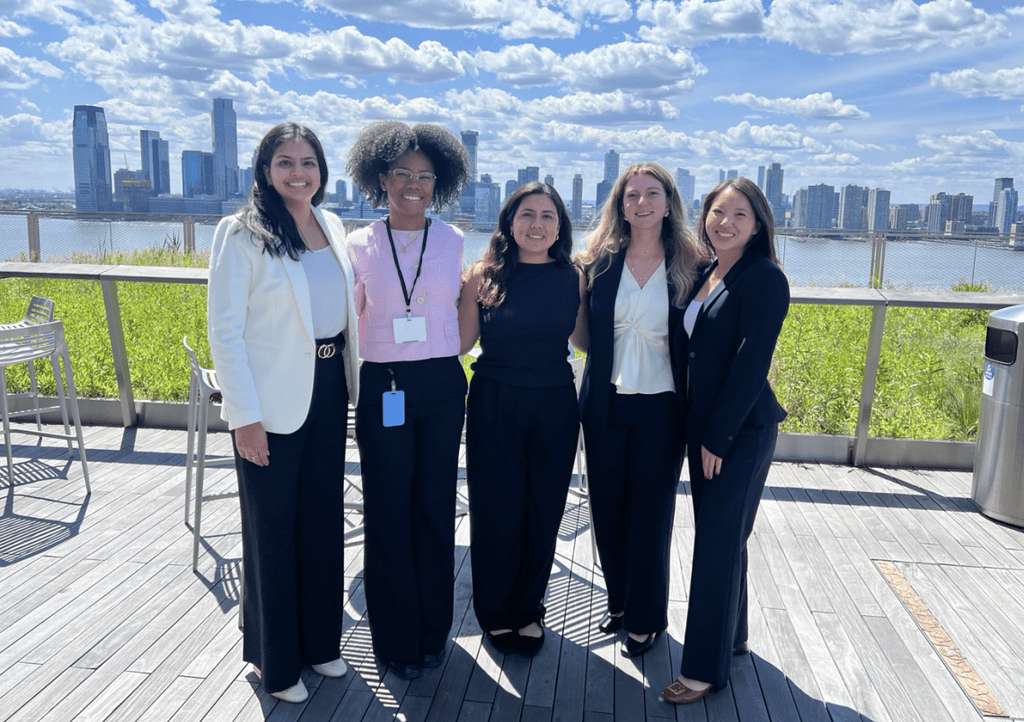
My intern class of four other women (representing the MBA and Master’s programs at Vanderbilt University, Emory University, Northwestern University, and Cornell University) was truly the highlight of my summer at Citi. Each of us brought our own specialized skills and experiences to the firm, and I thoroughly enjoyed learning with, and from, these other students. Because we had such a small class size, we got to know each other professionally and personally; though we did not have much time outside of work, we made the most of our time off by exploring the city together. Some of us are returning to the firm following graduation, and some of us are seeking other opportunities, but we have all committed to staying in touch, and I am so excited to see where our careers take us post-graduation.