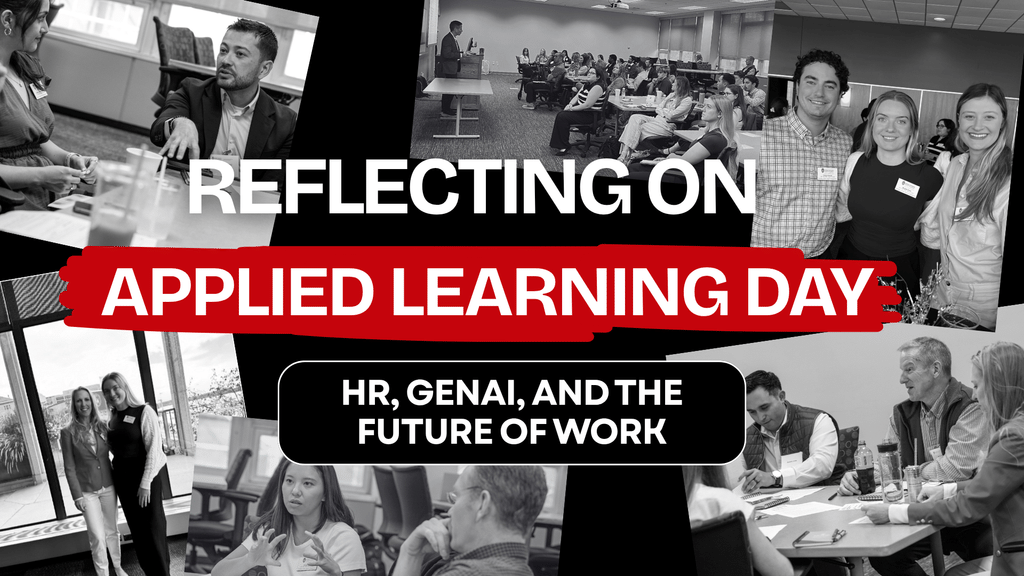

Last week, the Strategic Human Resource Management (SHR) Center hosted Applied Learning Day, and it was a valuable opportunity to step outside of the classroom and engage in conversations about some of the changes happening in the HR field. The day brought together HR professionals, undergraduate students, MBA students, faculty, and members of our SHR community for a day filled with discussions, case studies, friendly debates, and networking.
The theme of the day was generative artificial intelligence (genAI) and the growing role it is playing in the workplace. As someone pursuing my MBA with a specialization in Strategic Human Resource Management, I have become increasingly interested in how genAI is changing the way HR professionals work. Applied Learning Day allowed us to not only learn about AI updates in the workplace, but also to actually think through how it could impact the work we will be doing in our careers.
We kicked off the day with a presentation from Matt Seitz, Director of the AI Hub at the Wisconsin School of Business. His presentation got us thinking about how AI is part of our workplaces and how quickly its role continues to grow. He shared several studies and interesting statistics, including that in 2026, 89% of respondents’ organizations use AI in at least one function. This especially caught my attention when I thought back to my summer internship at Land O’Lakes, where one of my projects involved implementing a people analytics AI agent. It was interesting to connect the research and trends Matt shared to my own experience seeing firsthand how AI is being used in the workplace.
I enjoyed being able to hear different perspectives throughout the day. Having HR professionals, undergraduate students, and MBA students together created a diverse mix of experiences and ideas. We are all at different points in our careers, so we naturally approach these topics differently. For students, conversations about genAI can raise questions about what our future careers will look like. For HR professionals, these are questions they are already facing in their organizations. Bringing everyone together created a space where we could learn from each other.
At lunch, we had the opportunity to celebrate Marcus Alston, a member of our own SHR community, who received the Wisconsin School of Business Bold Award. The Bold Award recognizes graduates of the last decade who have achieved outstanding professional accomplishments and success since graduation. It was exciting to see someone who went through the same program as me find success in their career and have their accomplishments recognized. It was inspiring to celebrate someone who has made such a meaningful impact on our WSB community. In addition, Marcus and his husband founded a nonprofit called DreamVest, which provides scholarships to support adult students pursuing their education and career goals. He is working towards raising $1 million by June 2029. This part of the day continued to highlight what makes HR so meaningful: people, relationships, and community.
After lunch, we participated in a series of friendly debates. The debates were a way to challenge our thinking and hear different perspectives. As genAI continues to become more involved in areas like recruiting, talent management, employee development, and people analytics, there are a lot of questions for HR professionals to consider. How do organizations use AI and the extra time they can get back? Who is responsible for AI governance? How do we make sure employees are comfortable with these changes? These are not questions with simple answers. For me, one of the most significant takeaways from Applied Learning Day was that future HR professionals need to be a step ahead of the genAI conversation. As HR professionals, we have an opportunity to help organizations think about how to use these tools responsibly and effectively.
At the same time, I think the day was a good reminder that the “human” in human resources is never going away. AI may be able to help us analyze information, automate tasks, or make certain processes more efficient. But relationship building, communication, empathy, and human judgment will always continue to be important aspects of HR.
With that said, the highlight of my day was seeing my professional mentor, Heather Wollerman, in person and having the opportunity to catch up. Heather has been an invaluable source of guidance throughout my MBA journey, and I am incredibly grateful for her mentorship, support, and encouragement along the way. It was a great reminder of how valuable it is to have someone in your corner who can share their experiences, offer advice, and support you as you navigate a career. While technology and AI can be powerful tools, they simply cannot replace the impact of a trusted mentor who genuinely invests in your growth and success.
We wrapped up the day with a networking reception, giving everyone one more opportunity to connect and continue the conversations from throughout the day. I left Applied Learning Day feeling grateful for the opportunity to be in the same room of many different HR professionals and excited about the future. As always, our SHR Center leadership team, Tanya Hubanks and Mahina Adams, did an amazing job organizing the event. Their dedication and thoughtful planning consistently create opportunities for students to learn, connect, and grow.
In conclusion, as AI continues to become more involved in our work, days like Applied Learning Day are important because they give us a chance to stop and think about what these changes actually mean. We may not have all the answers yet, but creating spaces where students and professionals can ask questions, share ideas, and learn from one another is an excellent place to start. The day reinforced how important it is to stay curious, keep learning, and remember that while technology continues to evolve, HR will always have people at the center.