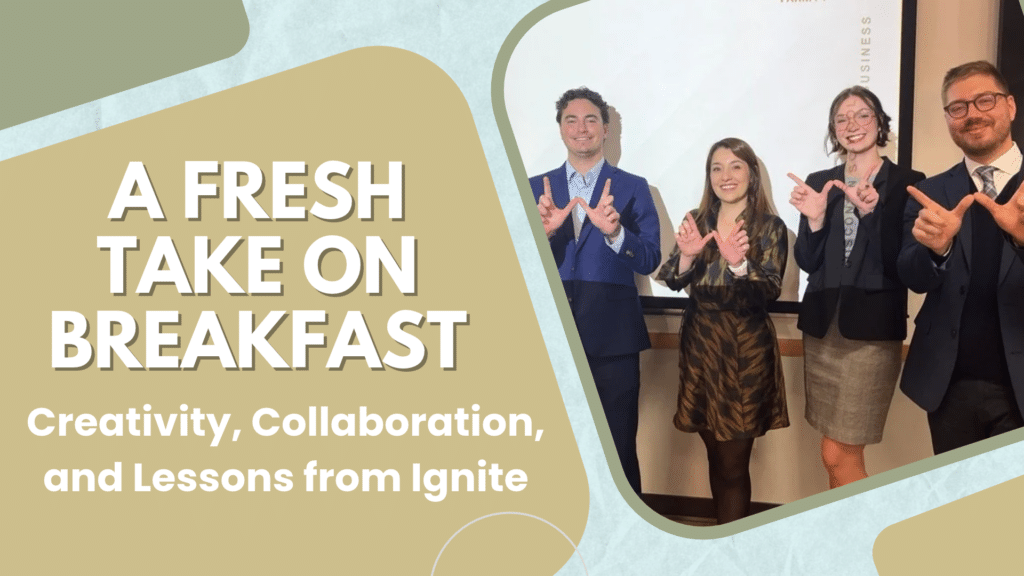

What if a beef stick could become part of someone’s breakfast routine? During the annual UW MBA’s Ignite case competition, that question became the foundation of my team’s growth strategy for Wenzel’s Farm. It also became an opportunity to learn how creativity, business strategy, and different professional perspectives can come together to address a real challenge.
Ignite brought my MBA class together for three days to develop recommendations for a Wisconsin company. Working in our core teams, we drew on our collective knowledge, skills, experiences, and our first module of coursework to turn our resources into a clear recommendation and present it to a panel of judges.
For our team, the experience centered on a simple idea with several business implications: giving consumers a new reason to reach for a familiar product.
Finding an Opportunity in the Morning
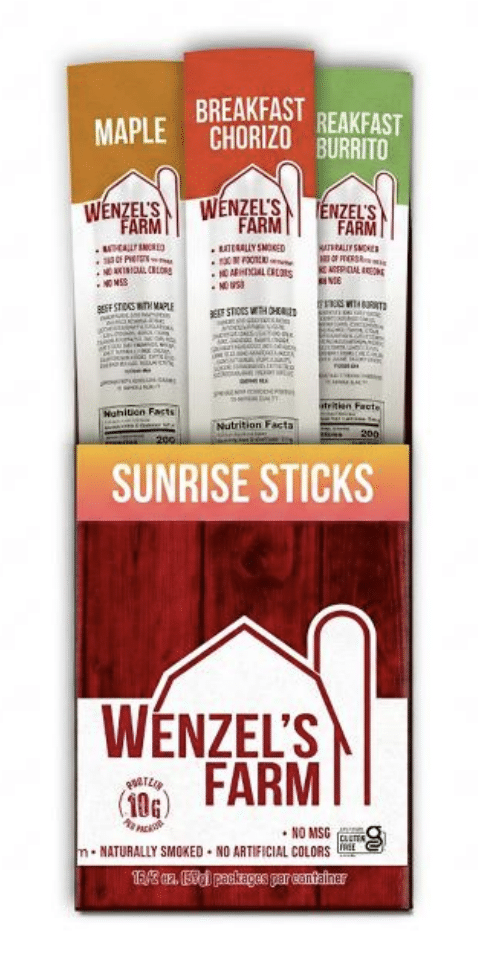
Our challenge focused on helping Wenzel’s Farm pursue its growth goals. Rather than concentrating only on selling more beef sticks as afternoon snacks, we considered how the company could introduce another eating occasion.
Our answer was Sunrise Sticks, a proposed line of breakfastflavored beef sticks featuring maple, breakfast chorizo, and breakfast burrito flavors. We envisioned the line as a convenient, protein-rich option for consumers navigating busy mornings.
The idea gave our recommendation a clear direction. We proposed more than additional flavors; we suggested a different place for the product in a customer’s daily routine. That distinction helped connect product development with our broader growth strategy.
We focused our marketing recommendations on consumers ages 18–34. To reach that audience, we proposed strengthening the company’s social media presence, refreshing its brand ambassador approach, and exploring distribution through university markets and regional coffee shops. A campus market pilot at UW–Madison offered a potential starting point for introducing the concept to younger customers.
Connecting Creativity with Execution
Developing the product concept was exciting, but we also had to address what would make it possible.
A new line would require production capacity, coordinated marketing, distribution relationships, and a realistic implementation timeline. Our recommendation included contract manufacturing to help support growth and free up internal capacity. We also identified profitability, operational scalability, and marketing return as risks the company would need to evaluate.
This part of the challenge helped me appreciate how interconnected business decisions are. Marketing can generate interest, but production must be able to meet demand. Expanding distribution can create opportunities, but the economics still need to work. A compelling recommendation must account for these cross-functional connections.
The time limit pushed us to prioritize. We couldn’t include every research finding or explain every possible scenario. We decided the company most needed to understand the opportunity, why our approach made sense, how it could be implemented, and what risks deserved attention.
Seeing Strategy Through an HR Lens
Our team brought together four specializations: Mathieu in Supply Chain, Rebecca in Marketing, Monica in Risk Management and Insurance, and me in Strategic Human Resources.
Working across those perspectives reinforced why an HR professional needs to understand all business functions. Decisions about products, customers, and production ultimately create decisions about people.
For example, our marketing strategy included hiring an internal marketing professional to manage social media and create consistent content, connecting a business objective of reaching younger consumers with a specific capability the organization would need.
The company HR team would also need to define the role, attract someone with the appropriate skills, and establish expectations that connect the employee’s work to business results. Likewise, changes in production arrangements would require clear responsibilities and coordination between internal employees and external partners.
Ignite made those relationships more concrete for me. Strategic HR contributes by understanding where the business wants to go and helping determine the people, skills, and organizational support needed to get there.
A Meaningful Outcome Beyond the Final Round
Sadly, our team did not advance to the final round. After all, we had some fierce competition with brilliant ideas! While we were disappointed not to move forward, we received feedback from our judges that gave us another reason to feel proud. As our team was watching the final round of presentations, our judges approached us and complimented our team on the creativity of our idea. They said they felt good ideas shouldn’t be buried and asked us to share our printed slide deck with the Wenzel’s representatives.
Frankly, this feedback mattered more to our team than making it to the next round could have. It was an invaluable feeling knowing we were still living the Wisconsin Idea beyond delivering a polished classroom presentation. We wanted to contribute something useful and offer a perspective the company might consider, and the request to share our proposal suggested that our idea had sparked interest.
Although it offered no guarantee that Sunrise Sticks would become a product, it reminded me that success in a competition is only one way to measure the value of the experience.
What I’ll Take Forward
Ignite offered a practical example of the Wisconsin Idea: applying what we learn to challenges beyond the classroom. It also showed me the value of an MBA education that brings different business disciplines into the same conversation.
As a Strategic HR student, I left with a stronger appreciation for the relationship between business strategy and organizational capability. I also gained experience developing a recommendation under time pressure, communicating its value, and learning from the outcome.
Although The Breakfast Club did not advance to the final round, the experience was was a win. We emerged with a creative concept, insightful feedback, and a stronger understanding of how diverse perspectives can fuel a company’s growth. I look forward to buildimg on the lessons I learned through Ignite as I prepare for the human resources case competition at Purdue this November.
Thanks for reading and On, Wisconsin!