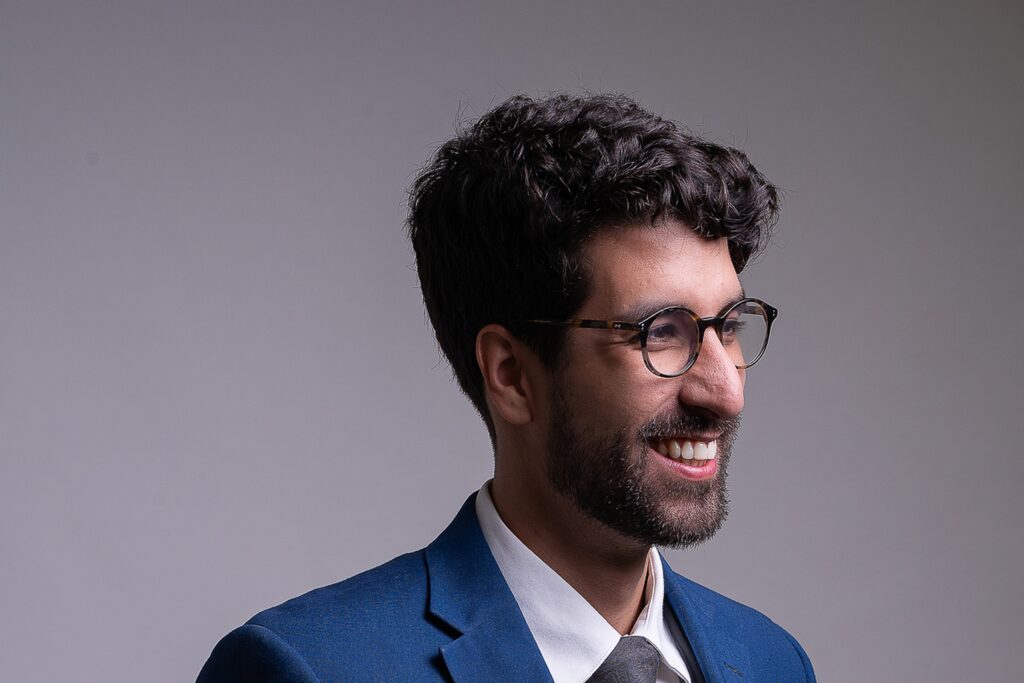
For Victor Santoro-Fernandes (MEB ’22 and WAVE ’25), entrepreneurship has been an interest since childhood. Growing up in São Paulo, Brazil, Victor remembers having entrepreneurial ideas from a young age. But it was while pursuing his PhD degree in medical physics at UW–Madison that entrepreneurship became something he could envision as a career path.
Victor earned his undergraduate and master’s degrees in physics at the University of São Paulo, where his work began moving toward medical physics. After meeting his future PhD advisor at a Brazilian Medical Physics Conference, he applied to UW–Madison’s medical physics program. “I applied here because it is arguably the best medical physics PhD program in the nation and the world,” Victor says.
While pursuing his PhD, Victor’s interest in entrepreneurship grew. His PhD advisor, Robert Jeraj, also played an important role in encouraging students in his lab to explore entrepreneurship and participate in the Morgridge Entrepreneurial Bootcamp (MEB). Victor said that “what made me start thinking about entrepreneurship as a reasonable career or progression path was participating in MEB.”
After completing his PhD in November 2023, Victor moved into a postdoctoral position in the Medical Physics Department called the Entrepreneurial Postdoctoral Fellowship. The fellowship gave him the opportunity to focus on technology translation and explore promising research.
Victor began that process by asking the Wisconsin Alumni Research Foundation (WARF) for a list of patents from the medical physics and radiology departments that had been filed but not licensed. The list contained approximately 120 patents, giving Victor a broad range of promising technologies that were protected but were not being pursued commercially.
From there, he developed three criteria for identifying a technology worth pursuing. First, it needed to have a strong technological value proposition. Second, he wanted to work with a principal investigator who supported entrepreneurship. Finally, the technology needed to align with his own field of expertise.
After narrowing the list to three patents, Victor chose to pursue CellTrack’s foundational cell radio-labeling technology. The technology stood out because its method generates 100 times more signal than previous methods described in the literature. Victor believed this difference could help create a strong value proposition.
As Victor began exploring CellTrack’s commercial potential, UW–Madison’s Technology Entrepreneurship Office (TEO) became an important part of that journey. TEO connected Victor to the National Science Foundation’s I-Corps program, which provided structured training in customer discovery and encouraged him to step outside the lab to test his assumptions about the technology and the problems it could solve. TEO continued supporting Victor beyond that introduction, helping him think through CellTrack’s commercial position, connect with people at different stages of development, and identify the next steps for the company.
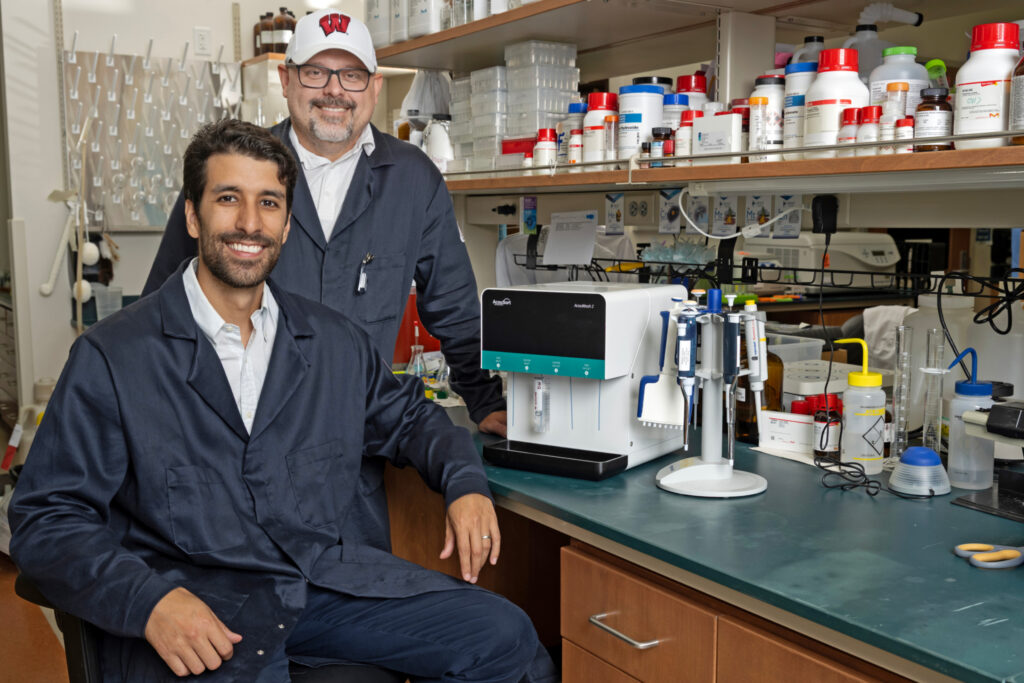
The project brought together complementary areas of expertise. The chemistry behind the cell radio-labeling technology was led by principal investigator Reinier Hernandez, while Victor’s background in medical imaging and his PhD research provided expertise on how those images could be used for drug development and clinical support. Together, the two areas created an opportunity to explore the technology from both scientific and entrepreneurial perspectives.
That entrepreneurial training became especially important as Victor began talking with potential customers. Through programs including NSF I-Corps, D2P and MEB, he learned the importance of customer discovery—the process of speaking directly with potential customers to understand their problems and determine whether a product can solve them.
That process has become a central part of CellTrack’s development. The team has conducted approximately 150 customer discovery interviews with potential customers, using those conversations to refine the company’s value proposition, messaging and target market. “I think customer discovery interviews are central to entrepreneurship,” Victor says. “When a business fails, it normally is because they’re building something that nobody wants to buy.”
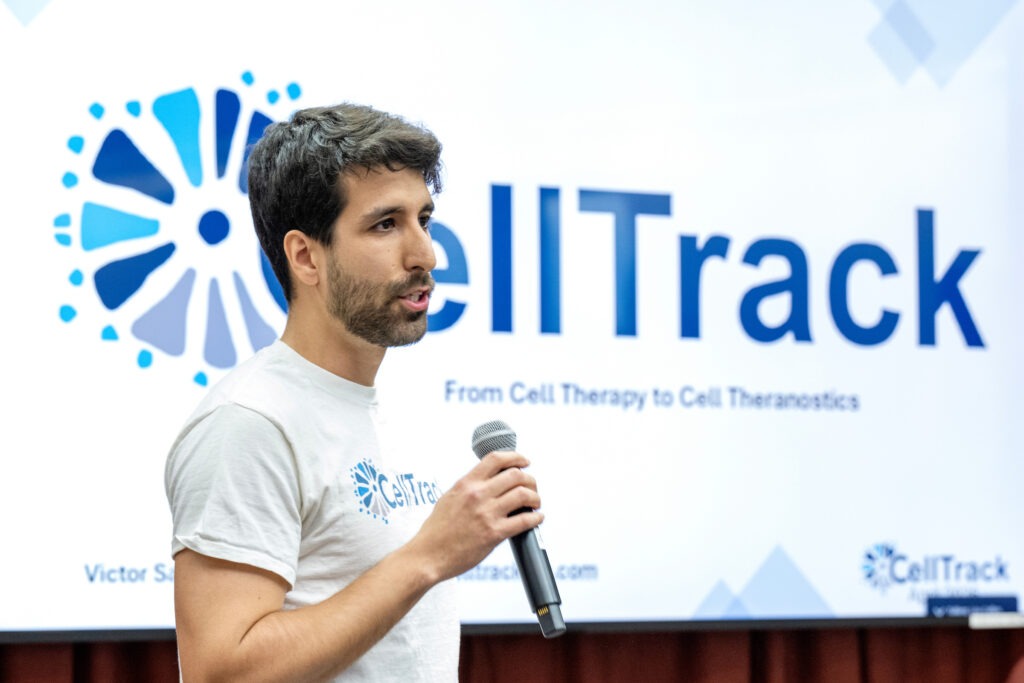
Another important step in CellTrack’s development came through the Wisconsin School of Business’ WAVE program. Victor took Dan Olszewski’s WAVE course, where he had the opportunity to spend a semester pressure-testing CellTrack alongside a strong group of MBA candidates. For Victor, the experience provided a perspective that is difficult to replicate as a scientist: having people with different business backgrounds challenge the assumptions behind his technology and help him think through its commercial potential.
“Dan Olszewski is an inspiration to just about every entrepreneur who comes out of UW–Madison,” Victor says. “The course gave me a semester of sitting with a very strong group of MBA candidates and pressure-testing CellTrack against their questions, which is a rare thing to get as a scientist.”
WAVE also provided CellTrack with $100,000 in funding, giving the company both financial support and access to the institutional knowledge that comes with the Wisconsin School of Business. For Victor, that combination has been an important asset as CellTrack continues to develop as a pre-seed company. “Having the Wisconsin School of Business back CellTrack with their investment, and with the institutional know-how that comes attached to it, is an enormously valuable asset for the company,” he says.
That momentum was recently recognized at Launch Wisconsin, formerly the Wisconsin Governor’s Business Plan Contest. CellTrack, led by Victor Santoro-Fernandes and Reinier Hernandez, earned first place in the Health Tech category. The recognition highlights the company’s progress as it continues refining its technology, validating its market opportunity, and advancing toward commercialization.
Building CellTrack has required Victor to move beyond the lab and continually learn new skills. Rather than viewing each new obstacle as a setback, he sees it as another lesson. “Every challenge is a class,” he says. Whether he is learning about intellectual property, licensing, science communication, pitching, company formation or fundraising, Victor approaches each new problem by solving the task in front of him. If he doesn’t understand something, he seeks out people who do and learns from them.
As CellTrack continues developing as a pre-seed company, Victor encourages other UW–Madison students and researchers with entrepreneurial ideas to focus on one fundamental question: Is there someone who will actually pay for the solution?
“You need to be sure it’s not because you think it’s cool, or your friends think it is a cool idea,” Victor says. “You need to be solving a problem in a way that would justify them spending their limited resources so that the problem gets addressed.”
For Victor, however, entrepreneurship ultimately comes back to people. “The most important aspect is people,” he says. “Make connections, be kind, and associate yourself with others that you believe to be ethical and inspiring.”
For students interested in entrepreneurship, Victor’s journey demonstrates how UW–Madison’s entrepreneurial resources can help turn an idea or research discovery into an opportunity worth exploring. His experience also highlights that entrepreneurship is not a single step, but a process of learning, testing, making connections, and continually refining an idea.
Categories: