With the support of the Strategic Human Resource Management Center, I was able to attend CultureCon 2026. CultureCon is a conference dedicated to transforming the workplace by building more connected and high performing organizations. Over the course of two days, I engaged in interactive sessions, made new connections, and learned about tools to transform the employee experience. As a higher education professional, these conversations were also shaped by a student lens and how we can build community not only with our team members, but students as well.
Workplace Culture as an Experience
Claude Silver, author of Be Yourself at Work, opened CultureCon with a keynote that immediately asked the audience to reframe how we think about culture in the workplace. After a karaoke inspired activity, she described culture as “the gap between the two songs stuck in your head.” Using music as an analogy, she said culture is the difference between what we say out loud and what we’re actually experiencing.
That gap matters as it frames where trust in teams either grows or erodes. Leadership is not a title but a felt experience. Silver challenged us to examine the song we sing publicly versus the one we sing to ourselves privately. Are they aligned? Are our values something we act on, or simply something stated? Culture only exists when values become behaviors. For me, this keynote set the tone for the entire conference about the importance of culture in action.
Culture Keepers in the Collapse and the Power of Trust
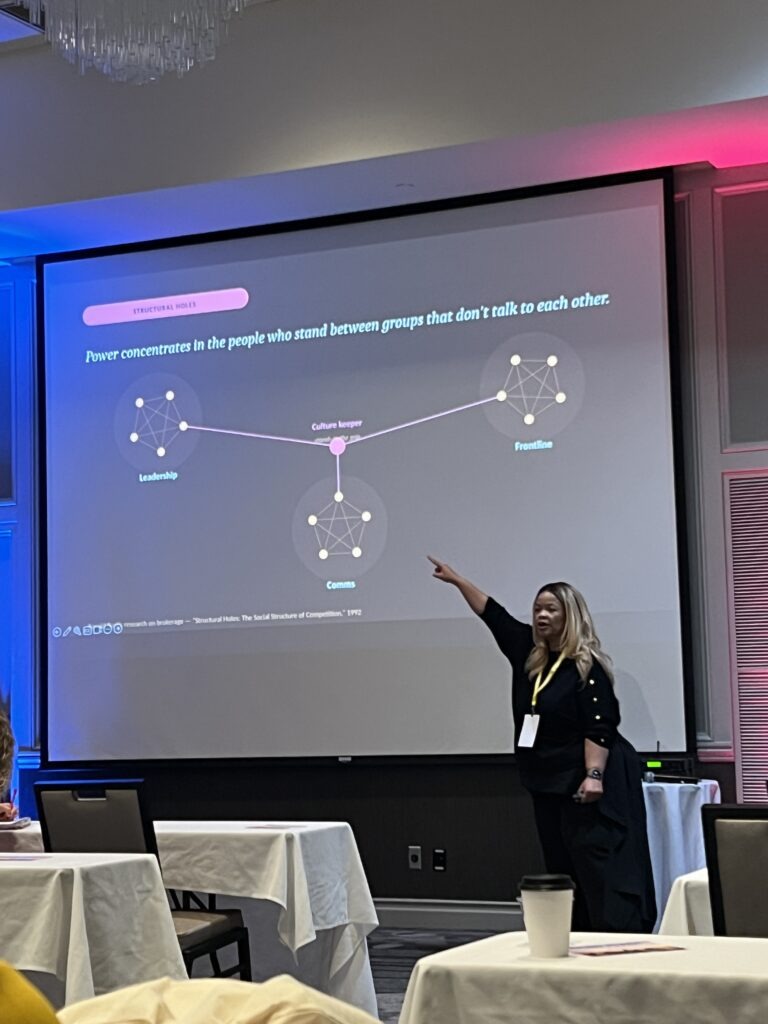
One of my favorite sessions described the world we’re living in as a landscape of collapse. In the current world, the cultures and structures we’re used to are quickly changing due to AI-driven restructuring and shifting power dynamics. But collapse, speaker Bryetta Calloway argued, isn’t destruction but realignment. With realignment, trust hasn’t disappeared but is now only found in relationships, not institutions (think governments and large corporations). Calloway introduced the idea of human resources as culture keepers. HR professionals are the people who shape opinion and move influence through networks rather than org charts. Culture doesn’t flow top-down but it moves diagonally and informally.
She introduced a concept that was new to me, mirrortacracy. This is the idea that power often consolidates among people who look, think, and behave alike. Innovation, however, comes from diverse voices which are the ones mirrortacracy excludes.
“Innovation comes from diverse voices.” – Bryetta Calloway
In a moment of collapse, she said, we must “bank credit,” which is the restraint that gets us through the threat is the same restraint that positions us to rebuild afterward.
Through the sessions, I also learned culture isn’t owned by leadership but is most successful when it’s shaped by everyone. Even when business decisions aren’t yours to make, your reaction, behavior, and next steps are always within your control. The framework offered (reinforce, tolerate, clarify, amplify) was a powerful way to understand how behaviors become norms. Every action sends a signal and every signal gets interpreted. Every interpretation becomes “the way things are done here.”
Storytelling as a Cultural Tool
Trust in the workplace hasn’t disappeared, it has migrated. This idea was discussed across multiple sessions, but I thought through the lens of storytelling was very interesting. As mentioned by Bryetta in an earlier session, trust now lives in proximity, not positions of power. People trust those they know. Dr. Rod Berger introduced the difference between authored stories (stories that are examined, claimed, and chosen by you) and assigned stories (stories that are handed to you). Organizations often hand employees assigned stories (ex: mission statements, values, narratives) without helping them author their own.Storytelling builds sustained trust, humanizes work, and creates connection.
AI in the Workplace
The second day of the conference focused on AI and its relationship to culture. One session I attended discussed psychological safety as the foundation to the rising stakes of AI adoption. Change, the speaker said, is always perceived as a threat even when it’s positive. AI amplifies that threat because it touches identity, capability, and the future of work. Her RIFF model (relieved by, inspired by, frustrated by, frightened by) offered a way to understand emotional responses to AI. Psychological safety isn’t just about inclusion; it’s about grounding and shared values. Without it, AI adoption becomes fear-driven. With it, AI becomes a tool for empowerment.
Emily Mabie, Senior AI Automation Engineer for HR/People at Zapier, ended the day by reminding us that AI’s greatest gift is time, but only if we use that time intentionally. AI automation should create more space for human work. Her strategies, which included Friday calendar forecasting, blocking deep work time, auditing time allocations with AI, were practical and immediately accessible.
CultureCon was a valuable experience reiterating what we believe and seek to create in our SHR Center: a strong and positive organizational culture is the foundation for a trusted work environment.