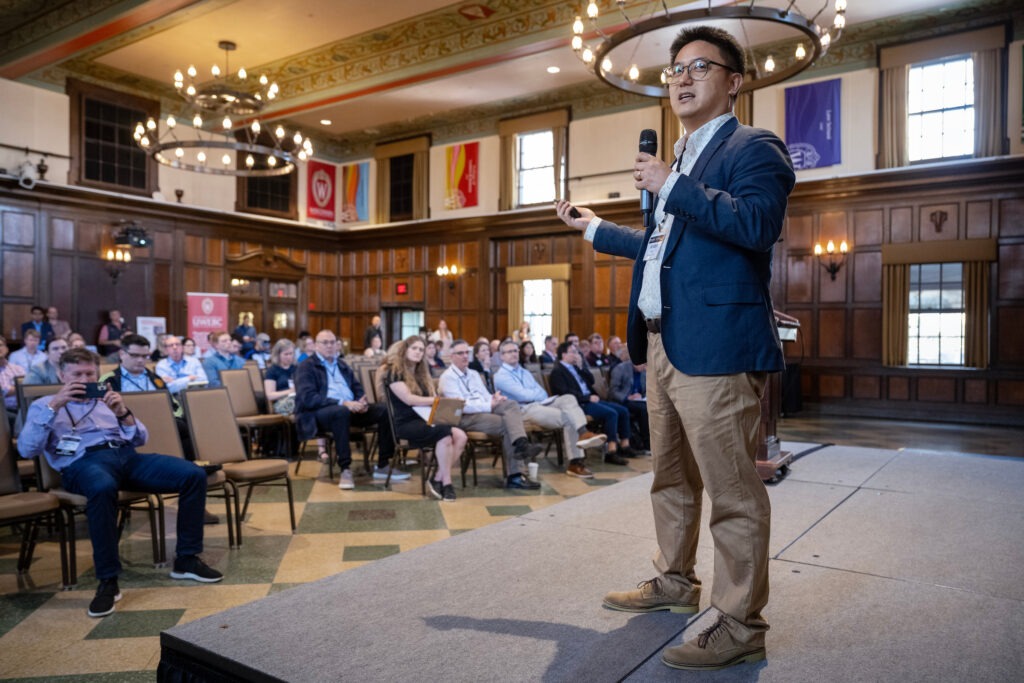
A new article in the September-October 2026 issue of Harvard Business Review (HBR) suggests that, for many organizations, the biggest AI bottleneck lies not within individual tasks but between them—in the handoffs and decisions that cross organizational units. Jordan Tong, Robert M. Steiner Chair in Business and a professor of operations and information management at the Wisconsin School of Business, and co-author Kris Johnson Ferreira of Harvard Business School, explore how agentic AI orchestration systems can connect work across functions and integrate human input.
“The most consequential decisions aren’t made within a single task; they emerge from linking together many narrowly scoped tasks,” write Tong and Ferreira, who interviewed leaders at companies such as Walmart and Medtronic in the field to understand how they were structuring their AI projects and where the bottlenecks occurred. “That explains why, despite significant investment in AI and even with better human-AI collaboration, organizations still struggle to move faster on their most important decisions.”
Tong and Ferreira encourage firms to rethink human-AI collaboration by asking what information AI may lack at each stage of a decision—and who within the organization can provide it. Agentic AI systems can connect work across functions, draw out and integrate employees’ specialized knowledge, and automate tasks where AI has an advantage. Rather than limiting people to reviewing and second-guessing AI outputs, organizations should design systems that combine the complementary strengths of humans and AI. “The correct model is ‘human + AI,’” the authors write.
Read the full HBR story for the authors’ four-step process to help your organization build its own agentic AI orchestration systems.