Complacency has never sat well with Dr. Christian Sanvanson (MBA ’26). It was his desire to keep learning, to keep pushing himself, that led the hospitalist of 13 years to pursue an MBA.
“I always like to be building something,” he says. “I saw the MBA as potential for growth, potential for opportunities. I felt it might open some doors for me.”
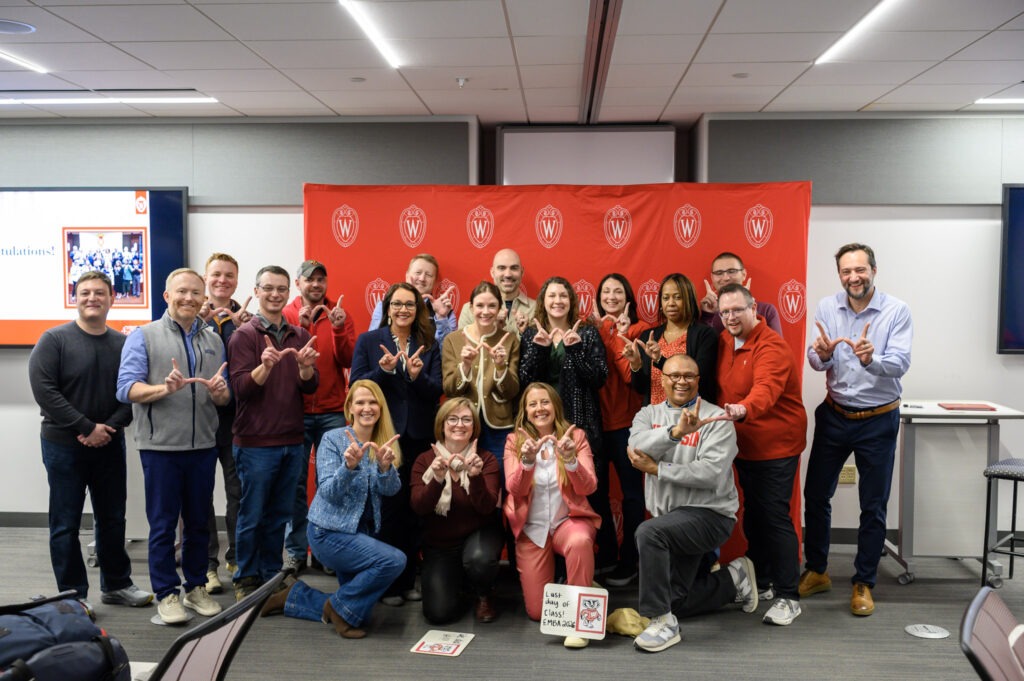
But it would take a certain type of MBA program to fit into the life of a physician who worked 12-hour days and was in the process of moving from Wisconsin to Illinois. In addition to a strong curriculum that would bring the personal and professional growth he wanted, the MBA would have to be part-time and flexible—but without sacrificing in-person connection. That’s what brought him to the Wisconsin Executive MBA. And in May, he walked across Camp Randall’s stage along with 19 other graduates—the first program’s first cohort since its redesign, which went live in Fall 2023.
The reimagined executive MBA
Built for the fast-paced, modern business world, the Wisconsin Executive MBA Program develops leaders who are analytically strong, adaptable, and self-aware. The program emphasizes real-world application, with students applying what they learn to challenges in their own organizations.
“The redesign was inspired by what we consistently hear from employers and alumni: Organizations need leaders who can think holistically, lead people effectively, and navigate constant change,” says Blair Nelson Sanford, associate dean of MBA and master’s programs.
Early signs suggest the program’s changes are landing; it has already earned a #12 ranking among public universities (#29 overall) in U.S. News & World Report.
“The redesign was inspired by what we consistently hear from employers and alumni: Organizations need leaders who can think holistically, lead people effectively, and navigate constant change.”
Blair Nelson Sanford, Associate Dean of MBA and Master’s Programs
Flexible format for busy professionals
The executive MBA program is designed to fit into business leaders’ busy schedules. Classes meet online on Wednesday nights; one weekend a month, students travel to campus to learn in person.
“The hybrid format allows students to participate fully without stepping away from their careers,” Nelson Sanford explains. “Just as important, it blends the flexibility of online learning with the depth of in-person residencies, creating space for both reflection and meaningful connection.”
Tina Lamkey (MBA ’26) says the one-weekend-per-month schedule “was the ‘unlock’ that made this program possible” for her.
“You quickly learn how to create space for what matters most,” she says of balancing work, life, and school.
For Lamkey, that was a series of micro-hacks: reading case studies on the treadmill, listening to recorded lectures during morning walks, and reviewing lectures on her commute from Illinois to Madison. And while juggling an MBA program on top of her usual responsibilities wasn’t always easy, it was worth it. “While I certainly missed some social activities with friends and family, I viewed it as a temporary trade-off for a lifetime of new experiences, career opportunities, and friendships.”
Equipping strong leaders
The new executive MBA features a more integrated, leadership-centered curriculum with strategy at the core. By developing self-awareness, enterprise-level thinking, and judgment to make complex decisions, students leave not only with knowledge but also the confidence and capability to lead at the highest levels of an organization.
Lamkey says the most transformative shift she experienced in the program was in her “leadership vocabulary.” Upon entering the program, she was senior director of design and operations at real estate and investment firm CBRE, with a design-heavy career background. The program challenged her to lean into the discomfort of unfamiliar disciplines like corporate finance, digital strategy, and accelerating innovation.
“It transformed me into a more confident leader by proving I could successfully bridge the gap between creative strategy and executive execution,” she says. “It didn’t just change how I lead teams; it expanded my vision of my own potential to impact an organization at scale.”
“[The Wisconsin Executive MBA Program] transformed me into a more confident leader … It didn’t just change how I lead teams; it expanded my vision of my own potential to impact an organization at scale.”
Tina Lamkey (MBA ’26)
One of the biggest takeaways for Sanvanson? There is more to leading than taking charge.
“A major leadership trait I’ve learned from the MBA program is to listen to people,” he says. “Certain people’s gifts and talents come to the surface if you just sit back and let them do so.”
One-on-one career support
The program’s impact goes beyond its curriculum; it also empowers students through one-on-one career support services.
Sanvanson credits the career team for teaching him the value of networking and persistence in communications—skills he hadn’t needed to cultivate as a physician. These new skills, as well as the guidance of the career team, helped him secure a position with an AI startup as their medical advisor and chief medical officer.
Lamkey says the biweekly coaching she received from coach Jean Sink, director of the program’s career management services, over her final four months of the program was “instrumental.”
“Her approach was the perfect blend of accountability and strategic insight,” she says. “Even when I felt prepared, Jean would bring a fresh perspective that I hadn’t considered. Her guidance was a major factor in me securing my dream role at Salesforce, and her dedication to student success is truly above and beyond.”
Close-knit cohort
Foundational to the executive MBA experience is the cohort, which brings diverse perspectives from across industries and roles. Students learn from one another and build relationships that extend well beyond graduation.
“The cohort was incredibly humble, approachable, and collaborative,” Lamkey says. “There was a constant sense of psychological safety and mutual support that I’m not sure I would have found in other programs.”
Sanvanson echoes Lamkey’s praise for their classmates. “The MBA program is a very encouraging environment,” he says. “People are very willing to help and introduce you to folks.”
Celebrating a hard-earned achievement
How did Sanvanson celebrate his graduation from the MBA program? The business way: “I used it as an excuse to buy a suit,” he says. “I walk around in scrubs and hoodies all the time, so it was nice to just buy some formal attire. And I also celebrated with my family.”
Nelson Sanford is proud of how this first cohort fully leaned into the MBA experience—embracing the hybrid format, engaging deeply with one another, and applying what they learned in meaningful ways within their organizations.
“Their feedback, engagement, and willingness to experiment with a new model have shaped the program in important ways,” she says. “They’ve demonstrated exactly the kind of leadership we aim to develop: thoughtful, collaborative, and forward-looking.”
Sanvanson is proud of everything he achieved in the program, and especially for doing it during a hectic time in his life. But what stands out to him the most comes back to a simple principle: not being complacent.
“I was happiest when I was doing the MBA program, because I knew I was building something, and that was important to me,” he says. “They say the most successful people invest in themselves, and one of the ways they do that is with skills and education.”
“I was happiest when I was doing the MBA program, because I knew I was building something, and that was important to me.”
Dr. Christian Sanvanson (MBA ’26)