The Wisconsin MBA gives you a leadership toolkit and the freedom to build your own expertise. Through our signature leadership experiences, Trusted to Lead ethos, and rising AI powerhouse, you’ll be prepared to meet the moment—and beyond.
Format
In-person
Duration
2 years
Start
September
Number of credits
53
Build your experience across two years
|
Year 1: General management core
Build essential business and leadership skills with your MBA cohort and explore career interests and opportunities. You can start taking courses specific to your career pathway if you’ve made a choice.
26 credits
Semester 1
Take all required courses
Core courses: Financial Accounting, Data to Decisions, Economics for Managers, Introduction to Financial Management, and Marketing Management
AI course: Foundations of AI in Business
Career and leadership courses: Career Management and Applied Learning and Industry Pathways
Semester 2
Continue core requirements and start taking electives
Core courses and electives: Operations and Supply Chain Management, Strategic Management, and up to 6 elective credits
Career and leadership courses: Consulting Project Capstone and Leading People and Organizations
Students intern at top companies across the country the summer after their first year. Internships are typically 10–12 weeks from June through August.
During your first year, you’ll prepare for your summer internship with structured coaching and mock interviews. You’ll also receive help finding and applying to internships that will help move your career forward.
Internship experience
Sakshi Morgaonkar (MBA ’25) was a product manager intern at Qualys in summer 2024 in San Francisco. She grew her product management skills, working on impactful projects to align product development with customer needs and market trends.
“These experiences helped me sharpen my skills in product management, cross-functional collaboration, competitive analysis, and user experience design, all of which enhanced my understanding of product lifecycle and market positioning.”
Sakshi Morgaonkar (MBA ’25)
AI Product Manager, Attri
Austin
Take electives to develop deep expertise in a single pathway or choose courses from across pathways to fit your career objectives. You’ll participate in real-world projects and workshops.
27 credits
Semester 1
Wrap up core and take electives, plus participate in co-curricular leadership activities
Courses: Electives or degree requirements
AI course: Artificial Intelligence and the Enterprise
Build essential business and leadership skills with your MBA cohort and explore career interests and opportunities. You can start taking courses specific to your career pathway if you’ve made a choice.
26 credits
Semester 1
Take all required courses
Core courses: Financial Accounting, Data to Decisions, Economics for Managers, Introduction to Financial Management, and Marketing Management
AI course: Foundations of AI in Business
Career and leadership courses: Career Management and Applied Learning and Industry Pathways
Semester 2
Continue core requirements and start taking electives
Core courses and electives: Operations and Supply Chain Management, Strategic Management, and up to 6 elective credits
Career and leadership courses: Consulting Project Capstone and Leading People and Organizations
Summer: Internship
Students intern at top companies across the country the summer after their first year. Internships are typically 10–12 weeks from June through August.
During your first year, you’ll prepare for your summer internship with structured coaching and mock interviews. You’ll also receive help finding and applying to internships that will help move your career forward.
Internship experience
Sakshi Morgaonkar (MBA ’25) was a product manager intern at Qualys in summer 2024 in San Francisco. She grew her product management skills, working on impactful projects to align product development with customer needs and market trends.
“These experiences helped me sharpen my skills in product management, cross-functional collaboration, competitive analysis, and user experience design, all of which enhanced my understanding of product lifecycle and market positioning.”
Sakshi Morgaonkar (MBA ’25)
AI Product Manager, Attri
Austin
Year 2: Customize
Take electives to develop deep expertise in a single pathway or choose courses from across pathways to fit your career objectives. You’ll participate in real-world projects and workshops.
27 credits
Semester 1
Wrap up core and take electives, plus participate in co-curricular leadership activities
Courses: Electives or degree requirements
AI course: Artificial Intelligence and the Enterprise
Choose a pathway & explore how we’ll meet your goals
You want more for your career—let’s make it happen. Step into roles that match your ambition in consulting, marketing, investment banking, and more.
Select a career pathway to see a sampling of courses and resources.
Take investments to new heights
Manage a real $25 million portfolio as an MBA student and be prepared to make investment decisions that make a real impact. This is your path to the C-suite.
Sample of courses: Applied Portfolio Management and Applied Security Analysis and Investment Management I and II
100
accepted a job offer within three months of graduation
—Classes of 2023–2025
Hawk Center for Investment Analysis
The Hawk Center connects MBA students to industry leaders, influential alumni, and applied learning experiences, including managing $25 million in actual securities. Students are also supported through mentors, networking, career preparation, and job opportunities.
Shape brands that shape the future
Build brand loyalty at top companies with strategic marketing and management expertise. Harness your creative storytelling and problem-solving skills to elevate long-term brand strategies.
Sample of courses: Marketing Growth Strategy, Marketing Research, and Marketing in the Digital Age
4
best marketing MBA
—Princeton Review, 2025
Marketing Leadership Institute
The MLI, known for cultivating marketing leaders, connects MBA students to a strong network, passionate alumni, career support, and applied learning. Leaders who are reshaping the industry mentor and teach MBA students and inform curriculum.
Navigate stakeholders through complex challenges
Advise stakeholders on strategic decisions. By applying an analytical framework, you’ll propose data-driven solutions and overcome obstacles that have no playbook.
Sample of courses: Change Management, Global Supply Chain, and Managerial Accounting
148,057
average starting salary in consulting field
—Classes of 2023–2025
Industry experts, faculty, and mentors support students through applied learning experiences, networking, and career preparation.
Drive growth, profits, and strategy
Play an influential role in strategic business decisions that bolster financial performance and shape companies. Start on your path to the C-suite.
Sample of courses: Business Valuation, Corporate Finance Theory and Practice, and Multinational Business Finance
9
in finance for graduate business specialties among public universities
—U.S. News & World Report, 2026
Nicholas Center for Corporate Finance & Investment Banking
The Nicholas Center is dedicated to supporting MBA students through networking, career preparation, and consulting projects with top companies. Faculty with extensive experience and finance leaders who are reshaping the industry mentor students.
See the big picture and leave your mark
Excel in management roles in organizations of all sizes and in any industry. Be the versatile, effective decision-maker and strategist who aligns stakeholders and executes plans.
Sample of courses: Change Management, Organizational Behavior, and Project Management
12
in management for graduate business specialties among public universities
—U.S. News & World Report, 2026
Industry experts, faculty, and mentors support students through applied learning experiences, networking, and career preparation.
Lead large-scale deals that transform businesses
Analyze and manage complex financial deals at top investment banks. Be the strategic financial leader people depend on.
Sample of courses: Business Valuation, Investment Banking, and Risk Financing Techniques
9
in finance for graduate business specialties among public universities
—U.S. News & World Report, 2026
Nicholas Center for Corporate Finance & Investment Banking
The Nicholas Center is dedicated to supporting MBA students through networking, career preparation, and consulting projects with top companies. Learn from and be mentored by finance leaders who are reshaping the industry.
Wield consumer insights to transform strategy
Be the data-driven leader who is the voice of the consumer. Use data and insights to shape strategy and answer complex questions.
Sample of courses: Business Data Visualization, Marketing Analytics, and Qualitative-Based Marketing Insights
4
best marketing MBA
—Princeton Review, 2025
Marketing Leadership Institute
The MLI, known for cultivating marketing leaders, connects MBA students to a strong network, passionate alumni, career support, and applied learning. Leaders who are reshaping the industry mentor and teach MBA students and inform curriculum.
Oversee product innovation from strategy to launch
Be the effective decision-maker and strategist who can work across industries and lead a product’s development, strategy, launch, and success.
Sample of courses: New Product Innovation, Product Management, and Technology Product Marketing
175,975
average starting salary plus signing bonus
—Classes of 2023–2025
Erdman Center for Operations and Technology Management
The Erdman Center connects MBA students to executives, managers, consultants, and alumni who offer mentorship and applied learning experiences. The center also supports students through internships, career preparation, and networking.
Navigate dynamic real estate markets with confidence
Whether managing million-dollar portfolios or developing affordable housing projects, you’ll make an immediate impact.
Sample of courses: Commercial Property Development, Real Estate Finance, and Real Estate Private Equity Investment
6
best real estate MBA program
—U.S. News & World Report, 2025
James A. Graaskamp Center for Real Estate
The Graaskamp Center links MBA students to a vast, engaged real estate alumni network and global professional real estate community. The center also supports students through applied learning, mentorship, and career preparation.
Turn uncertainty into strategy
Use data, analytics, and critical thinking skills to identify, analyze, and manage risk. Create resilient organizations using innovative solutions.
Sample of courses: Cyber Risk and Regulations, Principles of Risk Management, and Risk Financing Techniques
Designated a Global Center of Insurance Excellence
—International Insurance Society
Department of Risk and Insurance
The Department of Risk and Insurance supports MBA students who benefit from deep ties to industry leaders, applied learning, career preparation, networking, and world-class faculty.
Empower teams and shape culture
Use data and strategy to build culture, implement and manage policies, and drive success for people and businesses.
Sample of courses: Human Resource Management, Leading Change in Organizations, and People Analytics
2
best MBA program for human resource management
—Fortune, 2025
Strategic Human Resource Management Center
The SHR Center is backed by extensive industry expertise. It supports MBA students through internships, career preparation, applied learning, instruction from world-class faculty, and industry and alumni connections.
Optimize effective and profitable supply chains
Turn data into insights and lead supply chains in the face of any challenge. Be a strong cross-functional leader who can work in any industry.
Sample of courses: Logistics Management, Strategic Global Sourcing, and Supply Chain Analytics
9
among graduate supply chain degree programs in North America
—Gartner, 2024
Grainger Center for Supply Chain Management
The Grainger Center is dedicated to providing an immersive experience. Executives, alumni, and world-class faculty support MBA students through global trips, applied learning, internships, career preparation, and mentorship.
Be job ready with intensive applied learning
Past consulting projects with real companies
Growing attendance across 2 teams
Client: Summer collegiate baseball and softball organization
Challenge: How to build demand and awareness for a new softball team while sustaining and growing attendance for a well-established baseball team.
Deliverable: Students developed a real-time fan insights dashboard, improved survey tools, and recommended standardized systems to track fan data. Students refined marketing messaging, created a centralized data warehouse, and outlined long-term audience growth strategies.
Increasing in-store spending
Client: Multi-state convenience retail and fuel service chain
Challenge: How to increase in-store spending and visits among professional drivers who are already part of a loyalty program.
Deliverable: Students built a data-driven tool the company can use to inform decisions around what offers, incentives, and communication methods most effectively increase in-store revenue and visits.
Expanding HELOC market share
Client: Member-owned financial institution
Challenge: How to grow a new home equity line of credit (HELOC) product while competing with online and larger mortgage lenders in the area.
Deliverable: Students delivered a comprehensive data-informed analysis and provided recommendations for tools the company should adopt to make proactive and strategic decisions to grow in the competitive HELOC market.
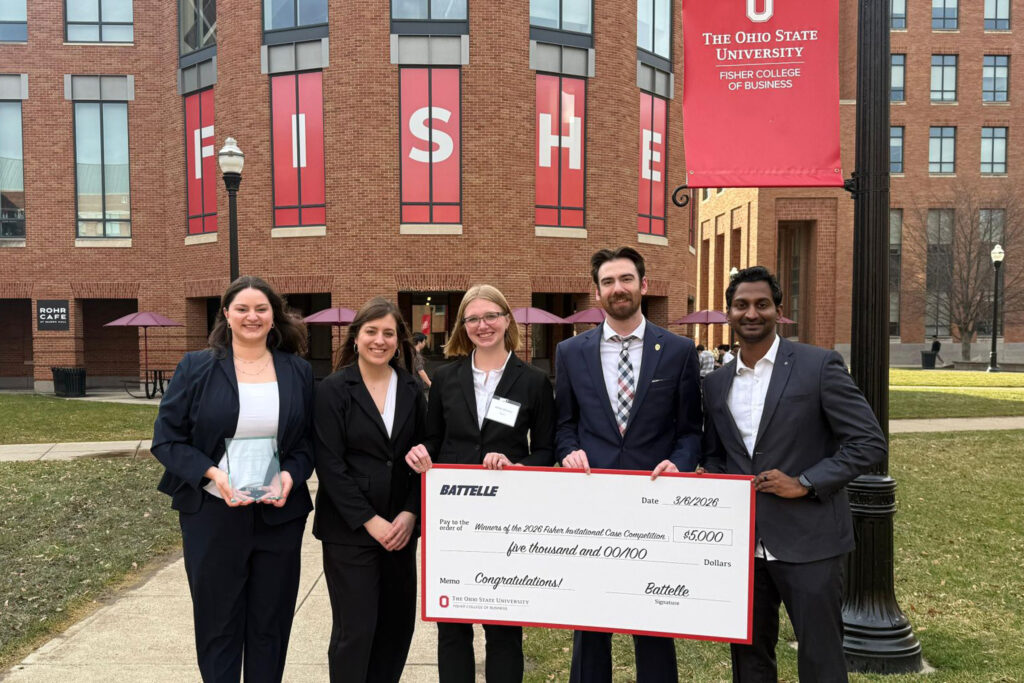
Case competitions that simulate real-world learning
Solve problems for startups
WSB Ignite Case Competition
A three-day competition where MBA students work in teams to provide recommendations to a Wisconsin startup. Teams are judged on their ability to define the problem, propose a solution, and present their findings to the client.
Pitch solutions to real companies
Reverse Pitch Competition
Corporate partners pitch a flawed internal process or ambiguous problem to student teams. Each team then spends a few weeks working together to refine their ideas before pitching a solution back to a panel of judges.
Participate in competitions at other schools
MBA students participate in multiple industry-relevant case competitions hosted at other universities and colleges across the country. Get hands-on experience. Solve real-world challenges.
The Wisconsin leadership blueprint
Leadership is embedded in the Wisconsin MBA through the Trusted to Lead Experience.
|
The Trusted to Lead Experience transforms you into the leader people seek out. It builds on three core competencies:
Entrepreneurial mindset
You bring clarity to uncertainty. An entrepreneurial mindset enables you to create change even within the most rigid and porous organizations.
Resilient
You navigate ambiguity with confidence. You don’t seek the easy answer but rather rigorously pour over data to make the most informed decision possible.
Inclusive
You foster trust and seek diverse perspectives. You’re the leader who welcomes everyone and seeks a range of perspectives to uncover biases and assumptions.
The Trusted to Lead Experience leverages four required leadership courses designed to help you become the leader that builds trust, challenges assumptions, and navigates complexity with confidence and empathy.
Courses
Applied Learning and Industry Pathways Discover different leadership and communication styles to develop your own by interacting with business leaders and industry experts. Explore emerging and current business topics through applied learning.
Leading People and Organizations As a leader, you need to understand the architecture of trust. You’ll learn how to build psychological safety so your team members can experiment and innovate without the fear of failure.
Business Strategy Expand your strategic thinking and leadership skills to evaluate and design business strategies that have innovative and entrepreneurial approaches.
Consulting Project Capstone Take what you’ve learned and lead a cross-functional team to solve a real client’s problem.
Participate in experiential learning opportunities that exemplify the three attributes trusted leaders embody. These co-curricular activities change to reflect the evolving business landscape.
A few examples of potential experiences:
The Intrapreneur’s Dilemma
A simulation of driving change inside a rigid organization (not just a startup) by leveraging alumni founders. Hosted by the Weinert Center for Entrepreneurship.
Core competency: Entrepreneurial mindset
The Mental Game Workshop
Learn how to navigate high-stakes pressure, recover from failure, and regulate emotions during crises with University of Wisconsin Athletics and the Badgers’ psychologists.
Core competency: Resilient
First Nations Cultural Landscape Tour
Visit cultural sites on UW–Madison’s campus, focusing on navigating complex stakeholders and understanding deep historical, community, and stakeholder contexts.
Core competency: Inclusive
“As future leaders, we have the opportunity and responsibility to reshape the workforce. Whether it’s advocating for more equitable policies or amplifying underrepresented voices, we are building our futures.”
Hannah Goldberg (MBA ’26)
HR Business Partner, Tennant Company
Minneapolis
Capabilities
The Trusted to Lead Experience transforms you into the leader people seek out. It builds on three core competencies:
Entrepreneurial mindset
You bring clarity to uncertainty. An entrepreneurial mindset enables you to create change even within the most rigid and porous organizations.
Resilient
You navigate ambiguity with confidence. You don’t seek the easy answer but rather rigorously pour over data to make the most informed decision possible.
Inclusive
You foster trust and seek diverse perspectives. You’re the leader who welcomes everyone and seeks a range of perspectives to uncover biases and assumptions.
Coursework
The Trusted to Lead Experience leverages four required leadership courses designed to help you become the leader that builds trust, challenges assumptions, and navigates complexity with confidence and empathy.
Courses
Applied Learning and Industry Pathways Discover different leadership and communication styles to develop your own by interacting with business leaders and industry experts. Explore emerging and current business topics through applied learning.
Leading People and Organizations As a leader, you need to understand the architecture of trust. You’ll learn how to build psychological safety so your team members can experiment and innovate without the fear of failure.
Business Strategy Expand your strategic thinking and leadership skills to evaluate and design business strategies that have innovative and entrepreneurial approaches.
Consulting Project Capstone Take what you’ve learned and lead a cross-functional team to solve a real client’s problem.
Signature experiences
Participate in experiential learning opportunities that exemplify the three attributes trusted leaders embody. These co-curricular activities change to reflect the evolving business landscape.
A few examples of potential experiences:
The Intrapreneur’s Dilemma
A simulation of driving change inside a rigid organization (not just a startup) by leveraging alumni founders. Hosted by the Weinert Center for Entrepreneurship.
Core competency: Entrepreneurial mindset
The Mental Game Workshop
Learn how to navigate high-stakes pressure, recover from failure, and regulate emotions during crises with University of Wisconsin Athletics and the Badgers’ psychologists.
Core competency: Resilient
First Nations Cultural Landscape Tour
Visit cultural sites on UW–Madison’s campus, focusing on navigating complex stakeholders and understanding deep historical, community, and stakeholder contexts.
Core competency: Inclusive
“As future leaders, we have the opportunity and responsibility to reshape the workforce. Whether it’s advocating for more equitable policies or amplifying underrepresented voices, we are building our futures.”
Hannah Goldberg (MBA ’26)
HR Business Partner, Tennant Company
Minneapolis
From AI proficient to AI leader
A sequence of AI courses and applied learning opportunities take you from AI fundamentals to hands-on application to AI leadership.
Gen Bus 707
Foundations of AI in Business
Learn what AI is, how it works, and its growing impact on business, society, and daily life. You’ll cover machine learning and emerging technologies, and end with a project using AI tools to solve a business problem.
Taught by Katie Gaertner.
Gen Bus 708
AI and the Enterprise
Dive deep into the strategic, operational, organizational and cultural implications of applying AI across various business functions. You’ll learn how to guide, manage, and make decisions about AI.
Taught by Matt Seitz.
Gen Bus 709
Future of Management
Move beyond theory to hands-on application. Explore AI and its impact on management, strategy, innovation, and the future of work. You’ll focus on the AI-driven transformation of business and the role of leaders.
Taught by Min-Seok Pang.
Meet your AI dream team
Katie Gaertner
Business Analytics Lecturer
A key player in the school integrating AI into existing curriculum and creating new AI courses, Katie Gaertner encourages students to experiment in the classroom.
In her courses, students apply what they’re learning to real-world simulations and challenges.
She joined WSB in 2023 as a business analytics lecturer and has extensive experience in data analysis, data science, and cloud computing.
Matt Seitz
AI Hub for Business Director
A recognized thought leader in AI, data analytics, and digital transformation, Matt Seitz brings more than 30 years of experience helping organizations use technology to solve challenges.
At WSB, he leads initiatives to advance AI research, foster industry partnerships, and prepare students for AI leadership roles.
His previous experience includes technology leadership roles at Google, McDonald’s, and Abbott Laboratories.
Min-Seok Pang
Information Systems and Analytics Professor Karen A. and William S. Monfre Professor in Business
Min-Seok Pang joined WSB in 2024. His award-winning research has been published in top-tier academic journals and is frequently featured in media outlets. His research interests include cybersecurity management, strategic management of information technologies, and technology-enabled public policies.
Pang was previously a faculty member at Temple University and George Mason University.
Lead with AI
“Leaders who embrace and use AI are going to shape the future of business. Our graduates are a step ahead of their peers, making an immediate impact.”
Matt Seitz
AI and the Enterprise instructor AI Hub for Business Director
Add expertise with certificates
Earn certificates in business disciplines important to you and your career growth or in other areas of interest.
Broaden your understanding of sustainable business practices to lead teams that integrate economic, environmental, and social decision-making into their operations.
Hone your technology, organizational strategy, and creativity skills to create social and economic value in existing organizations.
Previous card
Next card
Build an entrepreneurial mindset
Entrepreneurship is more than startups. It’s about seeing opportunity when others don’t, and using your curiosity and creativity to take on any challenge.
15
in entrepreneurship for graduate business specialties among public universities
—U.S. News & World Report, 2026
Weinert Center for Entrepreneurship
Access resources, find a mentor, and connect with industry professionals.
MBA Fellowship in Enterprise Development
Start or grow your own business and apply for $50,000 in startup funding.
Distinguished Entrepreneurs Lunch Program
Hear entrepreneurs’ stories of building and sustaining businesses.
Weinert Center for Entrepreneurship
Pioneer in education
The Weinert Center has been a leader in entrepreneurship education, outreach, and research since 1986.
The center helps students across campus develop the entrepreneurial skills they need to succeed in any environment.
Thanks to strong relationships with industry leaders, the center offers a variety of bootcamps, workshops, certificates, funding opportunities, networking events, and more to graduate students.
Building confidence
Through coursework and support from the Marketing Leadership Institute and Weinert Center for Entrepreneurship, Marina Bloomer (MBA ’22) began building the plan for what would become Stellar Tech Girls.
Now, every day, she inspires and empowers girls and nonbinary children to pursue STEM-related careers through hands-on projects and experiments at Stellar Tech Girls.
“Everything I do encourages girls to not be afraid. I want them to try things early, to build prototypes, to not be afraid of failure, to keep testing and iterating because that’s what engineering is.”
—Marina Bloomer (MBA ’22)
Founder and Program Director, Stellar Tech Girls
Middleton, Wisconsin
MBA Fellowship in Enterprise Development
One-year program
Full-time MBA students interested in starting a business or taking an existing business to a new level can apply to this one-year program. This immersive program combines business fundamentals, award-winning academic research, and cutting-edge techniques. You’ll receive mentorship, work on projects with local companies and entrepreneurs on campus, participate in competitions, and visit successful startups.
Fellows can apply for up to $50,000 in funding for a startup.
Expanding access
Lamarr Banks (MBA ’26) is on a mission to make opportunities more accessible to underrepresented entrepreneurs. By leveraging his finance background, venture experience, and community leadership skills, he plans to improve access to capital and help founders succeed.
While in the program, he gained the skills and experiences he needs to shape what’s next.
“I believe lived experience is a powerful teacher, and this program helped me translate those lessons into the tools needed to fund great companies and eventually build a business of my own. This fellowship was an important step toward becoming the kind of investor who creates lasting value for entrepreneurs and helps fuel the innovations that will define tomorrow.”
—Lamarr Banks (MBA ’26)
Venture Capital Associate, Gateway Capital Partners
Milwaukee, Wisconsin
Distinguished Entrepreneurs Lunch Program
Local entrepreneurs share their expertise and experiences during these casual, free lunches.
Held from noon–1 p.m. Wednesdays, this is a time to build your network, ask questions, and get advice.
8
graduate alumni startup founders among public U.S. schools
“I decided to use the MBA as a test platform. I wanted to build out a business plan, learn more about marketing and other sides of business, and see if it made sense to make the jump.”
Marina Bloomer (MBA ’22)
Founder and Program Director, Stellar Tech Girls Middleton, Wisconsin