- This event has passed.
Crosswinds and Crossroads — Risk and Resilience in Housing
Friday October 3, 2025 | 8:30am – 2:45pm

Federal housing policy is in flux, with recent and anticipated shifts reshaping long-standing programs, incentives, and regulatory frameworks. From changes in tax policy and affordable housing financing to evolving oversight and funding priorities, these disruptions are having a significant impact on housing markets—particularly for affordable and workforce housing.
Expert panelists who are leaders, policymakers, and advocates will discuss how they are navigating today’s policy uncertainty, and more importantly, how they are working to build resilience, identify solutions, and leverage emerging opportunities. With a focus on actionable strategies, panelists will discuss how to adapt to the changing federal landscape while continuing to advance housing affordability and equity.
Join Us!
- Learn from a range of experts — from the public and private sectors, from government and business and from academia — who are on the front lines of housing market research, policy and practice.
- Explore these questions and identify programs and solutions.
- Join us and you’ll have the opportunity to network with a diverse and passionate group of 150+ housing, banking, real estate, government and non-profit professionals to share ideas and best practices
Keynote and Featured Presenters

Jessica Lautz, Keynote Presenter
The core of Dr. Jessica Lautz’s research focuses on analyzing trends for both NAR members and housing consumers. She is in demand as a speaker and by major media outlets to provide commentary on the real estate market. She has testified before Congress on behalf of NAR.

Carlos Garriga, Keynote Presenter
Carlos Garriga’a research focuses on macroeconomics, monetary economics, housing and credit markets, asset pricing, and public economics. He is a member of the Bank’s Management Committee and is on the FOMC council that advises the Bank president on monetary policy and the broader economy issues.

Thom Amdur, Speaker
Thom is a nationally recognized leader in affordable housing and community development policy. He previously served as President, National Housing & Rehabilitation Association (NH&RA), where he received the NHP Foundation’s Affordable Housing Advocacy Award. He serves on the Board of Directors of numerous community development organizations including the Affordable Housing Tax Credit Coalition.
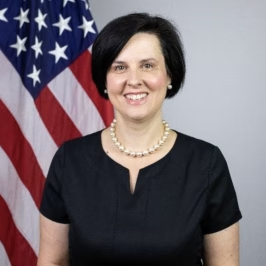
Erika Poethig, Speaker
Poethig led policy development on the housing, community and economic development for the Build Back Better Agenda. Under her leadership, the Biden-Harris Administration created action plans and policies to prevent evictions and foreclosures, increase the supply of rental and for-sale housing, improve housing affordability for low- and moderate-income Americans.
Presenters and Moderators
- Thom Amdur, Senior Vice President for Policy & Impact, Lincoln Avenue Communities
- Rob Brooks, Wisconsin State Representative, Assembly District 59
- Karl Eckart, Vice President of Intergovernmental Affairs, NAHB
- Mark Eppli, Teaching Professor, Department of Real Estate & Urban Land Economics, Wisconsin School of Business
- Carlos Garriga, Senior Vice President and Director of Research, Federal Reserve Bank of St. Louis
- Lu Han, Nathan F. Brand Chair Professor in Real Estate and Urban Economics at the Wisconsin School of Business and Faculty Director of the Urban Economics and Real Estate Ph.D. program at the University of Wisconsin-Madison
- Jessica Lautz, Deputy Chief Economist and Vice President of Research, National Association of REALTORS® (NAR)
- Elmer Moore, President, Wisconsin Housing and Economic Development Authority
- Erika Poethig, Executive Vice President for Strategy and Planning at the Civic Committee and Commercial Club of Chicago; Former Special Assistant to the President for Housing and Urban Policy in the White House Domestic Policy Council
- Bryan Schreiter, Senior VP of Commercial Lending, Associated Bank
- David Weiss, CEO, General Capital Group
Agenda
Time | Session |
|---|---|
| 8:30 – 9:00 a.m. | Continental Breakfast and Registration |
| 9:00 – 9:10 a.m. | Welcome and Introductions: Lu Han, Nathan F. Brand Chair Professor in Real Estate and Urban Economics at the Wisconsin School of Business and Faculty Director of the Urban Economics and Real Estate Ph.D. program at the University of Wisconsin-Madison |
| 9:10 – 10:00 a.m. | Keynote 1: The 2026 Economic and Housing Outlook Presenter: Jessica Lautz, Deputy Chief Economist and Vice President of Research, National Association of REALTORS® (NAR) |
| 10:00 – 11:15 a.m. | Panel 1: Charting a Course Through Federal Housing Policy Uncertainty As federal housing priorities shift and longstanding programs face disruption, the future of affordable and workforce housing hangs in the balance. Recent policy changes have introduced volatility in tax incentives, regulatory oversight, and funding mechanisms—creating challenges for developers, advocates, and communities alike. This panel brings together experts working at the intersection of policy and practice to explore how the housing sector can respond proactively. Panelists will share insights on navigating political and regulatory uncertainty, and offer forward-looking strategies to strengthen housing resilience, support innovation, and advance affordability in today’s unsettled policy environment. Moderator: Mark Eppli, Faculty Associate, Real Estate Department, UW-Madison Karl Eckart, Vice President of Intergovernmental Affairs, NAHB Erika Poethig, Executive Vice President for Strategy and Planning at the Civic Committee and Commercial Club of Chicago Thom Amdur, Senior Vice President for Policy & Impact, Lincoln Avenue Communities |
| 11:15 – 11:30 a.m. | Networking Break |
| 11:30 – 12:30 pm | Keynote 2: The Economics of Housing: Affordability, Policy, and the Road Ahead Carlos Garriga, Senior Vice President and Director of Research, Federal Reserve Bank of St. Louis |
| 12:30 – 1:20 pm | Lunch |
| 1:30 – 2:45 p.m. | Panel 2: Housing Under Pressure: Building Solutions for Wisconsin Amid Policy and Market Challenges Wisconsin, like many states, is grappling with a growing shortage of affordable and workforce housing—an issue felt acutely in both urban centers and rural communities. As federal housing policy continues to shift, state and local leaders must navigate the ripple effects of federal decisions while crafting solutions that address local needs. This panel will examine how federal policy uncertainty intersects with Wisconsin’s housing landscape, and how state-level efforts are rising to meet the challenge. From funding gaps to regulatory barriers and development pressures, panelists will explore what’s being done to expand access to housing, support economic development, and build long-term resilience in communities across the state. The conversation will focus on practical strategies for overcoming current constraints and strengthening Wisconsin’s housing future. Moderator: Elmer Moore, President, Wisconsin Housing and Economic Development Authority Panelists: Rob Brooks, Wisconsin State Representative, Assembly District 59 Bryan Schreiter, Senior VP of Commercial Lending, Associated Bank David Weiss, CEO, General Capital Group Legislative Representative |
| 2:45 p.m. | Wrap-up and Adjourn |
Thank You to Our Conference Sponsors and Partners
- Stevens Construction Corp.
- Mandel Group Inc.
- Hovde Properties
- Madison Development Corp.
- Stark Company Realtors
- Wisconsin Bankers Association
- League of Wisconsin Municipalities
- Wisconsin REALTORS® Association
- Wisconsin Bankers Association
- Wisconsin Housing Preservation Corp.
- Wisconsin Housing Alliance
Four Ways to Register
1. Call: 1-800-348-8964 or 608-262-2451
2. Register online »
3. Fax: 1-800-741-7416
4. Mail completed registration form to:
The Pyle Center
Registration Office
702 Langdon Street
Madison, WI 53706-1487
Registration Fees
$170 for government/non-profit and WREAA attendees
$200 for corporate attendees
Early Bird Registration (before August 15)
$150 for government/non-profit and WREAA attendees
$180 for corporate attendees
In-person fee includes conference materials, continental breakfast, lunch, and refreshments. The program includes two virtual keynotes broadcast at the conference and two in-person panels.
We are grateful for the support of our conference sponsors whose contributions help to keep registration fees low, allowing non-profit and government professionals to attend this important forum.
Registration Deadline: Friday, September 15. Call (608) 250-6401 for availability after this date. No refunds after September 15 but substitutions are allowed.
Cancellation Policy: Cancellations made before Monday, October 2, will receive a full refund; those made on or after October 4 are subject to the full registration fee. Substitutions may be made at any time.
Questions: If you have any questions, please contact Lee Gottschalk at lee.gottschalk@wisc.edu or 608-265-2032. If you have a disability and desire accommodations, please advise us when you register. Requests will be kept confidential.
Location and Lodging
Hotel accommodations
A block of rooms is reserved at the Fluno Center at $138 per night for the evening of October 2. Contact the Fluno Center directly at 608-441-7117 or 887-773-5866 to reserve your room. Be sure to mention that you are attending the Wisconsin Real Estate and Economic Outlook Conference.
Parking, Travel and Directions
A 290-stall parking facility (Lot 83) is conveniently located beneath the Fluno located at 314 N Frances St, Madison. The rate is $15 per day. We encourage you to arrive early the day of the conference, as there will be only one parking lot attendant on duty. There are also several public lots nearby. For additional information on getting to the Fluno Center by plane, car, or bus, please click here.
Sponsor Opportunities: Why Should You Join Us as a Sponsor?
We’re pleased to invite you to join us as a sponsor for the 2025 Wisconsin Real Estate & Economic Outlook Conference! The support of our sponsors is critical and has played a key role in making this event impactful and widely accessible. Now in its 21st year, the conference brings together 150+ leaders from real estate, housing, finance, and policy to explore critical issues facing our industry.
- Visibility and Exposure: Build valuable name recognition for your company by supporting a high-profile conference on critical real estate, housing, and community development issues. Your organization will receive extensive brand outreach throughout the conference marketing campaign – online via multiple media outlets and national press releases, and in the printed materials and verbal recognition at the conference.
- Direct Access to the Wisconsin Housing, Real Estate and Banking Community: Network with a wide variety of professionals and policymakers interested in the issues and opportunities presented by the real estate and housing markets. Attendees include real estate and finance professionals, non-profit groups, government and service agencies, and developers. We expect a capacity crowd at 150 professionals.
- Champion accessible housing education: Invest in your community and support critical housing and economic development issues by helping us keep the registration fee low so non-profit and government professionals can afford to attend this important forum. Your sponsorship helps maintain affordability and broad access to the event, supporting a diverse, cross-sector dialogue on pressing housing and policy issues.
- Competitive Edge: Take advantage of a unique opportunity to broaden your competitive edge by improving your company’s image, prestige, and credibility by supporting a world-class conference and the University of Wisconsin-Madison Graaskamp Center for Real Estate, the global leader in real estate education.
Sponsor Levels
- Lead partner: $7,500 – 7 complimentary conference registrations; 3 invitations to the pre-conference dinner.
- Platinum: $5,000 – 5 complimentary conference registrations and 2 invitations to the pre-conference dinner.
- Gold: $2,500 – 3 complimentary conference registrations and 1 invitation to the pre-conference dinner.
- Silver level: $1,000 – 2 complimentary conference registrations
- Bronze level: $500 – 1 complimentary conference registrations
Event Sponsorship Opportunities
Pre-conference dinner – $3,000 – 3 complimentary conference registrations and 2 invitations to the pre-conference dinner.
Continental breakfast – $1,500 – 2 complimentary registrations
Refreshment breaks – $1,000 – 2 complimentary registrations
Luncheon – $3,000 – 3 complimentary conference registrations and 2 invitations to the pre-conference dinner.