
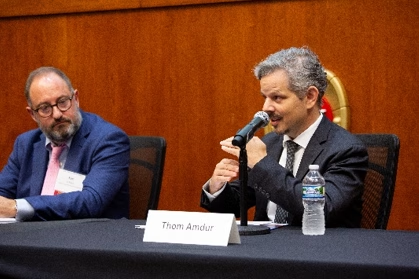
Following opening remarks from keynote speaker Jessica Lautz, the first panel brought together three experts in federal housing policy: Thom Amdur, SVP for Policy & Impact at Lincoln Avenue Communities; Karl Eckart, VP of Intergovernmental Affairs at the National Association of Home Builders (NAHB); and Erika Poethig, Executive VP for Strategy and Planning at the Civic Committee and Commercial Club of Chicago. The discussion was moderated by Mark Eppli, Teaching Professor in the Department of Real Estate & Urban Land Economics at UW–Madison
In his opening comments, Amdur framed the current housing environment as “The Good, the Bad, and the Weird.”
- The Good: Bipartisan recognition of housing’s importance is at a high point. The recently passed Big Beautiful Bill marks the largest expansion of the Low-Income Housing Tax Credit (LIHTC) in a generation. States such as California and Washington have enacted major zoning reforms to encourage higher density near transit.
- The Bad: The ongoing federal government shutdown is amplifying uncertainty, while cuts to programs like Medicaid and SNAP are squeezing household budgets. Meanwhile, trade and border policy may further increase construction costs.
- The Weird: Fannie Mae and Freddie Mac may soon go public—raising questions about how privatization could affect mortgage availability and affordability. There are also rumors of a potential presidential executive order aimed at boosting affordable housing supply.
Navigating the Crosswinds
Moderator Mark Eppli steered the conversation toward two key themes: the root causes of the housing shortage and potential solutions. Erika Poethig highlighted the importance of expanding access to construction trades, noting that rebuilding a productive, diverse workforce is essential to addressing supply constraints. Karl Eckart argued that rent control policies cannot fix a fundamentally supply-side problem, emphasizing instead the need for streamlined permitting and more flexible energy codes to accelerate new development.