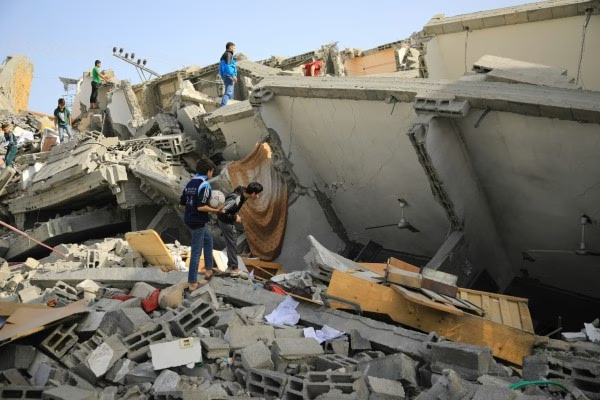
One of the core tenets of insurance and actuarial science is the idea of using historical loss data (damages and characteristics of the policyholder, in particular) to project future loss experiences. Doing so necessitates a large pool of experiences (e.g., policyholders, events) to make reasonably accurate predictions. However, how do insurers account for significant weather events and other catastrophes that not only have not happened (like a hurricane reaching Ashville, NC), but if and when they do happen, they can wipe out an entire portfolio worth of insureds?

This semester’s Catastrophe Risk and Reinsurance course taught by Professor Benjamin Collier aims to address how the insurance industry attempts this. Relative to the history of insurance (which, at the most recent, goes back to Lloyd’s Coffee House back in the late 1600s but could be traced back even further), catastrophe models are very new, with the first one coming into existence in the late 1980s. Their popularity didn’t kick off, however, until 1992’s Hurricane Andrew and 1994’s Northridge Earthquake devastated the insurance market. Following these events, carriers recognized that in the face of anthropomorphic climate change and expansion into disaster-prone areas, relying on historical loss data would no longer be enough to project losses.
Broadly, catastrophe (cat) models are stochastic models that use a multifaceted set of data to simulate tens of thousands of events (e.g., storms, wildfires, cyber outages, etc.) to project the expected losses within a portfolio or individual property. The amount of data that goes into these models is vast and continues to amaze me. Yes, historical events and loss data are components, but these models go beyond by incorporating things like topography, geological factors, gulfstreams, property characteristics like building materials and elevation, and the expected adherence to building codes across a property, to name a few. Non-natural disaster cat models get even more creative, such as leveraging elements of game theory to predict where a terrorist event may occur. The amount of thought and effort that goes into these tools has been amazing to read about.
Learning about catastrophe models has not only been really cool from a personal fascination standpoint, but it has helped round out my knowledge of the insurance industry. We had touched upon catastrophe models in a few of my other courses, but these were only surface-level moments acknowledging that these tools exist and insurers (reinsurers, in particular) use them. Professor Collier’s class has expanded upon this by not only detailing how these models work, but also by speaking to the history and current usage of these models and their increasing importance within the industry. As of writing, we’re entering the reinsurance portion of the course, where we will do a similar deep dive into how reinsurance, an often-overlooked part of insurance by the general public, functions and makes the insurance industry work as a whole. I look forward to the insights I’ll gain from this portion of the class and am excited to walk away with an even better understanding of this interesting and complex industry.
Photo by mohammed al bardawil on Unsplash.
Categories: