
There is something uniquely valuable about leaving the classroom. Having been both a student and working professional at different times in my adult life, I can attest that while both textbooks and case studies lay an important foundation, they also can only take you so far. The Wisconsin School of Business SHR Center’s annual Trek is one of those rare experiences that bridges the gap between academic theory and professional reality. For me, as a second-year MBA student in my final semester, it arrived at exactly the right moment.
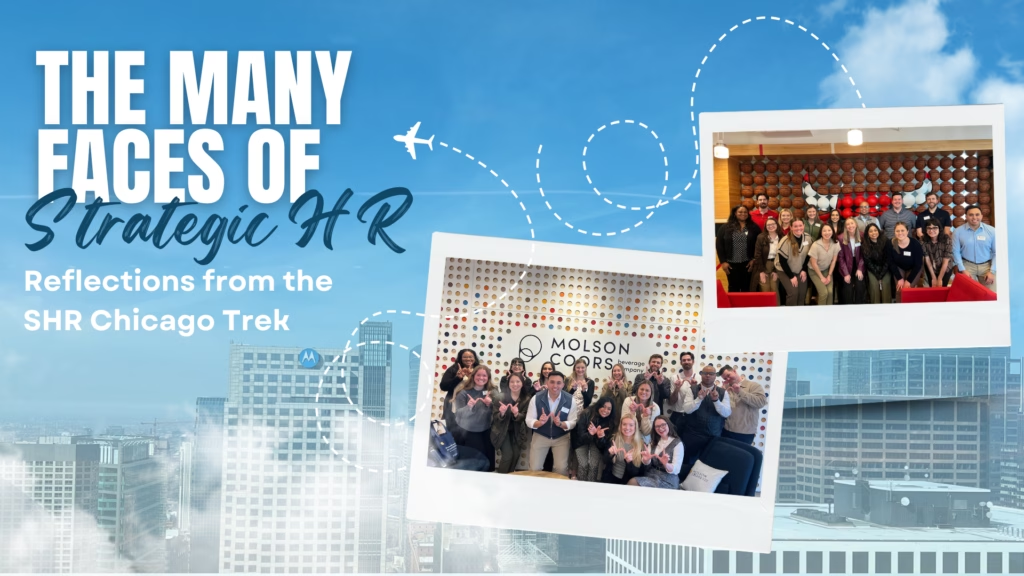
On March 19th, a group of SHR MBA students traveled from Madison to Chicago to tour the offices of five prominent organizations: Cisco, Molson Coors, WTW, the Chicago Bulls, and McDonald’s. Each visit followed a similar format, beginning with a facility tour and concluding with a panel discussion featuring HR and people professionals from the host company. However, the similarities largely ended there. What emerged across the two-day trek was a vivid portrait of how differently world-class organizations approach their most consequential asset: their people.
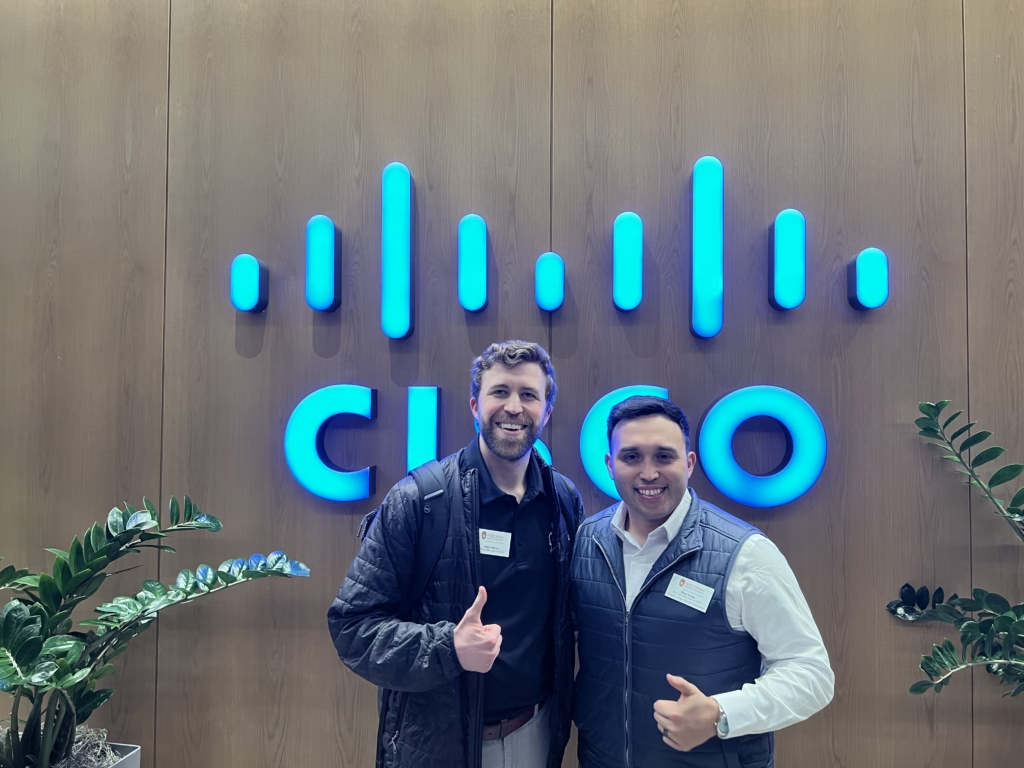
Our first stop was Cisco, a technology giant whose Chicago office felt intentional down to the last detail. Open floor plans and smart furniture were designed to keep employees moving and collaborating, discouraging what the team called ‘camping,’ the tendency to plant oneself at a single workstation and disengage from the broader environment. That same commitment to keeping employees engaged and growing carries into how Cisco approaches workforce development as well. The company dedicates formal calendar time to learning so that employees can build new skills during the workday. One panelist framed the stakes plainly: critical thinking and contextual judgment are the most valuable skills a professional can cultivate right now because they are the hardest for AI to replicate. Thus, continuous personal investment is a must. During the visit, we also heard from a senior leader on Cisco’s M&A team, who offered a candid look at the complexity of integrating acquired companies into Cisco’s benefits and compensation structure, a process that demands equal parts technical precision and human sensitivity.
From Cisco, we made our way to Molson Coors. I knew Molson Coors would be interesting, but I did not anticipate the level of business acumen its HR team boasts. This is a company navigating genuine market headwinds. Beer consumption is declining, wine is softening, and non-alcoholic beverages are on the rise. Yet their HR business partners spoke about portfolio strategy, market positioning, and category trends with the fluency of seasoned business strategists. Each HRBP on the panel was embedded in a specific business unit, and that deep familiarity with their respective segments was evident throughout the conversation. What impressed me most about HR at Molson Coors is that expertise doesn’t exist in silos. Each individual demonstrated both a deep knowledge of their own functional lane and a genuine understanding of the business as a whole. This balance between specialization and broader business literacy is something I have come to regard as a hallmark of effective HR leadership. Molson Coors’ HR philosophy reinforces that standard: their goals center on creating an environment where employees can thrive, grow professionally, and develop into exceptional leaders. That mission demands HR professionals who understand the business deeply enough to know what thriving actually looks like at every level of the organization, and the panel we met with reflected exactly that.
The second morning of this Trek took us to WTW, a global advisory and solutions firm that serves 92% of the Fortune 500. WTW’s work spans two primary areas: Health, Wealth, and Career consulting, and Risk and Broking services. Their Chicago team walked us through their Work and Rewards practice, and the session offered a compelling demonstration of what it looks like when a firm organizes its entire model around client outcomes. The central idea is straightforward but powerful: when clients grow, WTW grows. Staying relevant to clients requires anticipating where compensation and benefits trends are heading rather than simply reacting to them. The firm leverages an extensive global database and more than 1,200 Work and Rewards practitioners worldwide to deliver that kind of forward-looking guidance. Our WTW visit was a useful reminder that data fluency and advisory rigor are not the exclusive domain of finance or consulting. They are increasingly central to effective human capital strategy as well.
Of all the organizations we visited, the Chicago Bulls offered possibly the most distinctive window into what lean, high-functioning HR can look like in practice. With a People and Culture team of just five professionals supporting roughly 200 employees, the Bulls operate an HR function that prizes agility and adaptability above almost everything else. This constraint, rather than limiting the team, appears to have sharpened it. The team was candid about the realities of working in a professional sports environment: priorities shift quickly, the day-to-day is unpredictable, and every team member is expected to contribute well beyond the boundaries of a formal job description. One anecdote about assembling office furniture as an informal rite of passage drew a laugh from our group, but it illustrated the point effectively. Succeeding at the Bulls requires genuine teamwork and a high tolerance for ambiguity. What makes that culture sustainable is the strategic framework underneath it. The Bulls’ HR team draws an intentional distinction between goals and priorities: goals are tangible, time-bound targets with a one to two year horizon, while priorities are longer- term commitments, such as employee experience, that demand sustained attention rather than a defined finish line. The HR team’s north star is to function as a true strategic partner to the executive team, grounding every recommendation in data and leading with insight. Their guiding principle, Together Forward, came across as something the team genuinely lives by rather than a phrase on a wall.
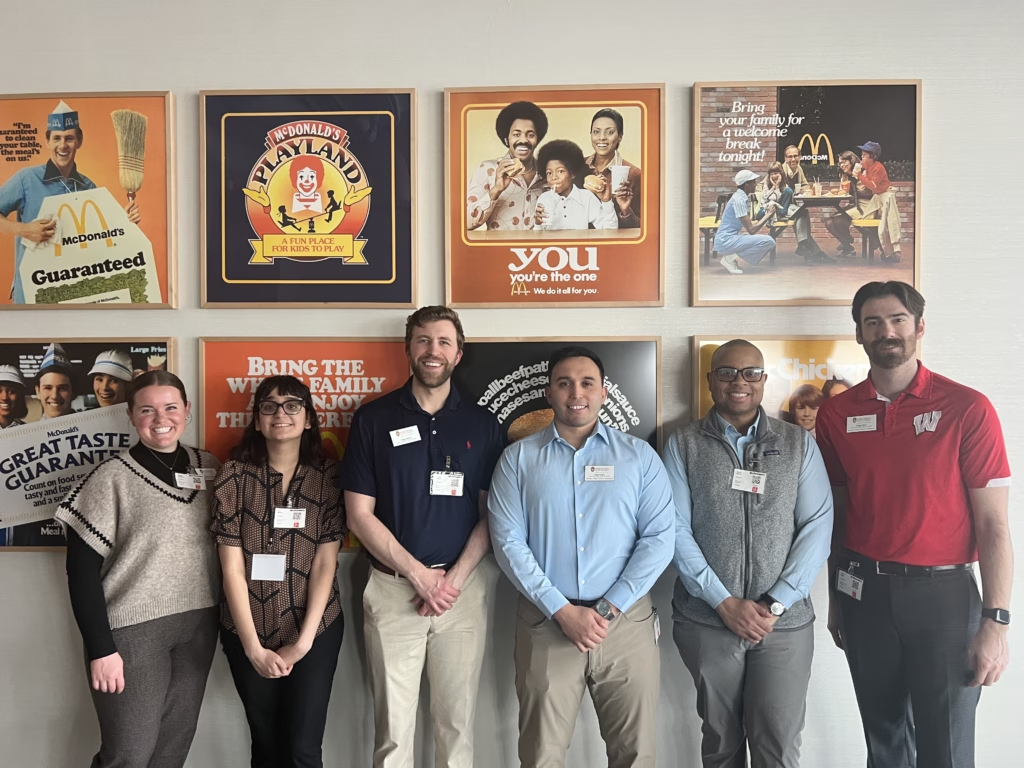
We closed out the trek at McDonald’s global headquarters in Chicago’s Fulton Market neighborhood. Few companies in the world operate at the scale McDonald’s does; that scale creates a people challenge that is truly exceptional. With 97% of locations being franchise-operated, the corporate HR team is responsible for setting the standard for an employee experience they do not directly control at the store level. Further, considering that one in eight Americans has worked at a McDonald’s at some point in their life, the stakes of getting that right are difficult to overstate. McDonald’s response to this challenge is a deliberate and expansive investment in its people. Programs like Hamburger University, free LinkedIn Learning access, a Young Professionals Network, a robust array of employee resource groups, and weekly corporate networking events reflect an organization that understands the connection between employee experience and business performance. Their team made that case openly during our visit often stating, “when you invest in your people, it shows up on the bottom line.” For someone sitting at the intersection of operations and people strategy, this is not just a compelling argument. It is a foundational one, and McDonald’s has the data to back it up.
Considered in aggregate, these five visits reinforced something that is easier to state in theory than to appreciate in practice: there is no single blueprint for organizational success. Each company is a leader within its respective industry, and each invests meaningfully in its people. The trek clearly highlighted that there is no universal formula for how that investment takes shape. Each organization’s approach to talent strategy, workforce management, and the role of HR within the business is distinctly its own, shaped by competitive environment, organizational scale, culture, and the specific challenges each is working to solve. Cisco builds for adaptability in a technology landscape that evolves faster than any annual plan can capture. Molson Coors navigates market disruption while holding fast to a commitment to develop leaders from within. WTW converts data and client relationships into a durable competitive advantage. The Bulls demonstrate that a lean, focused HR team can deliver outsized impact when guided by a clear strategic framework. McDonald’s shows what it looks like when people strategy is treated as a core business imperative at global scale. The throughline across all five firms is that winning is rarely simple; It is the product of deliberate, compounding decisions made in service of a deeper organizational strategy.
As I prepare to graduate from the Wisconsin School of Business in May, I leave this trek with more than just a few notes. The SHR Center has consistently created opportunities for students to engage with practitioners and organizations in ways that coursework alone cannot replicate. Across two days in Chicago, I witnessed HR functioning as a true driver of business strategy, not a support function operating at the margins. This distinction matters, and it is one I will carry with me as I continue building my expertise at the intersection of operations and people. I am grateful to the SHR Center and to the Wisconsin School of Business for making experiences like this one possible.