To highlight the contributions of another valued faculty member, we are proud to shine the spotlight on Qing Liu, whose passion for uncovering the stories behind data shapes both her research and the classroom experience she creates at the Wisconsin School of Business.
From Corporate to Classroom
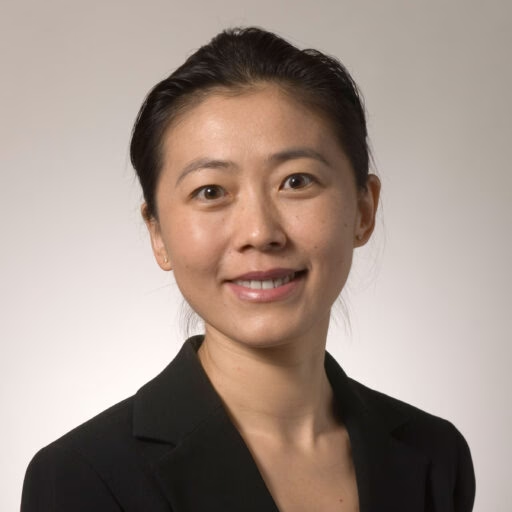
Before joining WSB, Qing spent more than eight years working in the corporate world as a statistician and analytics manager at companies like Capital One and JPMorgan Chase. She also worked in marketing analytics at Cendant Corporation as a manager in database marketing.
“While I enjoyed the fast pace in the corporate world and climbing up the corporate ladder, I felt a calling to understand the ‘why’ behind data on a deeper level,” she shares. That curiosity led her to pursue a PhD in statistics at The Ohio State University and eventually bring her expertise to WSB, where she enjoys both conducting research and developing future business leaders.
Finding the Human Story Behind Numbers
Qing describes the overarching theme of her three research streams as “finding the human story behind numbers” to inform better consumer and business decision making. One stream examines optimal data collection and how to design experiments that capture the right information to understand customer preferences and drive product development. Another area focuses on marketing for societal good, where Qing uses machine learning and AI to study the way design choices like food labeling can influence healthier consumer decision making. The third area involves research on the future of retailing and ways physical shopping environments can remain competitive with large online retailers such as Amazon.
Qing is also passionate about interdisciplinary research and is currently collaborating with physicians to help design better medical experiments and improve healthcare decision making. “I am excited that my research and my skillsets can help save lives,” she shares.
Using Data in Decision Making
In the data visualization course she teaches, Qing leverages her research to guide students in turning the abundance of data we have access to into clear and compelling stories. “Instead of just teaching students how to create charts, I actually focus on the key principles of effective visualization and storytelling,” she notes.
Students analyze real datasets, including stock market data, and create visualizations that explain trends and recommend business actions. Qing takes a “scaffolding approach” and the course content builds on itself. Beginning with core visualization principles, students learn best practices and gradually progress to more advanced techniques like dynamic dashboards.
By the final project, they can apply appropriate visualization techniques to datasets of their choosing. “Depending on their interests, students have the freedom to bring in the sources of data that they are interested in analyzing and telling stories about,” Qing shares. Connecting the concepts to student preferences allows them to develop a sense of ownership over the project.
Creating a Collaborative Learning Environment
Qing strives to create a classroom environment where students feel comfortable asking questions and learning from one another. She reminds students, “Don’t work in silos. Leverage the strength of each team member so that all together you can conquer obstacles that no one single person can conquer.”
Drawing on her experience in the corporate world, she emphasizes collaboration through rotating team leadership during weekly activities. “During the first week you may be the team leader, and you facilitate discussions and summarize what the team has discussed, and the next week someone else would be the team leader so everyone gets a chance.” This structure allows each student to shine the spotlight on the unique perspective they bring to the table and take ownership for their learning.
For students preparing to graduate, Qing encourages curiosity and teamwork as they enter their next chapter. “Be a proactive learner,” she advises, noting that while the tools used in analytics will continue to evolve, a strong understanding of foundational principles will help analysts adapt throughout their careers. The program is lucky to have Qing, whose influence will continue to guide students as they turn data into stories that matter!
Categories: