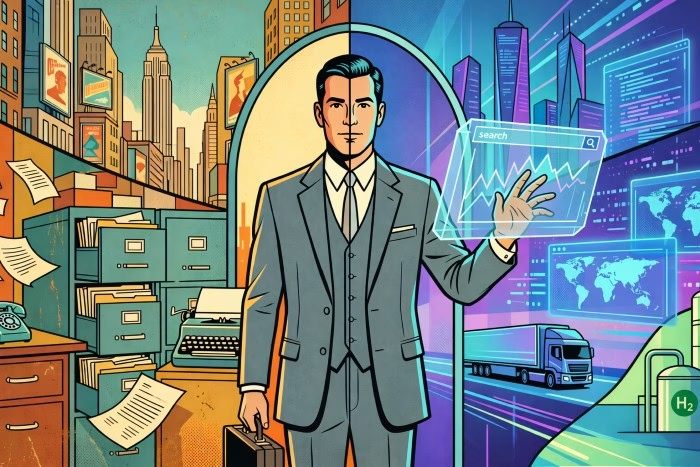
The obituary for the insurance broker was written in real-time on February 9, 2026. During that single trading session, the insurance brokerage sector experienced its most significant sell-off since the 2008 financial crisis. More than $20 billion in market capitalization was lost as investors reacted to the release of agent-grade applications from Insurify and Tuio. Stock prices for industry leaders like Aon and Willis Towers Watson fell sharply because the market assumed that automated tools rendered human intermediaries obsolete.
In the weeks following that panic, however, the sector began a steady recovery. Investors are starting to recognize a vital distinction that the initial sell-off ignored. There is a fundamental difference between basic distribution software and technical risk management. The recovery has not just stabilized the industry; it has clarified the actual value of the broker in a high-tech economy.

This narrative of terminal decline ignores over a century of resilience. The profession was officially codified in the United States in 1896 with the founding of the National Association of Local Fire Insurance Agents, known today as the Independent Insurance Agents and Brokers of America. Since then, the industry has survived the arrival of the telephone, the mainframe computer, and the internet. Each of these milestones was met with claims that the broker would soon be a relic. Instead, the industry has historically used new tools to refine its focus. The February panic was a reaction to a new tool, but it failed to account for the nature of the risk being traded.
We are seeing a trend toward the Great Separation, where the industry splits into two distinct categories. The first category involves commodity risks such as standard auto, homeowners, and basic renters insurance. These products are high-volume and low-complexity. When a risk can be quantified through a simple data scrape, a human interface often creates unnecessary friction. In this space, digital intermediaries are the logical successors. Consumers prioritize speed and price for these basic protections, and the routine is moving to the machine.
This shift represents a liberation for the professional broker. By offloading high-volume and low-margin administrative tasks, the broker can return to the role of a technical advisor. Global business exposures are becoming more difficult to model. While an app can quote a suburban home, it cannot navigate the bespoke manuscripting required for a green hydrogen facility or the liability nuances of an autonomous trucking fleet. These sectors require human judgment and the ability to negotiate the intent behind specific policy exclusions.
The broker of the future acts as a risk architect. This role involves managing complexities that software fails to handle. AI can provide a quote, but it cannot engineer a long-term risk transfer strategy. The industry is moving up the value chain toward technical advisory, where nuance is more valuable than speed. This evolution coincides with a significant demographic shift, as an estimated 400,000 veteran brokers are expected to reach retirement age by the end of 2026. Automation cannot fill the knowledge vacuum left by these departing professionals.
Negotiating a unique exposure requires a level of detail that a machine cannot replicate. This addresses the advocacy deficit inherent in direct-to-consumer models. An algorithm can identify a price point, but it lacks the capacity to defend a policyholder during a disputed claim or a loss that falls into a gray area. In a broker-led model, the insured has a representative with the technical knowledge to challenge a carrier’s decision based on precedent and relationship.
True value now resides in the ability to manage what is unquantifiable. Specialization in sectors like cyber liability and directors and officers coverage for firms using machine learning creates a professional barrier that conversational interfaces cannot cross. The $20 billion market loss in February was driven by a misunderstanding of this expertise. The middleman is not being replaced but is instead focusing on areas where technical depth is indispensable.
The February 9 sell-off was a multi-billion-dollar error in judgment regarding the role of technical expertise. Investors initially mistook a faster way to buy a policy for a better way to manage a loss. As the industry settles into this new reality, the divide is clear: machines will dominate the transaction, but specialists will own the risk. The recovery of these stocks confirms that while data is now a commodity, the judgment required to interpret it remains the industry’s scarcest and most valuable asset.
Categories: