
Every manager now has a research team, a strategy partner, and a first-draft analyst sitting on their laptop. ChatGPT, Claude, Copilot, Gemini, custom enterprise models, and agentic tools have quietly collapsed the distance between having a question and having a defensible answer. Analytical horsepower that used to live behind a consulting retainer now opens in a browser tab. Twenty years of corporate knowledge work, available on demand and reporting to whoever is holding the keyboard. That is a structural change in who gets to think at scale, and it has already happened. The competitive question has moved past access. If every company has the same engine, the only advantage that remains is knowing where to point it.
That was the argument the inaugural AI Ground Truth Summit delivered in pieces on April 16th and 17th. Hosted by the AI Hub for Business at the Wisconsin School of Business, it was the first event of its kind at the School. Over two days at Memorial Union on the UW-Madison campus, more than fifty operators, researchers, and executives gathered to push the conversation past pitch decks into the harder territory of deployment, governance, and workforce transition. I attended as an MBA student entering a general management leadership development program, looking for one answer. What does AI actually change about how a manager decides anything?
Karen Sauder, President of Global Clients and Agency Solutions at Google, opened with numbers designed to land hard. Half of Google’s codebase is AI-generated. Cloud support self-service has improved 40%. Supplier assessments run fourteen times faster. HR uses AI for help desk automation, career pathing, and resume screening. It would be easy to hear this as a presentation about tooling. Sauder made it a presentation about culture. AI transformation, she said, is ultimately a people and culture transformation. The technology is the easy part. The organizations making real progress are not the ones with the most advanced tools. They are the ones investing in the slower work around them.
Ramayya Krishnan, Dean Emeritus at Carnegie Mellon University’s Heinz College, gave that idea its clearest structure. He called it the 70-20-10 principle. Roughly 10% of any AI deployment is the visible technology that absorbs most of the executive attention. The remaining 90% is workflow redesign, governance, risk management, and workforce transition. The part that rarely makes the earnings call is usually the part that determines whether the deployment survives its first hard year. His headline example was ambient AI in healthcare. The technology listens to the appointment, generates the clinical note, and gives the physician back seven to eight hours a week. Patients get more of their doctor. Providers get relief from burnout.
The thread I kept pulling ran one layer deeper. Clinical documentation has never been pure paperwork. Writing the note is how the encounter gets organized, and that organization sits close to diagnostic reasoning itself. Move the writing to the model and you move part of the thinking with it. The senior physician who once wrote the note can still catch the atypical case, because she was trained by thousands of her own. The resident who never writes one is being shaped by a different apprenticeship, and the profession will not know the full cost for another decade. The logic generalizes. When AI absorbs the tasks that used to build contextual knowledge, decisions drift upward toward leaders who sit further from the work. The productivity gain is booked this quarter. The judgment debt accumulates quietly, and the invoice arrives years later.
Matt Seitz, Executive Director of the AI Hub for Business, made the strategic version of this point in his breakout. The session title was the thesis. Adoption is not a strategy. His test was disarmingly simple. Where in your business do you want consistency, and where do you need differentiation? Customer service, compliance, and supply chain logistics reward consistency, and AI delivers it cheaply and reliably. Brand, product development, and creative strategy reward differentiation, and a model trained on the same data as every competitor will converge on similar answers. Seitz offered Shein as the affirmative case. The advantage is not the AI. It is a proprietary data engine connecting web traffic, advertising performance, and supply chain signals directly to manufacturing. The data loop is the moat.
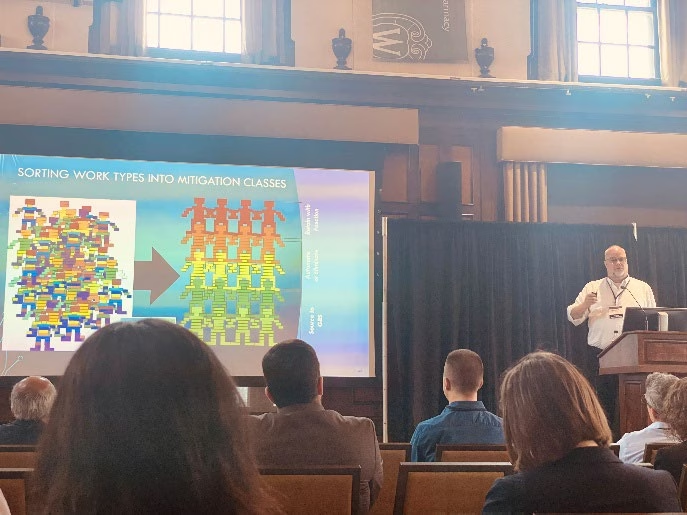
Rob Bradford, Vice President at Kimberly-Clark, delivered the most operationally honest session I attended. His slide on what actually happens after an executive approves an AI initiative was the single most useful thing I saw on stage. Teams are already at full capacity. Employees carry understandable concerns about what AI means for their numbers, their territories, and their careers. Change fatigue is accumulating. Accountability for outcomes is often diffuse. Bradford’s response was to stop approaching AI job by job and start thinking in “work archetypes,” the chunks of work that AI agents handle reliably, consolidated across the organization and rolled out as a transformation program rather than a technology initiative. AI is not coming to take your job, he told the room. People who know how to use AI are coming to take your job.
The panel that closed day one reframed everything that came before it. Noelle Baer, Group Strategy Director at Omnicom, named a problem the rest of the industry has been circling. Generative AI is commoditizing content so quickly that the market is filling with a wave of indistinguishable, mass-produced output, the kind of material commonly referred to as AI slop. Every brand has the same tools. Every brand is producing more content than ever. The winners in that environment will not be the ones with the biggest budgets. They will be the ones with the strongest ideas. AI cannot tell a company what it stands for. When AI is applied to creative work well, Baer said, the audience should never detect it. Ken Nelson, Chief Commercial Officer at Deloitte, reinforced the point from the opposite direction. A client’s campaign performance rose 50% after AI-driven localization, a lift only possible because the underlying creative concept was strong enough to be worth scaling. The tool amplified the idea. It did not originate it.
Taken together, the conference built toward a single conclusion. AI is the most powerful engine the business world has ever installed. But an engine does not choose a destination. Without a clear route, a faster engine produces faster travel in whatever direction the vehicle is pointed. The companies pulling ahead defined the destination before installing the engine. The ones struggling share the opposite shape. Impressive capability, underdeveloped destination, oversight still catching up, the transmission engaged before the map was drawn.
The implications run directly into human resources. Krishnan described two forces reshaping roles at once. Purification is the gradual standardization of roles as routine tasks get automated away. Proliferation is the creation of new AI-enabled tasks that let one person operate at previously impossible scale. Both land on the HR function. The technical upskilling challenge is well understood. The harder work sits downstream. Research presented at the Summit suggested employees hold AI to a stricter standard than they hold other humans, and that working alongside AI can reshape how people experience their own competence. Rolling out AI is not primarily a training problem. It is a leadership problem that reaches into how people understand their value at work.
AI competency for the next generation of business leaders is not technical fluency. It is understanding where the tools genuinely help and where they quietly change the shape of the problem. It is staying close enough to the work that the engine and the map remain in the same hands. The engine will keep getting more powerful. The question that will define the next decade of leadership is whether the people holding the wheel know where they are trying to go.