Artificial intelligence is emerging as a structural shift in both real estate education and industry practice, influencing how students learn, how faculty teach and how professionals interpret and analyze complex market data. Recognizing both the promise and the challenges of this rapid technological shift, the Graaskamp Center for Real Estate conducted a coordinated set of surveys of students, faculty and alumni to better understand how artificial intelligence is being adopted across real estate education and professional practice.
The goal was to assess how AI tools are currently being used, how expectations and guardrails are being established and what skills will be required of students entering an increasingly technology-driven workforce.
“The AI revolution may prove to be as consequential as the arrival of spreadsheet software, email, or even the internet itself. In many ways, it is already reshaping how we use all three of those foundational technologies,” said Jacques Gordon, Director of the Graaskamp Center for Real Estate. “At the Wisconsin School of Business, we will continue to track this rapid adoption closely through regular surveys and ongoing engagement with our faculty, students, and alumni.”
The Emerging Professional Standard: Preparing Young Professionals for an AI-Integrated Industry
A consistent theme across the Graaskamp Center surveys is that AI is becoming a baseline skill, not a substitute for expertise. AI fluency will increasingly sit alongside financial modeling, market analysis, and relationship-building as a core competency.
Industry professionals consistently agree that young professionals entering the field must be able to:
- Use AI to increase efficiency and generate insight
- Critically evaluate outputs and verify accuracy
- Protect confidential and proprietary information
- Understand the underlying drivers of valuations, development feasibility, and investment strategy
- Apply sound human judgment to decisions that technology alone cannot.
AI and the Information Advantage
in Real Estate
Real estate’s multi-disciplinary nature makes it well suited to benefit from AI’s ability to quickly synthesize large volumes of information. A typical investment underwriting involves engineering and environmental reports, leases, expense statements, market studies, comparable sales data, legal and title documents, zoning requirements, building codes, and climate risk forecasts. In such a data-heavy environment, the potential for AI to assist decision-making is clear.
At the same time, real estate education must help students understand the fundamental relationships that drive successful investments and developments. When AI accelerates that understanding, it is a valuable tool. If it replaces it, we risk losing something essential. The goal in the classroom is to help students appreciate machine-driven tools while reinforcing the importance of human insight and judgment.
Student Survey Results: High Adoption, Growing Confidence, Desire for Clearer Guidance
AI use is widespread; the vast majority of students actively use AI in coursework. The most popular AI platforms used by students: (1) ChatGTP; (2) Gemini; (3) CoPilot; and (4) Claude.
- Most students useAI as a productivity and comprehension tool. The most common applications include writing assistance, editing, outlining, brainstorming, summarizing dense materials and generating study guides.
- Adoption is expanding into more technical areas as well with 36% report using AI for financial analysis, valuation modeling and market research.
- 94% say instructor expectations around AI use are very clear or somewhat clear.
- 80% report classroom discussion of ethical and responsible use.
- 91% describe themselves as somewhat or very confident using AI responsibly.
- At the same time, many students are seeking clearer guidance on how to verify AI-generated outputs, avoid over-reliance and better understand employer expectations regarding AI proficiency.
Industry Adoption: Productivity Gains, Policy Catching Up
The real estate alumni and industry survey shows that AI adoption is accelerating across commercial real estate firms. A large majority of organizations now encourage AI use in at least one function. Firms report productivity gains, particularly in research efficiency, document review and workflow organization.
However, policy frameworks are still evolving, with only 38% of surveyed firms reporting that they have implemented formal AI training programs and just 32% have updated employee policies to clarify expectations around AI use. Common concerns include:
- Data privacy and confidentiality
- Accuracy and verification
- Over-reliance on automated outputs
- Potential erosion of human judgment
A Deliberate Approach at Wisconsin
The Wisconsin School of Business is approaching the AI evolution with intention. Through initiatives such as the weekly Teaching and Technology series and the addition of six faculty members focused on AI-related research and the work of the AI Hub for Business, the school recognizes that AI represents a critical shift in how business operates. WSB’s AI hub is founded on the belief that AI is a powerful tool that students, professionals and business leaders alike must learn to leverage. Like any new technology, there are plenty of ways that AI can be abused or misused. Faculty and students are aware of these pitfalls in their careful and deliberate use of AI in the classroom.
The Graaskamp Center and Looking Ahead
The Graaskamp Center’s surveys provide a valuable benchmark at an inflection point for the industry. They reflect a community that is thoughtful and measured in its approach, embracing innovation while maintaining careful scrutiny. Students are experimenting thoughtfully and faculty are integrating AI with structured oversight. Industry professionals are realizing productivity gains while continuing to refine governance frameworks.
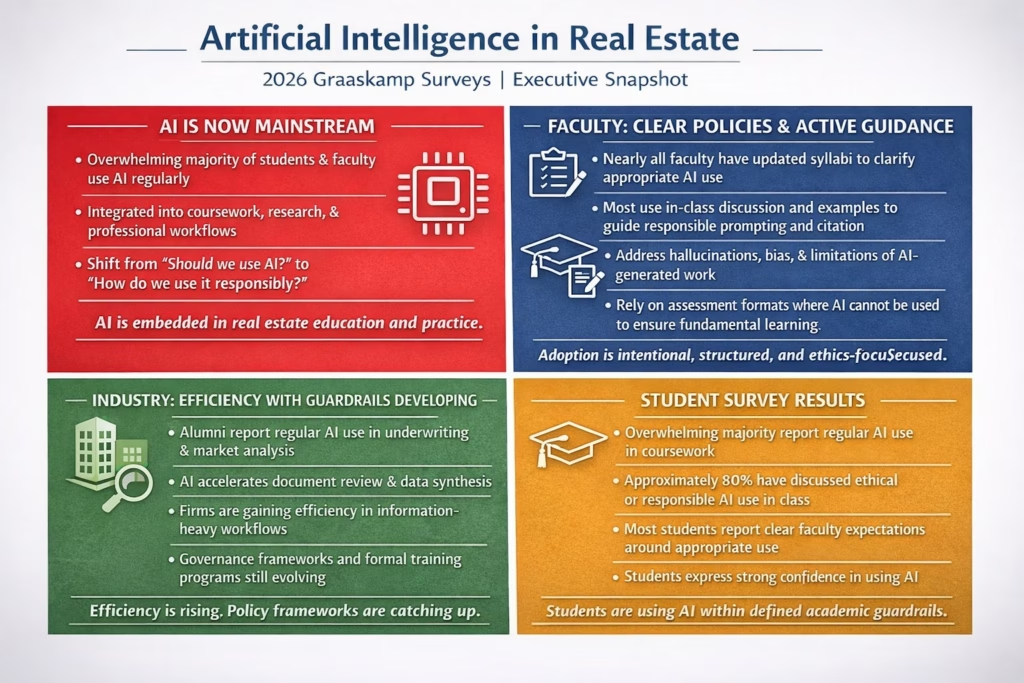
AI’s capabilities are expanding rapidly but so are conversations about responsible use. Like any powerful technology, it can be misapplied, over-relied upon or used without appropriate safeguards. Wisconsin’s approach recognizes both dimensions: AI should be applied with technical fluency and guided by sound judgment. As a university, we are committed to equipping students not only to harness its capabilities, but also to understand its limitations, critically evaluate its outputs and use it in ways that strengthen rather than substitute for independent thinking. The matrix below summarizes the findings of the Graaskamp Center’s survey. We expect to repeat this survey every year to track how AI usage continues to grow and change.
2026 Graaskamp Survey Executive Snapshot
Thank you to the survey team for their assistance with this project:
Dayin Zhang, Assistant Professor of Real Estate and Urban Land Economics
Connor Nowakowski, MBA ‘27
Vannessa Lynn Geich, BBA ’26
Angelo Alfaro, BBA ‘26