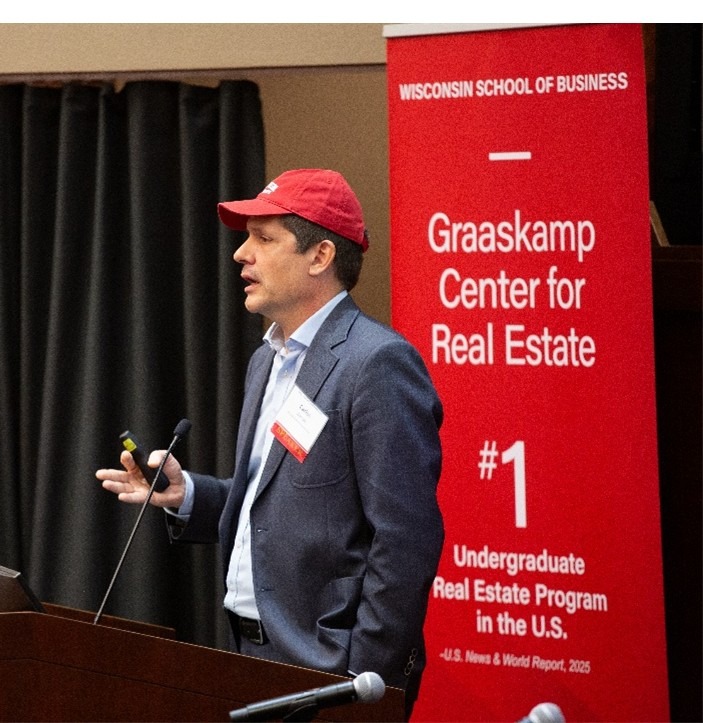
The day’s second keynote featured Carlos Garriga, Senior Vice President and Director of Research at the Federal Reserve Bank of St. Louis, who offered a macro-level view of housing through the lens of monetary policy and economic data.
Garriga discussed the Fed’s dual (triple) mandate as given by Congress:
- Maximum Employment: Promoting job growth and low unemployment.
- Price Stability: Maintaining stable prices, typically measured by the inflation rate. Since 2012, they target 2% measured Headline PCE.
- Moderate Long-Term Interest Rates: Maintain stable interest rates over the long term, fostering economic growth, and financial stability.
Garriga also delved into the Fed’s approach to interpreting data, and the balance of risk-taking between the public and private sectors. He noted that in times of high uncertainty, businesses often delay hiring, investment, and project starts—trends visible in today’s environment. Housing and services, he explained, remain the primary drivers of inflation, while goods and energy have largely stabilized.
Acknowledging the challenge of today’s high cost of capital, Garriga emphasized that expanding housing supply is essential to easing housing inflation. When asked about the rationale behind the Fed’s 2% inflation target, he responded that maintaining liquidity and keeping debt service manageable—especially on U. S. foreign obligations—are key reasons for that benchmark.
Key takeaways
Growth and Employment Outlook (Softening)
- Economic Activity is Slowing, Uncertainty is High: Economic activity has slowed in the first half of the year, and uncertainty can increase again.
- Downside Risks to Jobs: Contacts expect little to no change in employment or wage growth, with increasing reports of layoffs and decreased attrition rates. Risks to job growth are tilted to the downside.
Conflicting Signals: Inflation and Monetary Policy
- Inflation Risks Tilted Upward: While current inflation pressures remain moderate, near-term inflation expectations have risen, partly due to tariffs and higher costs of necessities. Risks appear tilted toward the upside.
- FOMC Stance: The FOMC’s current policy stance is dual: it guards against risks on the employment side of the mandate while remaining focused on persistently above-target inflation
Carlos Garriga’s presentation provided a rare insider’s look at the Fed’s analytical process and the complex interplay between housing policy, capital markets, and