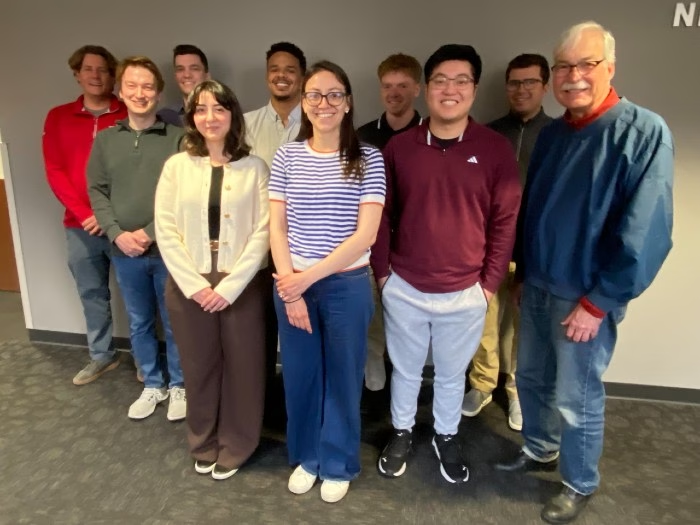
At the beginning of the semester, I wrote about my excitement to lead an Applied Learning Project that would bridge classroom theory with real-world application. Over the past several months, that expectation proved accurate, but the experience also introduced a level of complexity and ambiguity that went far beyond what I initially anticipated. As the leader of an eight-person team composed of six MBA students and two undergraduate students, I was responsible for liaising with the client, delegating responsibilities, and meeting regularly with our professor to ensure we remained on track. This role required strong organization and communication, as well as the ability to adapt quickly as new challenges emerged.

Our objective was to conduct a risk optimization study for a Fortune 500 company using real internal data. We leveraged AI tools to develop frequency and severity curves across six exposures and constructed a correlation matrix to better understand how those risks interacted. Many of the challenges I anticipated in theory became more pronounced in practice. Due to confidentiality constraints, we were unable to input sensitive company data into AI tools, which limited the precision of our outputs. We also lacked access to broader industry data and did not have full visibility into the company’s reinsurance premiums, making certain aspects of our analysis, such as determining attachment and exhaustion points, more assumption-driven. These limitations required us to rely less on perfect data and more on structured thinking and creativity.
Despite these constraints, we delivered meaningful and actionable recommendations. We advised the client to consolidate their reinsurance program, develop an internal loss database, and adopt a more holistic approach to risk management. In addition, we built a customizable model using @Risk that allows the company to refine inputs over time, along with a detailed “cookbook” to guide implementation. Presenting our work to the company’s risk management team was a rewarding conclusion to the project, and their positive feedback reinforced that our approach was both practical and valuable.
Reflecting on the experience, the most significant growth came in areas I initially hoped to develop, including leadership, time management, and the ability to translate complex analysis into actionable insights. Leading a diverse team required aligning tasks with individual strengths while maintaining accountability and momentum. The project also reinforced that real-world problem-solving often involves incomplete information, requiring decisions to be made with uncertainty. This experience strengthened my ability to lead in ambiguous situations and highlighted the importance of adaptability, communication, and pragmatic thinking in risk management.
Categories: