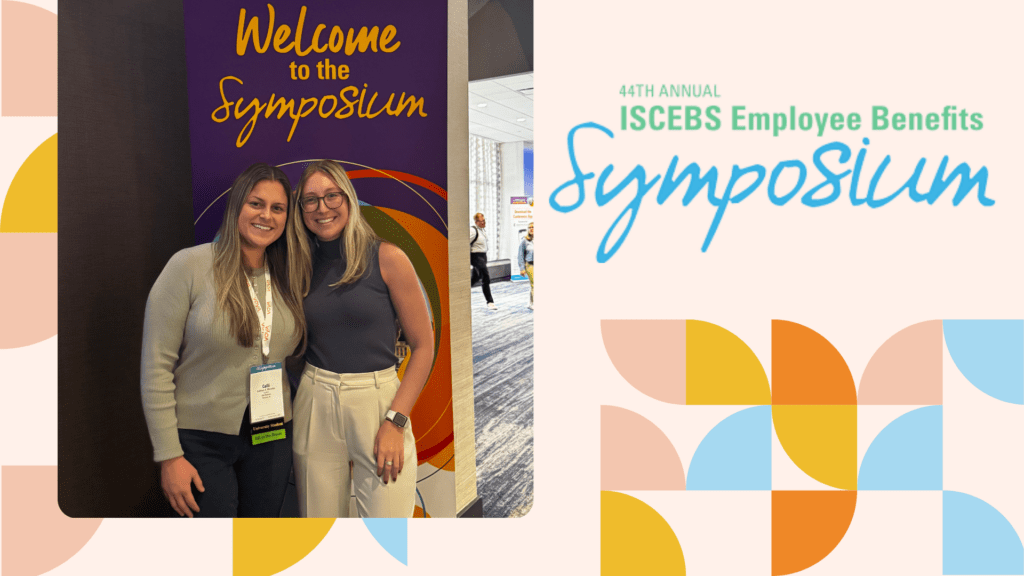
Employee benefits are no longer defined by perks, plans, and policies—they are a strategic lever for advancing HR priorities, attracting and retaining talent, and supporting a diverse, multigenerational workforce. Earlier this month, my classmate Hannah Goldberg and I had the privilege of attending the 44th annual ISCEBS Employee Benefits Symposium, where we explored the opportunities and challenges shaping employee benefits across North America.
With the support of generous scholarships from the International Foundation of Employee Benefit Plans, Hannah and I joined more than 600 stakeholders—including HR leaders, actuaries, attorneys, consultants, vendors, and plan providers—who each brought a unique perspective to the world of employee benefits. The four-day conference, held at the Hyatt Regency in downtown Minneapolis, also marked a return to the Twin Cities for both of us, as we had recently wrapped up our summer internships with UnitedHealth Group in early August.
Leading up to the Symposium, I didn’t know exactly what to expect, but I was eager to immerse myself in the experience. At the Wisconsin School of Business, our first year in the MBA program is largely focused on core business fundamentals, while the second year pivots toward building HR expertise. With much of that specialized coursework still ahead of me, the Symposium provided a fantastic opportunity to hear directly from professionals navigating the evolving world of employee benefits.
The Symposium kicked off on Monday morning with a keynote session led by Chris Mahoney, Senior Partner and Defined Benefit/Defined Contribution Leader at Mercer. Her presentation, Ripple Effects of Increased Longevity on Benefits and Retirement Strategies, set the tone for the week with a central theme: today’s workforce is multigenerational, and each generation approaches benefits with different priorities and expectations. For example, Millennials and Generation Z often value emerging benefits and paid time off, while Generation X and Baby Boomers tend to emphasize physical health and retirement security. With many employees now outliving their savings by nearly a decade, benefits professionals play a critical role in aligning employees’ health span and wealth span.
As a young professional preparing for a career in strategic human resources, I found this framing especially powerful. It emphasized that benefits strategy—and HR strategy more broadly—must anticipate employees’ evolving needs across all stages of life. Ultimately, HR is about serving people. When employees join an organization, I believe we take on a responsibility to support them in ways that promote their lifelong success and well-being. Mahoney closed her session with a question that captured this responsibility and stayed with me throughout the week: Do my benefits open or close doors for all generations in my workforce?
While the keynote session highlighted the differences across generations, another session focused on what unites them: a shared value for flexibility in benefits. In Transforming Total Rewards with Employee Choice, Katie Hansen from WTW and Emily Maher from Land O’Lakes shared how this value is being brought to the forefront at the Minnesota-based agricultural company. Relying on external research and internal employee surveys, Land O’Lakes adopted a cost-neutral, phased approach to redesigning its benefits. The first phase prioritized financial wellness, giving each employee $500 in seed money to allocate towards one of three options: an Emergency Account, a Family Needs/Lifestyle Account, or a Health Savings Account (HSA). Their goal was simple: empower employees to choose the option that best supports their individual needs.
I was impressed by Land O’Lakes’ creativity in incorporating flexibility into their benefits plan. What stood out most was the unexpected outcome: while 75% of employees took advantage of the offering, 25% declined the $500 seed money. This serves as a powerful reminder that even the most innovative benefits lose impact if employees are not fully engaged in their total rewards package—or if they don’t clearly understand how to maximize the value available to them. For HR professionals, this underscores a critical responsibility: not only designing thoughtful, flexible benefits but also ensuring employees are educated and motivated to use them in meaningful ways.
Building on these broader conversations, I was intentional in choosing sessions that aligned with my interest in healthcare. One of the most impactful sessions, The Hidden Costs of Overlooking Women’s Healthcare, was led by Angela Johnson, CEO and co-founder of sanoLiving. During her presentation, she shared the biological reasons behind disengagement and burnout among working women ages 45-54, who also happen to be the fastest growing working segment across North America. The session was inspiring as it called benefits professionals to action: women need to be supported via self-guided tools, health coaching, and clinical care. Just as generational differences shape employee priorities, so do factors like gender and health needs. The challenge—and the opportunity—for HR is to ensure benefits meet people where they are and support their well-being.
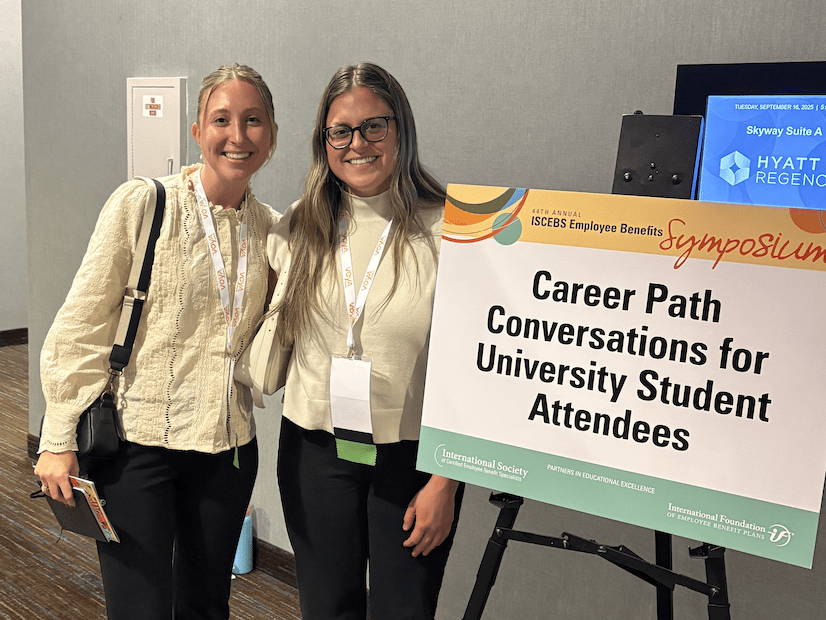
Other highlights of my week in Minneapolis include attending a career exploration session with benefits professionals and grabbing dinner at one of our favorite spots—Gai Noi—with a former UnitedHealth Group colleague. Beyond the sessions and networking, this experience gave me the chance to reflect on the type of HR leader I aspire to be—one who advocates for benefits strategies that are innovative, inclusive, and people-centered.
I am especially grateful to Sandy Tellefson, the International Society of Certified Employee Benefits Specialists, and the International Foundation of Employee Benefit Plans for welcoming us into their benefits community and investing in the next generation of HR professionals. And to my conference buddy, Hannah—thank you for making the week both insightful and fun. Attending the ISCEBS Employee Benefits Symposium not only deepened my appreciation for the complexity of employee benefits, but it also reinforced my interest in the field of Total Rewards. I’m excited to bring this perspective into my second year of the MBA program—and to see where this path in HR may lead me.