September 26, 2025 – Madison, WI
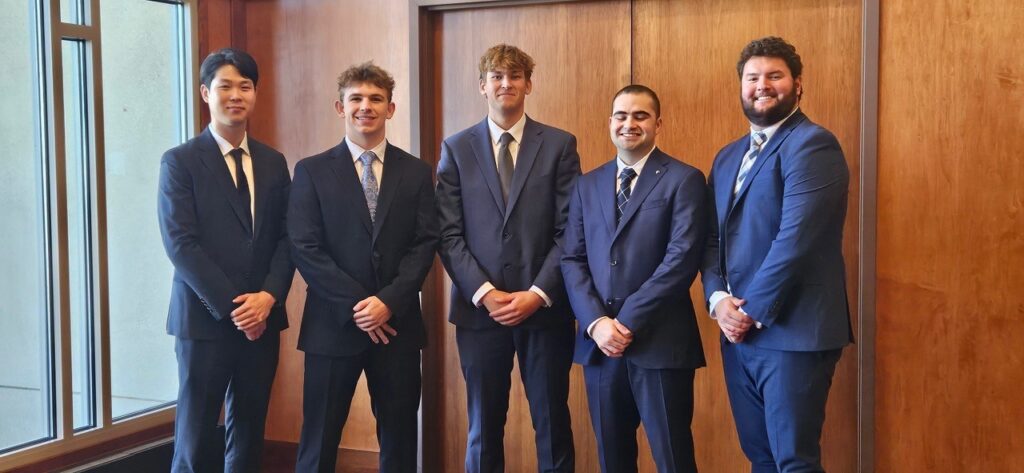
A few weeks ago, two teams of graduate Real Estate students in the Applied Real Estate Investment Track (AREIT) at UW – Madison hosted their Fall Board Meeting during a two-hour session on the UW-Madison campus. Students in the AREIT track direct the investment of nearly $2 million into Real Estate Investment Trusts (REITs), and student investment decisions are overseen by a board consisting of UW Alumni with decades of experience in Real Estate investment management. Prior to the board meeting and presentations, the teams meet frequently with Tim Pire, AREIT Program Advisor, who spent 24 years as Managing Director and Portfolio Manager for Heitman’s public real estate securities group.
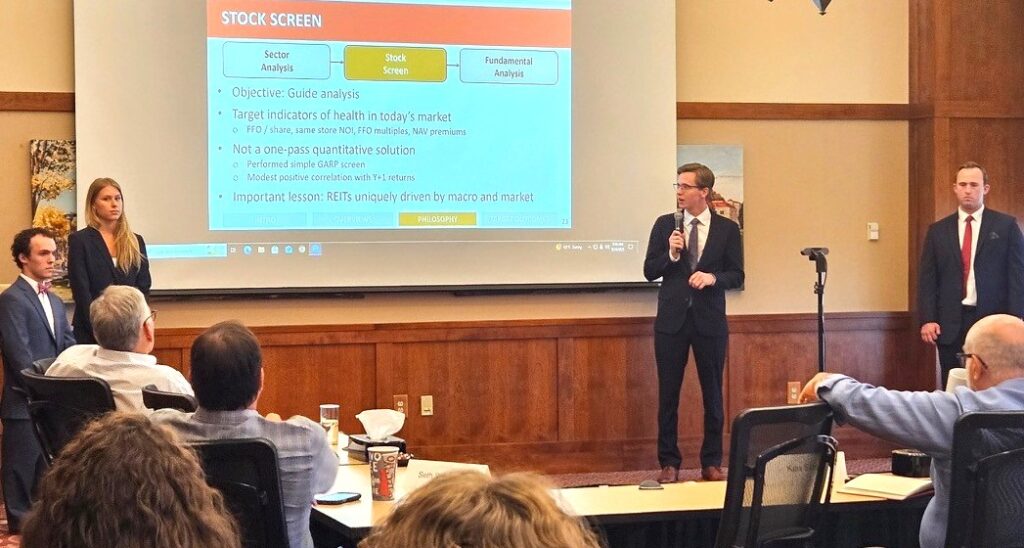
This was the first of three board meetings that will take place this academic year. During the meeting, each student-led team presented their investment thesis to the board. This thesis included their process for evaluating individual REITs, economic forecasts, risk factors, market opportunities, and overall investment goals. The board then asked questions to dig deeper into the team’s work and provided feedback to the team, drawing on their own experience, perceptions of market factors, and knowledge of the underlying asset types.
Teams Agree on a Forecast of Steady Growth
Both the Red Team and the White Team began with a look at the current state of the broader economy and seemed to agree that while booming expansion seems unlikely, there are indicators pointing to steady growth over the coming year. The White Team touched on a few of their observations from the data, including that Capital Expenditures appear to currently be driving GDP growth, that Cap Rates seem stable and are unlikely to compress in the near term, that transaction volumes are ticking up again, and that REITs are currently trading at relatively fair values based on their analysis. The Red team echoed this sentiment of steady growth in their presentation, and noted that while we’ve seen some rate cuts, the Federal funds rate remains high compared to pre-pandemic levels.
Same Goal, Different Strategies
During their presentations, both teams presented the same goal: to outperform the MSCI US REIT Index (RMZ) by 200 basis points. Their strategies, however, differed. The White Team presented a plan to allocate their funds based on weighting different sectors by their perceived strength or weakness, using a matrix they developed to evaluate each sector. For example, their analysis concluded that Data Centers and similar Industrial are poised to continue their growth trajectory and should therefore be overweight, while Lodging and Hospitality appeared to be slumping and should therefore be underweight.
For its part, the Red Team is planning a sector analysis based on macro trends and subsequent sector weighting as well, but prescribed a more stock-oriented approach with analysis into which REIT stocks are likely to have the most growth potential, then reviewing nominal and implied caps to determine whether and how much growth is already priced in.
The Board Provides Feedback
Following each team’s individual presentations, the members of the Board asked questions and provided feedback. Some of the feedback included the critiquing the strategies for being too in line with the consensus view on the market, with at least one board member noting that while it is a reasonable philosophy and outlook, it would be difficult to generate a 200 basis point return over the RMZ with such a conservative approach. There was also a desire on the Board’s part to see a comparison of REITs with the broader equity market to understand the risk premium built into REITs right now, and to account for the possibility that some capital may flow out of an overvalued equity market and into REITs. The Board members also offered a suggestion that the teams factor political risk into their risk control strategies, and that the teams should consider how political uncertainty might have downstream effects.
Next Steps
Since the board meeting, the teams have regrouped and are preparing to send a letter to the Board members outlining how they plan to incorporate Board feedback into their strategies. They will continue to meet in their teams and with Tim, and are preparing to attend a REIT focused conference later this Fall.
The Winter Board Meeting will take place in January, and we’ll have more updates then!