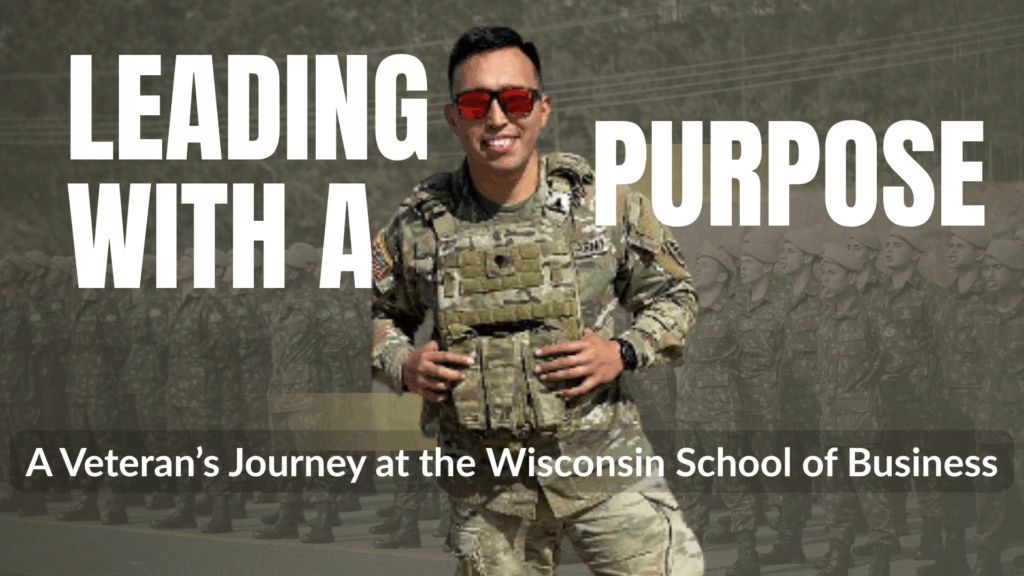
Transitioning from military service to civilian life was not just about changing uniforms, it was about redefining my purpose. For me, that journey began in the U.S. Army, where I served as an HR Manager. My role wasn’t just administrative; it was deeply personal. I was responsible for the well-being, career development, and morale of soldiers who depended on clarity, consistency, and compassion.
That meant being a trusted resource during some of the most challenging moments in their careers. I advocated for their needs during leadership meetings, ensured their voices were heard, and worked behind the scenes to remove barriers that affected their mission readiness. Whether I was helping my team, developing leadership plans, coordinating promotions, or advising commanders on internal team movements, I learned early that HR is about people and people are the mission.
In the military, HR isn’t a back-office function. It’s embedded in every operation, every deployment, and every decision that affects the lives of service members. Assisting with deployments wasn’t just a theoretical exercise, it was a responsibility that demanded discretion and strategic thinking. I had to ensure all soldiers were accounted for, benefits were processed, and every promotion was earned and documented.
One of the most developmental chapters of my military career was serving with the 7th Special Forces Group (Airborne). Working in a special operations environment taught me how to operate under pressure, lead with clarity, and adapt quickly to changing circumstances. In this setting, HR wasn’t just about paperwork, it was about mission readiness. I led an HR team that ensured staffing coordination, retirement benefits, awards, and other additional services were delivered with the least number of errors. The expectations were high for HR professionals in this environment because soldiers always looked up to us for answers or directions. I learned to lead with empathy while maintaining strict standards, a balance that continues to shape how I approach business strategy today.
Being airborne added another layer to my development. Jumping out of planes taught me more than courage, it taught me attention to detail in an unforgiving environment. In airborne operations, precision isn’t optional. Every checklist, every piece of gear, every movement matters. That mindset of discipline to prepare thoroughly has stayed with me and continues to influence how I approach workforce planning, compliance, and organizational development.
While still in uniform, I received my acceptance to the University of Wisconsin-Madison. That moment was a turning point; it gave me a vision of what life could be like beyond the military. It motivated me to finish strong, leave the service with purpose, and prepare for the next chapter with discipline and optimism. I knew I wanted to continue working in HR, but I also knew I needed to expand my toolkit. That’s what led me to the Strategic Human Resources MBA specialization at the Wisconsin School of Business.
Today, I’m pursuing my MBA with a focus in Strategic Human Resources. My goal is to blend the emotional intelligence I developed in the military with the analytical rigor required in business. I believe that veterans bring a unique lens to HR, one grounded in service, structure, and resilience. We understand the importance of mission clarity, team cohesion, and accountability. We know how to lead under pressure, communicate across diverse teams, and adapt to complex environments. These are the very skills that help veterans thrive in various organizations.
The Wisconsin School of Business has given me the platform to refine those skills, connect with mentors, and contribute to the broader HR profession. Through the SHR Center, I am exploring workforce strategy, talent analytics, and leadership development in ways that build on my military foundation while preparing me to create a leadership impact. It’s not just about earning a degree; it’s about building a career that aligns with my values and vision.
As a Business Badger, I’ve found community and inspiration through the Veterans Club, which has been essential in helping me transition into the academic mindset by connecting me with others who have served. Through these connections, I’ve been able to share my own experiences, listen to stories of other veterans, and rediscover a sense of brotherhood I deeply value. I also attended the Veteran’s conference in Atlanta, where I had the opportunity to engage with veterans from other universities and hear directly from companies that place trust and care in hiring veterans. Listening to the success stories of other veterans who have built meaningful careers in business was both inspiring and motivating. This reinforced my belief that the skills I developed in the service can translate into real impact in the corporate world.
As I continue this journey, I’m committed to helping organizations build stronger, more human-centered workplaces. That means using data to inform decisions, empathy to guide leadership, and strategy to drive results. It means seeing HR not as a support function, but as a strategic partner. I carry forward the discipline and precision I developed in the military, not just as memories, but as tools for meaningful impact in the business world.