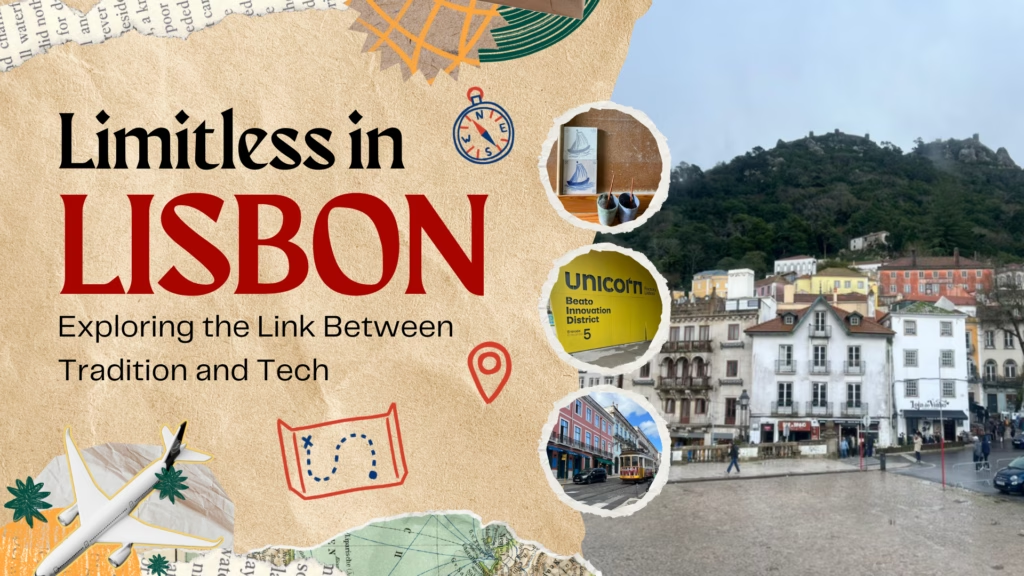

Over winter break, I had the opportunity to travel to Lisbon, Portugal with Department of Management and Human Resources professor Min Li and Master’s and MBA candidates from the Wisconsin School of Business (WSB) as part of a one-credit course, International Business 765, Global Learning Experience. The trip encouraged us to think about business on an international scale, consider cultural differences and how they inform professional settings, and build connections across industries. Lisbon enjoys many advantages in the research and development space across all industries, thanks to its leading universities and competitive talent pool. Our first visit was to Casa do Impacto, a self-proclaimed “incubator” for startups addressing social issues through innovation. I was surprised to learn the company fills a critical role in bridging the gap between the public and the government—in fact, Caso do Impacto supplements Portugal’s social security agency and has far-reaching impact in Lisbon. This concept of companies identifying societal needs and taking action to solve these challenges proved to be a consistent theme throughout the trip, and I noticed the Portuguese carried a sense of stewardship for their communities, even in their corporate responsibilities. At Coca-Cola Europacific Partners, for example, we saw firsthand how a brand powerhouse can enable social change through its platform and investment in the local population. Similarly, at The Navigator Company, we learned how the company’s ownership of its entire pulp and paper supply chain allows the firm to cut costs and maintain its competitive advantage as the leading European manufacturer of sustainably sourced paper products.
In addition to maintaining a social consciousness, Lisbon companies must straddle the divide between the old and the new. Traditional industries, including wine-making and tile production, are fundamental sectors, necessary for promoting tourism for the region. São Simão e Faianças Vila Fresca is the only tile producer in the region whose business model still follows the ancient process of cutting, drying, kilning, and painting by hand, and the company has gained notoriety for its adherence to historic methods. Similarly, Bacalhôa Winery in Azeitão continues to hand-pick grapes and age their wines according to traditional practices, though they have begun to incorporate specific machinery in the grape stomping process to increase efficiency. These types of companies are juxtaposed by the city’s emerging startup culture. Towards the end of our trip, we visited the Unicorn Factory’s AI lab. This company is one of several entities in Lisbon receiving recognition by the government for its commitment to positioning the city as the foremost European innovation hub, and it supports startups by providing financial, educational, and business development resources. We heard from BloodFlow, a startup seeking to expedite analysis of blood test results for health care providers using an AI model, and I observed how the
firm seamlessly leveraged new technology to improve longstanding processes in the Portuguese healthcare system. Overall, companies in Lisbon are highly attentive to tradition and seek to remain competitive by creatively employing modern technology to progress in fields, such as biotech, AI, and sustainability.
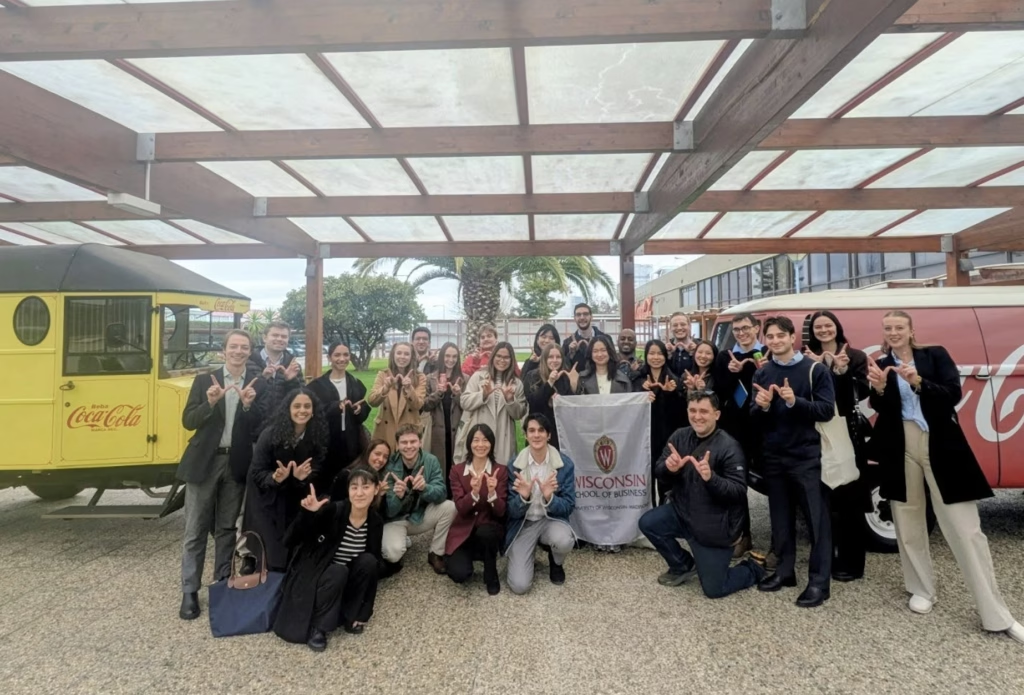
Our trip would not have been complete without a human resources-oriented company visit to Pur’ple, a management consulting firm. Upon arrival, we were presented with a business problem and split into teams for a mini case competition. I was able to apply concepts learned in my strategic HR class in the fall, as well as practice my presentation skills in front of a panel of judges from the company. Each team received personalized feedback, and it was a great opportunity to learn subtle differences in management preferences between the U.S. and Portugal.
In addition to company visits, we were given time to explore the various neighborhoods in Lisbon, try the local fare, and explore nearby towns, such as the fishing town of Setúbal and Cascais, a seaside vacation town. Our itinerary even included a day trip to Sintra, where we got to tour several castles, including Quinta da Regaleira, the National Palace of Pena, and the Moorish Castle. We ended our time in Lisbon with a traditional Fado show, where live musicians and singers performed the melancholic music between set dinner courses. I thoroughly enjoyed this study abroad experience and appreciated the opportunity to build my network with faculty and WSB students from other programs in a unique environment. Perhaps more important, I now have a greater understanding of business from an international perspective, and I hope to refer back to my observations in Portugal in the future when I work with international partners or clients.