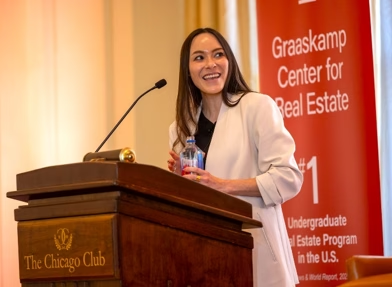
At the Graaskamp Center’s Spring Board Conference on April 17, Emi Adachi, Managing Director and Co-Head of Global Investment Research at Heitman, delivered a clear, data-driven outlook on today’s commercial real estate (CRE) landscape — highlighting where capital is flowing and why selectivity matters more than ever.
Adachi began with the macro picture. While U.S. GDP growth remains steady, job creation has slowed sharply — from 380,000 monthly gains in 2022 to about 10,000 in 2025. Despite geopolitical uncertainty, she emphasized that the U.S. entered this period from a position of strength: capital markets remain open, and transaction volumes are rising, though still below 2021 highs.
On valuations, CRE prices sit roughly 16% below their peak, according to the Green Street Property Price Index—a correction similar in scale to the Global Financial Crisis. Adachi struck a cautiously optimistic tone, noting that historically, downturns have often been followed by strong performance rebounds. A notable divergence: while most global central banks are expected to raise rates, U.S. markets are signaling potential rate cuts.
Sector performance tells a nuanced story. Medical office and retail are leading, while traditional office and life sciences lag. Industrial, senior housing, and multifamily present opportunities—but outcomes vary widely by market. For example, apartment rents are declining in Sunbelt cities like Austin (-7.8%) and Denver (-7.5%), while Chicago (3.5%) and San Francisco (7.3%) show resilience. Industrial trends echo this divide, with Midwest markets outperforming coastal hubs. Niche industrial segments, such as outdoor storage, cold storage, and shallow-bay, stand out for their low vacancies and strong fundamentals.
Adachi closed by pointing to the rapid rise of alternative sectors. Institutional allocations have nearly tripled since 2013, with alternatives outperforming traditional property types by 230 basis points annually over the past decade. Looking ahead, she identified four key drivers: affordability reshaping demand, demographic tailwinds from an aging population, overlooked opportunities in underperforming sectors, and the expanding (and increasingly complex) investment universe.
Key Takeaways
- A Market in Recovery, Not Yet Recovered: Values remain ~16% below peak, but limited new construction—starts down 46% from cyclical highs—sets up a favorable backdrop for patient capital.
- Location and Subtype Selection Are Everything: Broad sector labels mask wide performance gaps; Midwest and Northeast markets are significantly outpacing Sunbelt and West Coast peers.
- Alternatives Are Now Mainstream: Institutional allocations have surged, and return data backs it up—self-storage, medical office, and senior housing have outpaced traditional sectors over both five- and ten-year horizons.