When the first COVID-19 vaccines rolled out, I kept hearing two things. First, the vaccine was highly effective in clinical trials. Second, we should continue social distancing, because we didn’t know if vaccinated people nonetheless infect other people. Understanding the real world direct effects was important for me—could I socialize? Could my kids return to school—but also for business and policymakers thinking not only about reopening and return-to-office, but also about vaccine policies like coverage, subsidies, and mandates.
To learn about real-world effectiveness, I worked with my colleagues Seth Freedman, Kosali Simon, Coady Wing (all of Indiana University). We set out to answer three questions: Outside of a trial, what is the direct protection? Does it protect family members (the indirect effect)? And how far do those ripples actually travel?
The Challenge of “Real World” Data
Clinical trials are the gold standard for safety, but they have blind spots. They aren’t designed to measure “herd immunity” or indirect effects, and they often use specific populations that don’t reflect the messy reality of a changing virus like the Delta variant.
The hurdle in studying this is “selection bias.” Generally, people who choose to get vaccinated might be more cautious overall—maybe they wear masks more often or avoid crowds. If we just compared vaccinated people to unvaccinated people, we might be measuring their cautiousness, not the vaccine itself.
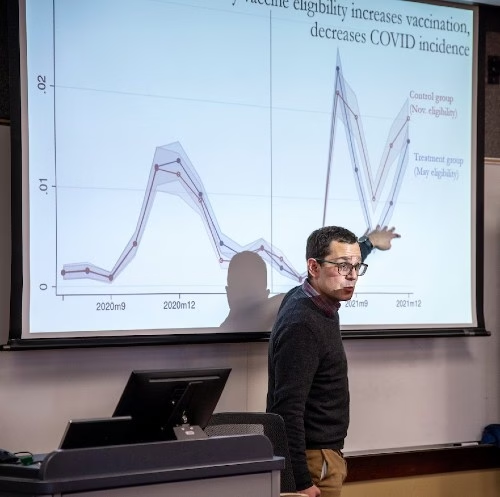
To solve this, we looked at a unique “natural experiment” in Indiana. Because the vaccine rollout was age-based, 12-year-olds became eligible months before 11-year-olds. By comparing these two nearly identical age groups—and their families—we could isolate the vaccine’s impact from other lifestyle choices.
What We Discovered
Our findings, recently published, offer a powerful look at the mechanics of risk:
- Strong Direct Protection: Even during the Delta wave, the vaccine reduced COVID rates by about 80% compared to what they would have been.
- Important indirect effects: This was our most striking find. For every single case of COVID-19 prevented by a child’s vaccination, another half a case or more was prevented among their household members.
- Limited reach: Interestingly, while the protection was strong at home, we did not find significant “indirect effects” at the school level. Having more vaccinated schoolmates didn’t necessarily lower the risk for an individual student in the same way having a vaccinated sibling did, although there is a lot of statistical uncertainty with this finding.
Why This Matters for Insurance and Business Leaders
If you are a benefits manager, a risk officer, or a business owner, these aren’t just academic statistics—they are insights into your organization’s resilience.
- For Employers & Benefits Managers: The “value” of a vaccination program is higher than we previously thought. When an employee or their dependent gets vaccinated, you aren’t just preventing one person from getting sick; you are significantly lowering the risk of a “household cluster” that could lead to extended absenteeism and higher claims costs.
- For the Policy Debate: Our research informs the heated debate over vaccine mandates. We found that indirect effects are real but concentrated. They are most powerful among close contacts (households) rather than broad social circles (schools). This suggests a strong justification for policies that allow private parties—like employers—to set their own requirements based on their specific close-contact environments.
In the world of risk and insurance, we often talk about “mitigation.” Our study proves that vaccination is one of the most effective tools we have, not just for the individual, but for the stability of the family unit and the productivity of the workforce.
___________________
Read more or listen: Dan’s research was the subject of an interview by Wisconsin Public Radio.
Categories: