On paper, product managers oversee strategy, coordinate teams, and bring ideas to life. Their role stretches from big-picture vision to fine-grained execution.
In practice, it’s a high-stakes, high-pressure job. While launching a new product can be thrilling and rewarding, product managers are also the ones under the microscope when things go wrong. Deadlines slip, client expectations spiral, and they’re the first to shoulder the blame.
Peter Commons, a senior lecturer in the Department of Operations and Information Management at the Wisconsin School of Business, perhaps captures the reality more succinctly, and only partly tongue in cheek.
“A lot of times, your challenge as a product manager is to bring the desired impossible down to the practical and impactful as best possible,” says Commons.
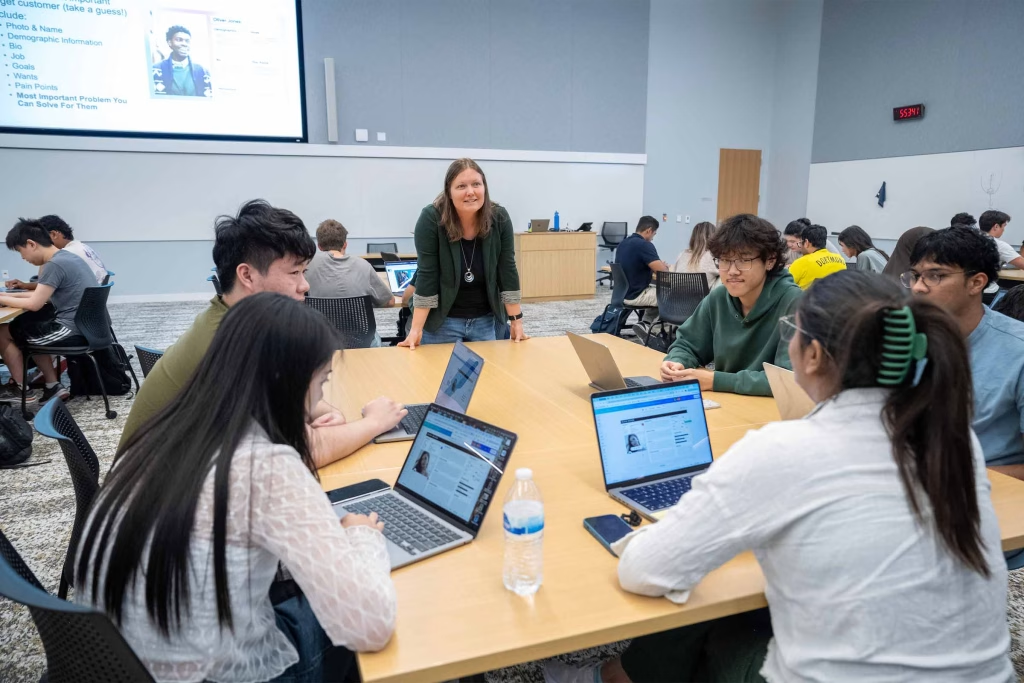
This fall, Wisconsin MBA students in his capstone product management course, Product Management Practicum, are taking on that challenge by teaming up with senior computer science majors from the University of Wisconsin–Madison’s School of Computer, Data and Information Sciences (CDIS) in instructor Amber Field’s Computer Science Capstone class.
The business students act as product managers for the CDIS teams. Together, the students tackle a real-world problem from one of CDIS’ sponsors—industry leaders such as Amazon Shopbop and Capital One—who then work with the teams throughout the semester-long projects. The project is a capstone; both sides receive academic credit for the experience once they successfully complete the final build at the end of the semester.
Field says this elevation to a capstone project grew out of an existing partnership she had with her classes and business students from WSB’s Erdman Center for Operations and Technology Management.
Commons saw an opportunity and wondered: How can we take it to the next level?
“To me, the highlight is that it’s easy for schools to get focused on what their school is and what they do. As we know, in the real world, things are a combination of different skill sets in different areas,” Commons says. “This partnership feels like a really awesome blend of a builder skill—in this case, computer science—and a leadership management skill—in this case, product management—to be able to create an opportunity for those types of folks to work together in a practicum-capstone situation that they normally wouldn’t be able to do.”
Replicating real-world teams
Being able to work in cross-functional teams is a critical, in-demand skill for business and computer science graduates. The capstone’s design gives them that practice, with one WSB student assigned as a product manager to each computer science team of four or five students.
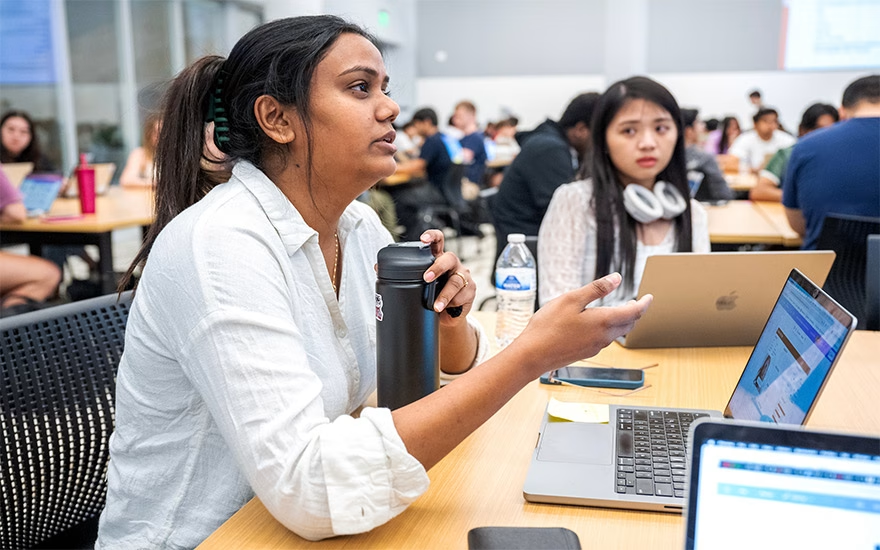
Field says each industry or nonprofit partner submits a brief summarizing the issue the teams hope to solve.
“It’s a paragraph, and it’s pretty nebulous; we do that for a reason,” Field says. “That’s because in the real world, most projects start as a paragraph and then you have to dive in and figure out what the client really wants and ask the right questions. Students get that experience of going from something that just looks kind of ‘out there’ to something that looks like a roadmap they can continue to work on.”
During her class, which MBA students attend, Field walks the teams through the project steps such as deciphering the problem, creating a customer persona of what the typical consumer using this product might look like and what their tastes and preferences might be, and building a product prototype. Teams meet remotely with their assigned industry mentors each week. The mentors typically come to campus midway through the semester when the first prototype is assembled and for the final presentation in December.
Will Morosoff (MBA ’26) and his team are working with logistics company Schneider National on Schneider FreightPower, an app the company created for trucking owner-operators.
“The goal of the project is to optimize the way the FreightPower app conveys information about loads to the users, so that they can book their next load of freight more efficiently,” says Morosoff. “We are exploring a few ways of doing this, but we are hoping to leverage Schneider’s data on the app to show the user the loads they want to book faster, and potentially give them the ability to use more robust search and filtering tools.”
Morosoff will graduate with an MBA in technology strategy and product management. He hopes to work at an innovative company where he can use his experience in an engineering management, product or project management, or supply chain management position. “My background is in biofuels, so I would love to stay within the green energy startup space, but I don’t want to limit myself. Mostly, I just want to grow with a company that lets me leverage my skills and make a big impact.”
Learning by doing
For WSB product managers, Commons holds a concurrent section they attend along with Field’s course. It’s a time to debrief, share ideas and experiences from the week, and receive feedback and guidance on both pitfalls and progress. The students are given reading assignments that generate discussions in class on what they are witnessing in their teams and within the projects.
In addition to building technical knowledge and refining expertise, the course gives students valuable opportunities to strengthen their collaboration skills. Working across disciplines often means encountering disagreements, and this experience helps them practice navigating—and resolving—conflict in real time.
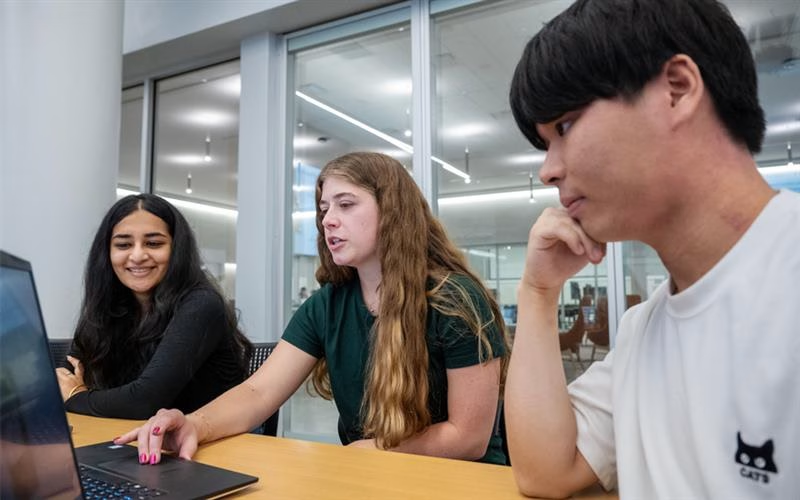
“I would say most teams have some kind of collaboration issues,” says Field. “To me, it’s an awesome experience for the students to have these tough conversations with their co-workers and try to motivate them to get back in the loop. And if that doesn’t work, they have to figure out who to talk to about it: Do you go to Amber? To a TA? It’s a really good experience for them.”
After this year, the partnership will be offered each fall.
“To be able to jump into a real-world situation but within the control and confines of a practicum where you are also the leader is a unique opportunity,” Commons says. “You can’t just call up a company and say, ‘Hey, I have an intern and I’d like them to head up this group.’’’
“Amber created this, and I think we were able to able to leverage all the great stuff that was already in this program to give product management students a slightly more tuned version of it that combines leadership skills and product management seminar,” Commons adds. “We are excited to see it play out.”
Tags: