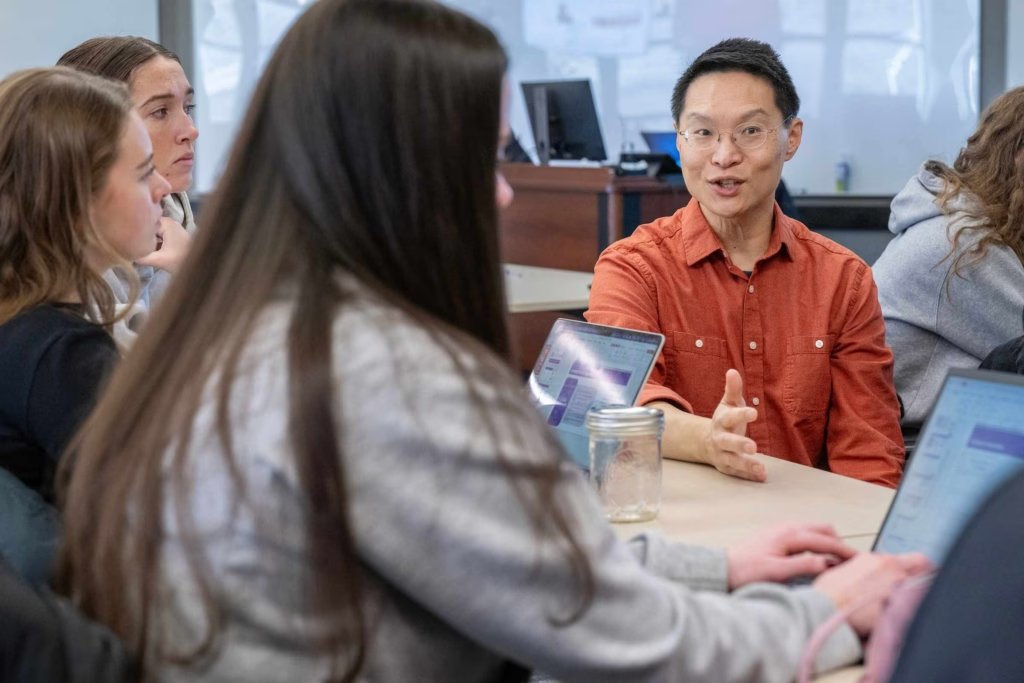
When Wisconsin School of Business lecturer Milt Hwang noticed the growing anxiety on his students’ faces in early 2025—questions about AI, uncertainty about expectations, and a sense of falling behind—he knew he had to act. That realization sparked RequirED Discussions, a weekly LinkedIn livestream series where recent alumni and young professionals take the mic to discuss navigating a business landscape in flux.
Hwang, who joined the Department of Marketing in 2023, just as ChatGPT began disrupting higher education, saw a “convergence of unprecedented change.”
“I was two years into teaching and I’m watching the stress build on students’ faces,” he recalls. “It was this awakening moment.”
With three decades of experience—transitioning from engineering after two decades to technology and marketing—and years as a volunteer for GE’s recruitment team at UW–Madison, he realized he could leverage his passion to create something that would help students meet this moment and fulfill a very real need.
“I’ve never gone wrong by just staying in touch with the people that the technology is actually impacting,” says Hwang. “It also fuels me as a marketer to never forget about the customer.”
Hwang made calls within his network, including lining up former students to appear on the first few episodes, and in September 2025, RequirED Discussions launched as a livestream series on Hwang’s LinkedIn profile.
Unpacking Tech, Week by Week
Now wrapping up its second season, the 30-minute livestream is unscripted and informal. It features a different student or recent alumni guest (Hwang’s current semester students are prohibited from participating due to conflict of interest) each week engaging with Hwang on their personal journey and their views about AI—everything from what they learned in their latest internship to that nagging feeling of being “behind” the technology’s rapid advance.
The show gives students and young professionals the opportunity to talk about what they are experiencing and offer a point of view—things that can sometimes be intimidating to do in larger lectures or discussions.
“Coffee chats are the best way to learn about real world experiences, and Milt brought this directly to us,” says early livestream guest Suji Goetzke (BBA ’25), now based in Athens, Greece, as head of go-to-market for Trellus, an embedded parallel dialer company. “Viewers can feel that they’re a part of the conversation and take away valuable information to apply into their professional lives.”
Any questions Hwang asks are designed to put the guests “into an action mode,” he says. “The first questions I ask them are what guidance would you give yourself from two years ago? And what more can we do to help them?”
Recent guest Tyler Voss (BS ’26) shared that he’d tell the Tyler of two years ago to “do more of the things that make you uncomfortable,” and not to fear code.
Voss, a School of Human Ecology senior majoring in consumer behavior and marketplace studies and working for Madison-based marketing firm Driven Marketing Solutions, didn’t initially see himself as a tech person but overcame that as he progressed.
“Don’t just look for larger companies that have something more established or secure,” Voss advised fellow students during his appearance. “Be open to looking at smaller companies that you can have more impact in.” During a previous internship, he was able to implement HubSpot, a customer relationship management platform.
“These were candid conversations that I haven’t been able to have until this point, and I left feeling really grateful for them”
–Lily Macdonald (BBA ’26)
That experience happened, Voss told the audience, because he was at a smaller company. “I could use the skills I built in academia to apply in a real-world setting. Right now, what I’m looking for in my career is to find those opportunities where I can apply things on my own, see if they work, and not be pigeonholed, so to speak, into one task. Always try to take advantage of AI in that it can help you learn and have a broader knowledge base on things.”
Hwang’s show “is a great resource for students to get insight,” says Voss.
“Our conversation about the current state of AI and the importance of agency, I believe, are some of the most important topics that young people need to hear about. We touched on both in great detail and I believe listeners would get immediate steps to better their future.”
The name itself, RequirED Discussions, was designed with intentionality as well. The students are tasked with so many requirements, says Hwang, that may or may not still be as important or as relevant.
“The word ‘discussion’ is really important to me in terms of pros and cons, and just having that open, safe environment,” Hwang says. “I truly view it as a privilege that students are willing to participate because they are not required to.”
Student Lily Macdonald’s (BBA ’26) experience is a testament to Hwang’s approach.
“What I appreciated most was that Milt really broke down the student-teacher barrier,” she says. “We sat down for a longer conversation and got to talk about things like the job market, pedagogy, AI, and identity in the workplace. These were candid conversations that I haven’t been able to have until this point, and I left feeling really grateful for them.”
Building a Social Network
With nearly 30 episodes in the books, Hwang is reconnecting with former guests to craft the show’s future.
He hopes to poll the previous guests for their ideas, possibly creating a private LinkedIn group for alumni to share, network, and provide guidance to each other as they take on new jobs and new roles. Ultimately, Hwang envisions it as a social network, connecting individuals and “helping the next person coming down the line that doesn’t have that experience yet,” he says.
“It’s really the breaking down of barriers that I’m striving for,” says Hwang. “Paying it forward, one person at a time, has always been important and impactful to me.”