When MBA student David Hadar (MBA ’26) and his project partner Kyuha Shim (MBA ’26) first encountered EverOS, an innovative startup security system, they saw more than code. Their goal? Develop a go-to-market strategy for the venture’s creator, Bryson Turner (BS ’27), a student in the School of Computer, Data and Information Sciences (CDIS).
“Security is a very classified space, so it’s hard to make connections and work with companies to test products,” Hadar says. “Bryson had a very polished product, but he was limited in the ways he could test the product because security teams on campus are very cautious about allowing an outside entity to hook into their system. Kyuha and I had to be creative in how we went about guiding him and making recommendations because neither of us comes from a security background.”
A Multi-Disciplinary Approach
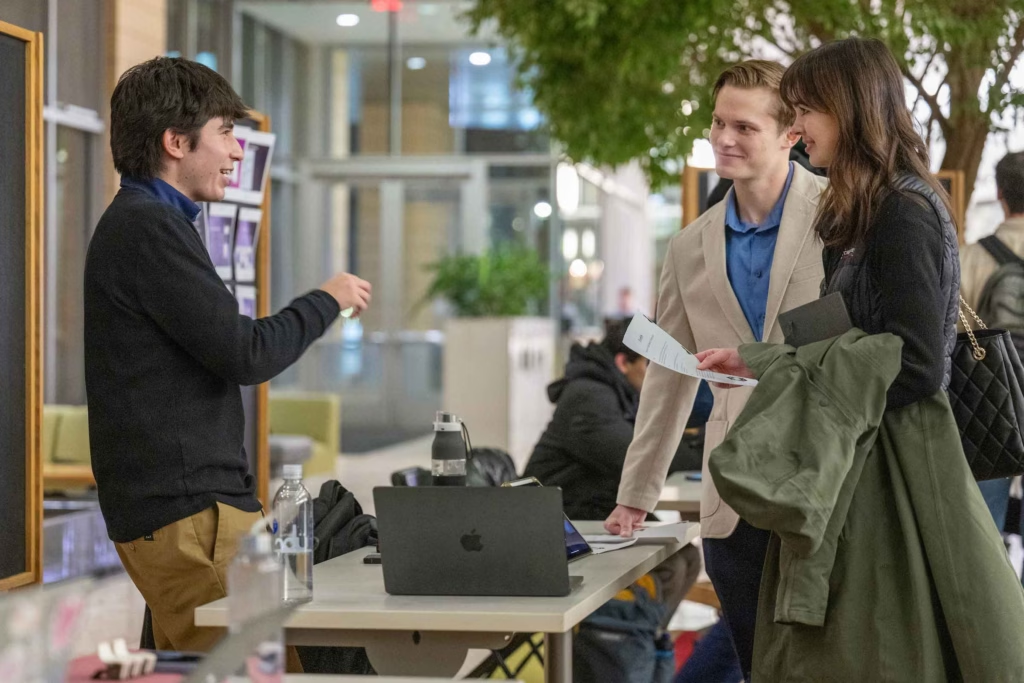
The EverOS collaboration was one of several venture build projects showcased at the UW Tech Exploration Lab’s recent Demo Night. Held at the Wisconsin Institute for Discovery, the event marked the end of a semester-long partnership pairing Wisconsin MBA students with students from CDIS and engineering disciplines.
The MBA students participated through Professor Page Moreau’s new product development class in conjunction with UW Tech Exploration Lab Executive Director Sandra Bradley. The program’s structure is intentional: tech students provide the foundational venture idea, while MBA students provide the marketing strategy and value proposition—effectively closing the gap between raw idea and market feasibility.
Throughout the fall, 15 teams—composed of two MBA students per team and tech student teams—worked to transform concepts into finished prototypes. Moreau, the John R. Nevin Chair in Marketing, advised the business side, requiring students to conduct real-world research with the stakeholders.
“I teach the new product development class with a focus on the process of understanding consumers’ needs and creating new concepts designed to address those needs. A key part of this process is learning the types of questions to ask along the way to really understand the consumer and their motivations, whether it’s business-to-business, or B2C [business-to-consumer],” says Moreau. “The customer needs to really be at the forefront of the value proposition.”
Teams also benefited from the mentorship of the program’s alumni partners—industry professionals who volunteered their time to provide students with expert guidance and project insights.
“Venture Build is where technical depth meets market discipline,” Bradley says. “When MBA students and technical builders collaborate, the conversation shifts from ‘Can we build this?’ to ‘Should we build this—and for whom?’ That dynamic dramatically increases the odds that strong technology becomes a fundable, scalable venture.”
Unique Ventures, Real Solutions
Beyond security, the venture build projects represented a wide range of industries including:
- proTecht: Cloud cybersecurity system streamlining compliance workflows for audit firms
- Lyntra: An AI-powered startup focused on the education sector
- SeaPay: A blockchain platform created by tech students Colin Yamada and Fuchun Hsieh alongside MBA students Naomi Bell (MBA ’26) and Zachary Riddle (MBA ’26). SeaPay uses cryptocurrencies like Bitcoin to allow consumers to book hotel reservations directly, bypassing third-party intermediaries and giving hotels end-to-end control over the customer experience.
Strategic Roadmap for Success
For EverOS, Hadar and Shim’s final recommendations moved beyond theory into diverse applications, including crowd security for concerts, situational awareness tools for campus police, and AI-driven command centers for disaster response. By expanding the use cases based on market insights, they strengthened the product’s go-to-market strategy and clarified where early traction was most viable.
For Hadar, the Venture Build partnership was about more than a grade. “Delivering a go-to-market and pricing strategy to Bryson was rewarding because it validated that his idea has real potential and that it is a scalable entity,” he says. “Throughout the semester, Kyuha and I could see the enthusiasm in Bryson’s eyes whenever he showed us developments he was making on the technological side. To bring that all together into a comprehensive plan and see his excitement from it brought me a lot of joy.”