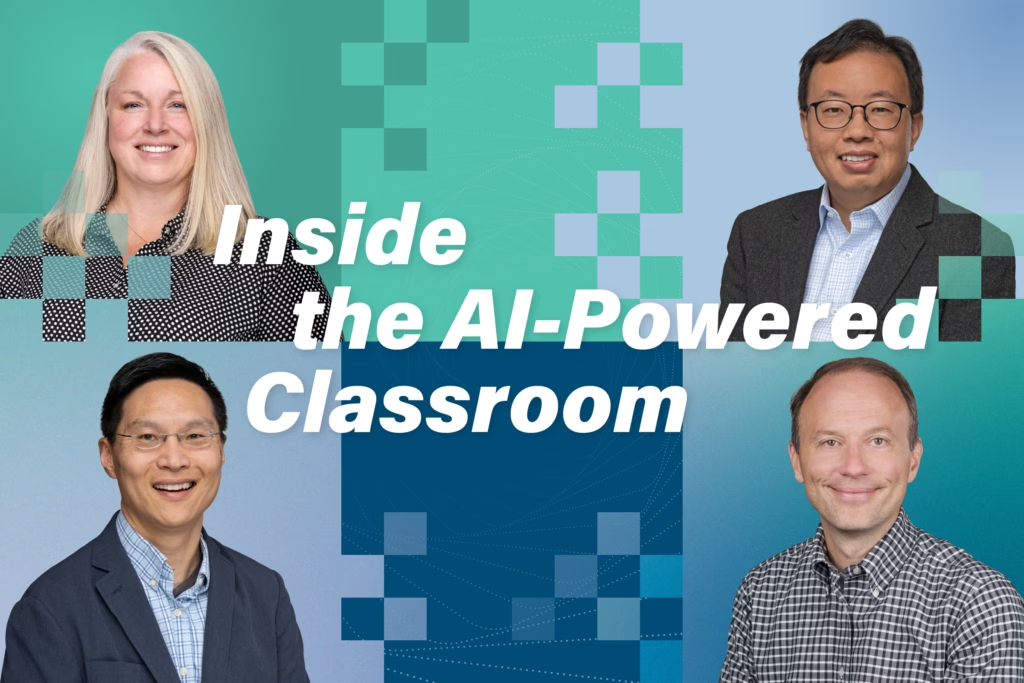
Preparing the next generation of Business Badgers means giving them the tools, knowledge, and skills they need to navigate and lead the AI era.
“AI is rapidly changing the world,” says Joann Peck, the Irwin Maier Distinguished Chair in Business and Associate Dean for Learning Success and Assessment at the Wisconsin School of Business. “As educators, it is our responsibility to help prepare students for these changes by giving them the skills they need to be trusted leaders in business. WSB has innovative instructors incorporating AI into their courses and preparing students to lead in these turbulent, but exciting times.”
Four WSB instructors share how they’re integrating AI learning into their classrooms:
Boosting Confidence Through Realistic Practice
Wendy Fritz, Executive Director of Teaching, Learning, and Technology
Intentionality, transparency, and accountability shape Wendy Fritz’s approach to AI in the classroom. “My guiding philosophy is that AI should expand, not replace, student thinking. AI is most valuable when it is used to deepen sensemaking, improve decision quality, and make reasoning visible rather than to accelerate task completion.”
Fritz teaches Organizational Behavior for undergraduates, integrating AI as a learning tool rather than course content. AI application is “intentionally structured to surface student reasoning, not obscure it,” she says, effectively making AI a “catalyst for deeper learning, metacognition, and decision quality rather than as a productivity shortcut.”
The course also uses AI to help students practice thinking on their feet in tense situations, including hiring or dismissing an AI employee or negotiating with AI management.
Fritz’s assignments frequently require students to connect the dots between activity and learning outcomes, document AI interaction, pinpoint where AI was in error, and justify final decisions.
“This approach changes the learning experience by shifting the focus from producing answers to demonstrating judgment,” she says. “AI allows students to test ideas, explore alternative perspectives, and practice decision-making in realistic but low-risk scenarios, while assessment remains centered on reasoning, reflection, and the quality of sensemaking rather than the output itself. Ultimately, the goal is the development of sound judgment under conditions of uncertainty.”
Building AI Fluency and Course Mastery
Milt Hwang, Lecturer, Marketing
After 20 years with GE, Milt Hwang began teaching at WSB in 2023. “I am very up-front with my students that this was also when AI went mainstream on campus,” he says. “Therefore, we are all learning it in real time, which is why being a ‘continuous learner’ in marketing is so critical!”
Hwang teaches Digital Marketing and Marketing Strategy in the undergraduate program. The digital marketing course is a natural fit for AI inclusion, he says, because the normal customer channels of content creating, editing, and publishing have been completely disrupted by the technology. For example, while search engine optimization (SEO) remains vital, the rise of AI tools such as ChatGPT has introduced generative engine optimization (GEO) as a crucial counterpart. In the Marketing Strategy course, a major theme is “responsible AI usage,” with a focus on critical thinking. An example exercise has been asking AI to complete a first-pass SWOT (Strengths, Weaknesses, Opportunities, Threats) analysis on a company, but then critiquing that output for what it missed—or where it didn’t provide any deeper insights—based on their own reading and experiences.
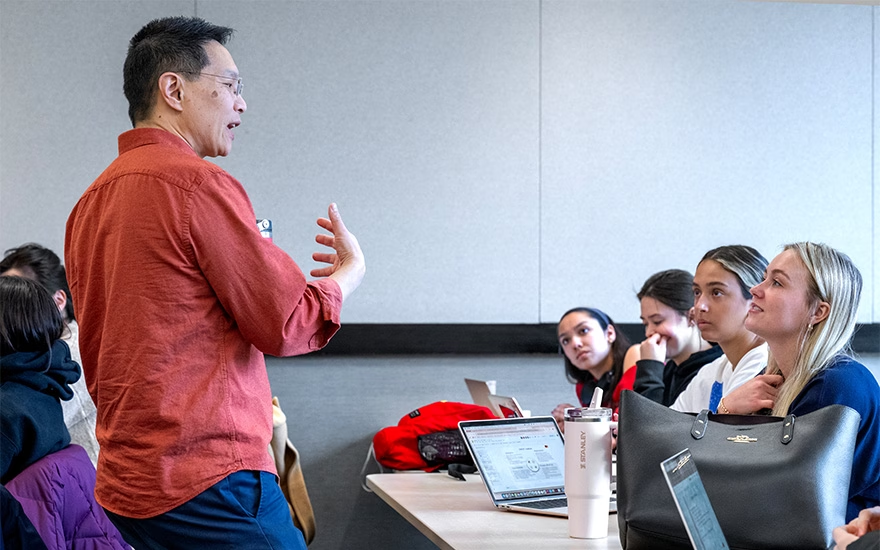
What is one thing Hwang wishes more people understood about AI? Large language models (LLMs), he says. “More people need to get an overview of the basics of how the LLM models are trained. I have covered an overview of it as a sophisticated prediction engine that helps people understand why it’s so powerful, but also a black box we’re all still learning.”
Relevant, Rich Case Studies in Minutes
Min-Seok Pang, Karen A. and William S. Monfre Professor in Business, Professor of Information Systems and Analytics
Dr. Elena Reyes, vice president of innovation with high-precision semiconductor tool manufacturer NovaTech, has a big presentation two hours from now and an even bigger decision to make: Should the company adopt public generative AI services such as ChatGPT, Copilot, and Gemini? Or should NovaTech take the plunge and develop its own proprietary generative AI model to the tune of millions of dollars?
Such is just one of the many teachable moments for students in Min-Seok Pang’s executive MBA (EMBA) course, Competing on Analytics. The course uses a case study Pang created himself with ChatGPT, the first time AI has been used for the course. He perused Harvard Business School case studies—the gold standard staple for instructors needing real-world style case studies for their classes—but couldn’t find what he needed.
“This case gives a lot of flexibility with respect to specific topics, focus, industry, length, and gender of main characters,” says Pang. “It also allowed me to demonstrate to EMBA students what generative AI can do.” During the first session with students, Pang held off telling the class it was created by ChatGPT until the end of the hour. “It was a fun surprise for them,” he says. “I asked them if they were bothered by the professor using ChatGPT to generate a case and they told me they were not.”
Always-On Personalized Learning
Chair, Management and Human Resources; Teaching Faculty III, Bolz Center for Arts Administration, Management and Human Resources, Initiative for Studies in Transformational Entrepreneurship (INSITE)
“We need to constantly consider how to present AI as a tool to augment student learning—not replace it,” says John Surdyk, one of the first University of Wisconsin–Madison AI Fellowship recipients. “It can feel threatening, but AI is in essence only a tool for making sense of information. It doesn’t have the perspective, intention, and judgement that people do.”
Surdyk integrated AI into the Management and Human Resources course Introduction to Entrepreneurial Management, including encouraging students to use AI in the class T-shirt design projects that encompassed customer discovery, artwork ideation, and digital marketing campaign assets. He also provided Google NotebookLM, a research and productivity tool, to help with readings and exam preparation. Surdyk is also experimenting with AI in case studies for the Entrepreneurship in Arts and Cultural Organizations course, and with using tools like Elicit, a scientific research AI, in his Community Consulting class.
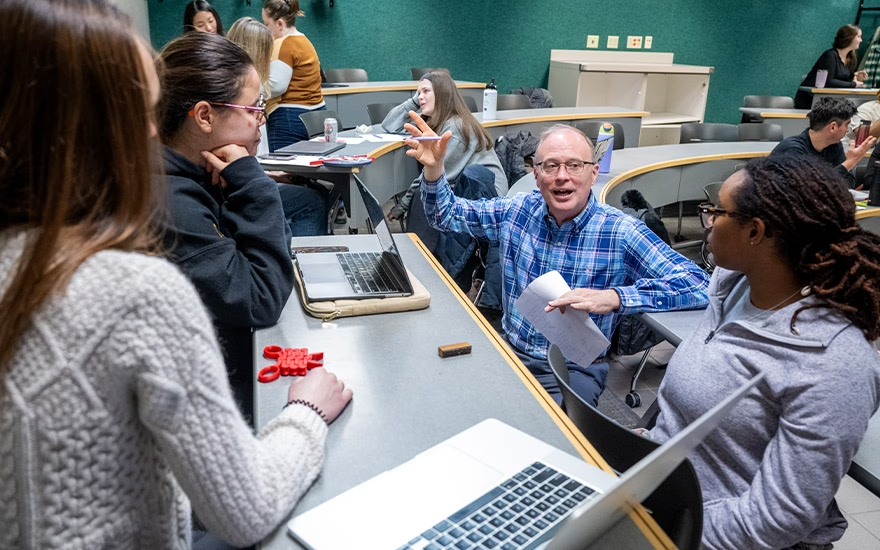
Surdyk has been inspired by the community of practice available at WSB, citing the AI Hub for Business, the student organization AI Excellence, and the school’s Teaching and Learning team events as “tremendous resources.” Integrating AI into course design and delivery has changed his work “in every way,” says Surdyk, and aligns with his deep expertise in entrepreneurship. “I am weaving AI into all my classes. Students should expect to be encouraged to use AI, as I model how to integrate these services into workflows that mimic what entrepreneurs, leaders, and consultants use to support their efforts.”
Learn more about AI at WSB through the AI Hub for Business.