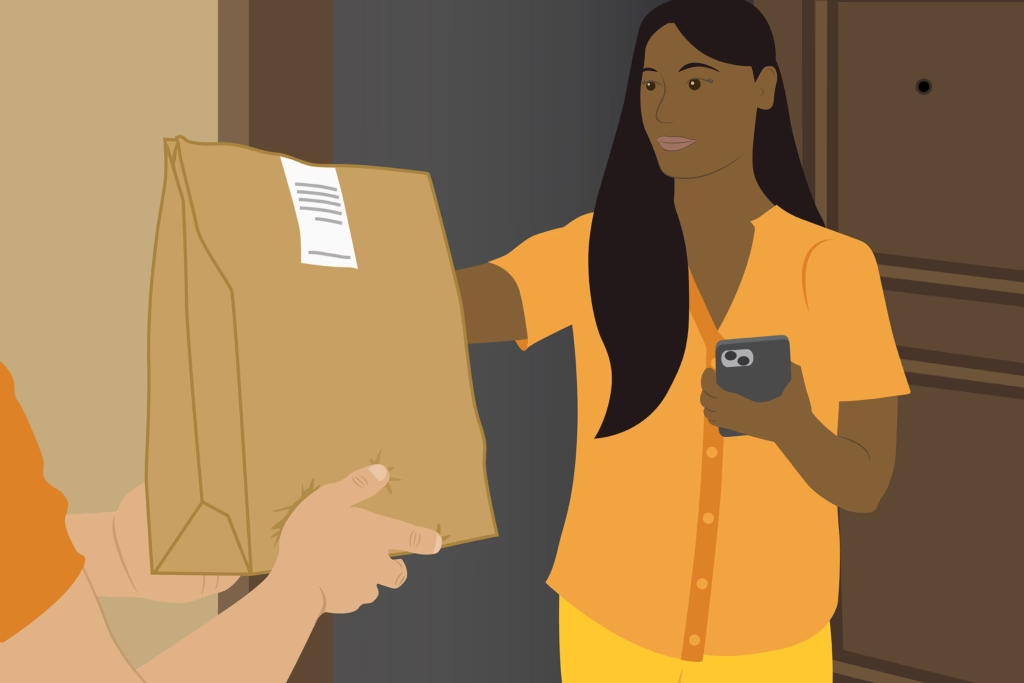
Nothing drains the spirit quite like coming home after a long day and having to decide what’s for dinner. The rise of online food delivery apps like Grubhub, Uber Eats and DoorDash seemingly solved that problem overnight, replacing the mental load of meal prep with a city’s worth of restaurants a single click away.
For Yash Babar, this isn’t just about convenience, it’s about behavioral change. The John and Anne Oros Term Professor and an assistant professor of operations and information management at the Wisconsin School of Business is an expert on the sharing economy, examining how digital interventions reshape our daily identities and habits. His research spans everything from electric vehicle charging stations and ride-hailing to digital storefronts.
His latest study examines potential impacts food delivery services may have on our habits and health.
WSB: How did you and your co-authors first realize food delivery might be influencing household routines in meaningful ways?
YB: One of the things that got us interested in all of this is that it’s changing cooking, one of the most fundamental daily activities, right? Sure, Uber could impact commuting, but not many people are taking an Uber every day. Like everything else that we look at, digital platforms have changed how we get food and groceries, yet these kinds of platforms are still relatively understudied. There are a lot of studies on online food delivery, but the focus has been on what happens at the restaurant end—does it help the restaurant survive, what kinds of restaurants see change, etc.—but not too many people were talking about what’s happening at the consumer end.
That’s when we started digging into this, because especially when it comes to food, you abstract a lot of this decision-making online. How do these choices affect your health? It was a byproduct of these decisions that we started thinking about, particularly if and how it might impact cooking.
WSB: Your findings point to some population-level health effects. What did you observe about the connection between delivery use and health outcomes?
YB: When we talk about cooking at home versus getting takeout, you’re talking about more than one meal. While you may replace one act of cooking, you’re technically replacing multiple meals in consumption as one takeout order might last you between one-and-a-half to two meals. Healthwise, that has implications: Instead of one unhealthy meal, you may have more since we also tend to order a little more than we otherwise would have to make the delivery worthwhile.
Takeout today offers us a wider variety of healthier choices than it did, say, 20 years ago when the options were limited to pizza and Chinese food. Obviously, things have changed a lot and that’s all thanks to these kinds of platforms. But based on industry reports from these companies, most items being ordered are not healthy food.
Our study did suggest a small increase in the body mass index (BMI) of individuals who ordered out frequently, but it was at a population level, in other words, occurring in the geographic areas where those services became available.
WSB: What might these trends mean for the next generation? Do you see a future where ‘home cooking’ becomes a niche hobby rather than a life skill?
YB: Our results come from some of the early years of online food delivery. COVID-19 was a big anchor for people to get into the world of online food delivery, and statistically between 30% and 40% of the people who sign up for these kinds of services never leave.
Besides the main study using the U.S. Census Bureau and Centers for Disease Control surveys, my co-authors and I also did an online survey of about 600 people that asked them just these types of questions: When did you first start using food delivery service? How often do you use them? That type of thing. Naturally, there were people who’ve never placed an order in their lives and others who use food delivery all the time. If you extrapolate from that, from a health perspective, the segment of the population ordering four times a month—well, that could be pretty extreme. At that point, it’s not just replacement of a single meal; it’s a replacement of food habits. What are the long-term implications for these folks, especially when they become adults who are head of households? How frequently will they be cooking?
That is something for time to tell.