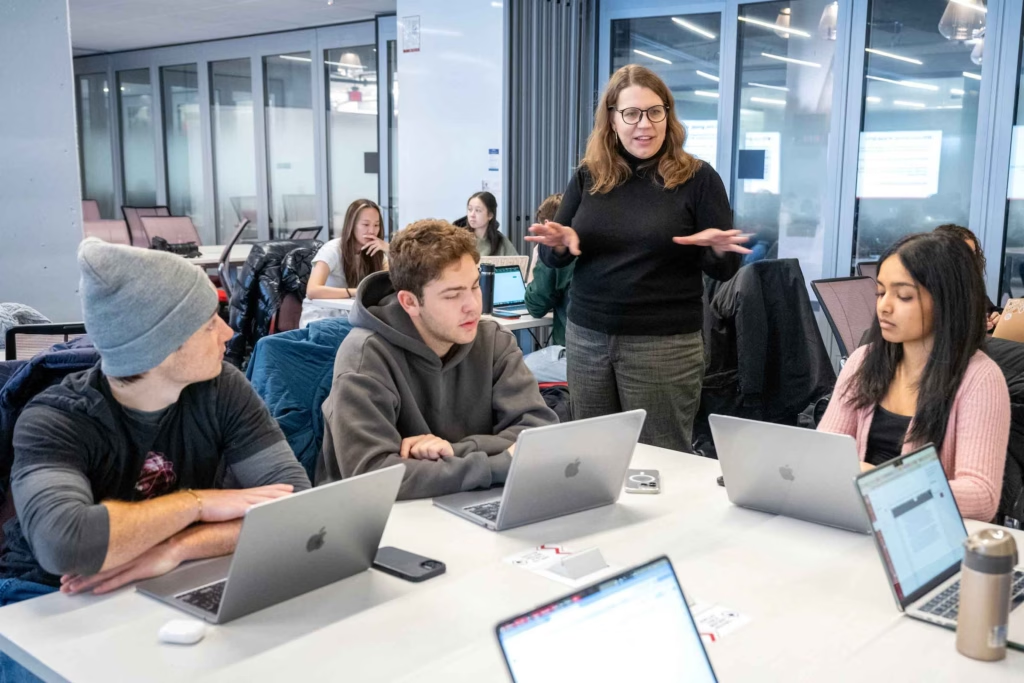
The assignment sounded straightforward: create compelling digital ads to promote sustainability on campus. But as students in Katie Krueger’s class at the Wisconsin School of Business quickly learned, even the best ideas can take an unexpected turn once they reach a real client. A split-second shot of a coffee cup in the wrong bin became the kind of teachable moment you can’t script in a classroom.
Yes, the coffee clip was among the images approved for usage as a still, but when put in video form, the context now contradicted the main message about separating coffee cups, sleeves and lids for correct disposal. The video will now be disqualified because of the recycling parameters, but it makes for “a good lesson about client work,” Krueger (MBA ’11) tells her undergraduate Marketing in the Digital Age class. “The client ultimately has the final decision, and it’s not always one you agree with.”
The teachable moment was one of many for Business Badgers during the Meta Ads Campaign project in Krueger’s class. Krueger, a senior lecturer of marketing at WSB, tasked students with creating compelling ads to drive traffic to two new resources launched by the University of Wisconsin–Madison’s Office of Sustainability (OS). The resources included Free Food Alert, an app that notifies users about leftover catering food on campus and UW–Madison’s Zero Waste Compass, a tool that helps users determine whether an item belongs in the trash or recycling and where to dispose of it.
The students’ ads were placed online across Meta platforms, including Facebook and Instagram, for a limited period. Students tracked their performance and analyzed the data.
“This assignment allows students to see, from the beginning to the end, what they and their work alone can do out there in the real world,” Krueger says. “There’s the unknown factor of what the people of Facebook and Instagram are going to do with it. But I think that means a lot to students, knowing that something can go out in the world and have either little to no impact or catch fire—or anywhere in between—and the creation is theirs alone.”
Advancing Experiential Learning, Driving Change
Krueger’s class is part of a larger collaboration and partnership with WSB’s Weinert Center for Entrepreneurship and the OS. The collaboration is in its third academic year and Krueger’s sixth semester—a different sustainability initiative is chosen each semester—and it’s all made possible thanks to the UW Environmental Awareness Fund (EAF), which was started by a gift from Jim Weinert (MBA ’69).
“Jim asked us to think about how he might make a gift that combined sustainability and entrepreneurship,” says Dan Olszewski, Goldberg Family Director of the Weinert Center for Entrepreneurship. The team did some research and talked to different groups in the sustainability arena. “We realized there was a bit of a gap in the ability to market a lot of the great work and initiatives that they are doing over in the Office of Sustainability,” he says.
Olszewski knew about Krueger’s class projects and how, even in the very successful class, the learning could only go so far without funding social media ads. The students could come up with a plan and create mock ads, but they didn’t have the financial resources to execute it and learn from the results.
“This assignment allows students to see, from the beginning to the end, what they and their work alone can do out there in the real world.”
—Katie Krueger
Now, “It’s been fascinating for all of us to see the results and where students take their creativity but also see what gets traction and what doesn’t,” Olszewski says. “I know Katie’s talked about how it’s taken the student learning to the next level.”
The OS office has also witnessed positive changes since the inception of the partnership.
“To me, the Meta ad campaign is the purest distillation of the ethos behind the mission of the UW EAF and its benefactor, Jim Weinert,” says Tim Lindstrom, student intern program manager with OS.
“One of the first ad campaigns was targeted at promoting awareness about the Office of Sustainability Intern Program and thereby increasing application numbers to the internship, a program that fundamentally takes a bottom-up or grassroots approach to promoting sustainability on the UW–Madison campus.”
Krueger’s marketing students met with OS staff, researched the intern program, and created effective ads that put out a call for hires.
“During that hiring cycle, our program received more applicants than ever before,” Lindstrom says. “The ad campaign seeded our applicant pool with a deeper well of candidates, ensuring that our intern team would be stronger and more effective in carrying out our mission of advocating sustainability initiatives at a grassroots level to students, staff, and faculty on the UW–Madison campus.”
Positioned for the Future
Students who have participated in Krueger’s class have come out the other side with greater confidence and honed expertise.
Lily Dulman (BBA ’28), who worked on the Free Food Alert campaign, says she gained skills in translating behavioral insights into targeted messaging and creative strategy while optimizing her content for the audience and platform.
“One of my biggest takeaways was seeing how intentional design and message framing can influence engagement when you’re working within tight constraints,” she says.
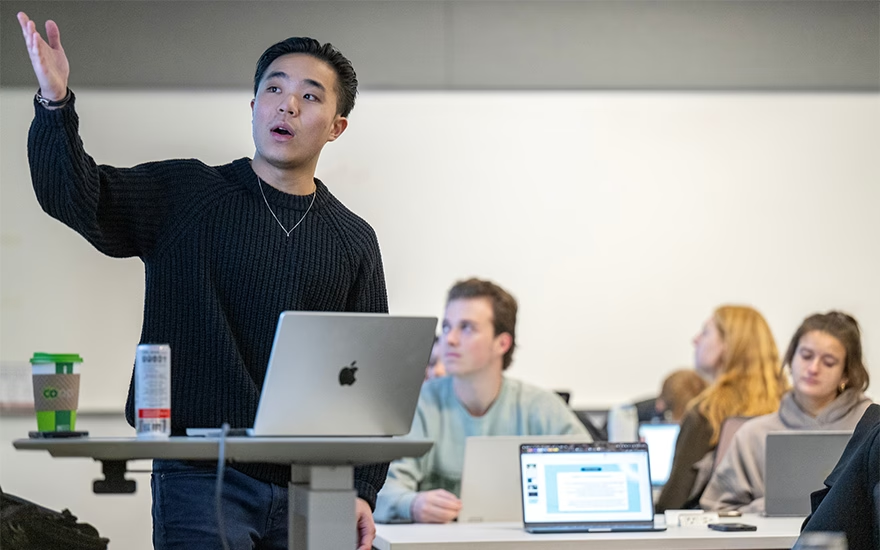
Guardrails like not being able to adjust either Bucky Badger’s image or the Wisconsin logo and including crucial campaign information.
“It pushed me to think more strategically about how marketing decisions directly shape audience response. Overall, it was a really rewarding opportunity to apply classroom concepts to a real-world client scenario.”
Jacob Pezewski (BBA ’26), who took Krueger’s course in Spring 2025, said Krueger “created a safe and positive environment in the classroom that helped make this hands-on learning easy to digest for someone who hasn’t worked in the Meta platform before.”
As he continues his job hunt, he uses his work from her class to showcase his digital marketing acumen.
“It was an incredible hands-on experience that deepened my understanding of digital advertising metrics and how to apply those insights to future campaigns,” Pezewski shared on LinkedIn.
Even for a digitally savvy generation that thinks nothing of making a TikTok, having students “see the work that goes into the back end and understand that the influencer they adore who has a million followers didn’t get there simply because they’re so popular is important,” says Krueger.
“What my class exposes is that they’re actually putting a ton of money behind getting these followers. I want my students to understand why and how certain content shows up in their feed so that they can be mindful of how they use social media,” she says. “My goal is to give every student who walks into an interview for a digital marketing position a competitive edge because they have already done some of the work required of the job.”