
Morgan Piehler (MBA ’25), co-director of Creative Destruction Lab-Wisconsin, remembers the moment early in her job when it all crystallized. She was on a Zoom call with Joan Schmit, professor emeritus of risk and insurance.
“Joan is the one who defined risk for me,” reflects Piehler, who joined CDL-Wisconsin, a nonprofit startup program for tech entrepreneurship housed at the University of Wisconsin–Madison, in 2020. “The way she described it was that community is what insurance is all about. Many consumers are frustrated by the insurance process, but it’s really meant to pool and share risk, whether that’s to protect one person or to protect the group. When one person has a problem, the group lifts them up. Only together can we protect ourselves.”
CDL-Wisconsin, one of 15 global CDL sites, launched five years ago with Piehler serving as its first full-time employee. At the time, Schmit was already a co-site lead. The lab’s initial focus, known as the Risk Stream in CDL parlance, was made possible through a partnership with American Family Insurance. This stream supports ventures aiming to “transform society’s ability to manage risk,” according to CDL-Wisconsin’s website. Later, a second stream—Health and Wellness—was introduced to accelerate health care innovations and bring them to market.
Like the Risk Stream, the Health and Wellness Stream has an eye toward resiliency. “We’re thinking about how to make the world a healthier place and hope to do some of that preventatively, before people get sick,” says Piehler. “So, there’s something very strong about both streams in that regard of helping the world.”
Program design
CDL-Wisconsin welcomed a new cohort of entrepreneurial founders into its nine-month program this month. It’s competitive; not every company that begins the program will complete it. The names of those selected are not made public until the nine months are up so as not to put a blight on their experience, Piehler says. “Many companies that don’t make it through the program are still going to be very successful.”
“When you’re starting a small company, nobody’s looking for you. You’re having to sell yourself all the time and we ask [the founders] to leave that at the door, to adopt a different mindset.”
Morgan Piehler
Once accepted, founders work with mentors throughout the program to solve business problems, expand their network, and scale the company. The mentors are top industry, academic, and nonprofit leaders with a variety of specializations, such as Jennifer Olson (BBA ’95, MBA ’97), Children’s Minnesota, and Kyle Nakatsuji (MBA ’11, JD ’12), founder and CEO of Clearcover.
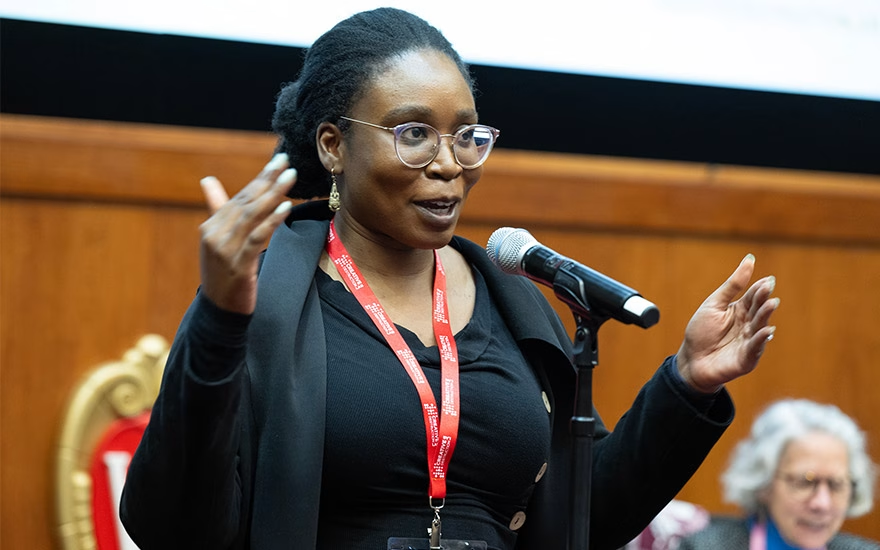
The mentors help the founders with strategy and positioning—and no elevator pitch is required.
“When you’re starting a small company, nobody’s looking for you,” says Piehler. “You’re having to sell yourself all the time and we ask them to leave that at the door, to adopt a different mindset. The founders that can make that adjustment and express vulnerability are the ones that tend to be the most successful. ‘Coachability’ is one of the biggest concepts in terms of what we’re looking for.”
Piehler says most of CDL-Wisconsin’s ventures won’t have the name recognition of a Google or X but will be very industry-specific, and often extremely innovative to that field. She recalls a recent example of a founder who created beanies for newborns in a neonatal intensive care unit (NICU) that mimic the natural noise filtration of the womb and allow parents to better connect with their baby.
“The premise of CDL is that there are incredible ideas anywhere in the world, but it takes a whole network of people to launch those ideas into a scalable commercial business,” says Piehler. “If you’re not in a place such as Silicon Valley, you might not have access to that network. So how can we solve that problem? How can we create better access to the kinds of business judgement that you need to scale your business effectively? Getting to be part of that problem has been really fascinating for me.”
Connecting the dots
As CDL-Wisconsin has grown, Piehler has grown in her role too. Prior to joining CDL, Piehler worked for nearly a decade in business operations and strategy with Operation Smile, a global nonprofit that provides lip and cleft palate surgeries to those in need. It was during this time she started thinking about getting an MBA.
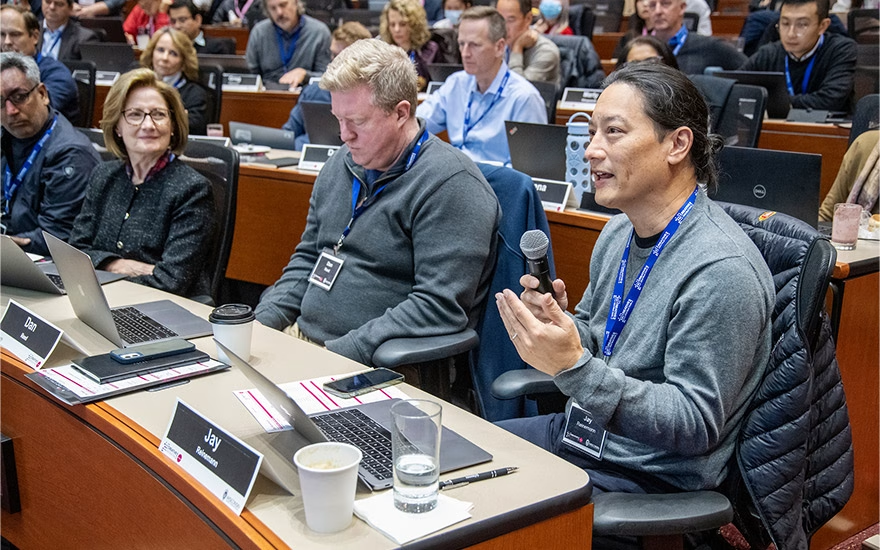
Working at a nonprofit and observing how Operation Smile balanced organizational priorities and diverse stakeholders, while navigating the dynamics of a global team, inspired her to learn more. After taking the role with CDL-Wisconsin and seeing founders, mentors, and WSB faculty such as Schmit in action, Piehler decided it was time to go for it. She enrolled in the school’s professional MBA (PMBA) program, a part-time, hybrid option that allows students to complete their degree while working full time.
“Really understanding the relationship between the information we have and the decisions we’re making as an organization was where it started for me,” she says. “I’ve been lucky enough to complete my MBA and use those skills, tools, and connections to grow CDL-Wisconsin.”
Wide-ranging impact
Over five years, CDL–Wisconsin has continued to expand, with new founders, ideas, and mentors building on each success.
- 124 CDL alumni ventures have added more than 1,071 employees and generated $2.33 billion in equity value creation, including five acquisitions as of September 2025
- 33% of participating companies have at least one female founder; 46% include a co-founder from an underrepresented group
- 17 CDL ventures have headquarters in Wisconsin
- 197 industry mentors have contributed over 10,830 volunteer hours (more than 1,350 business days) to support innovation and discovery
Successful ventures with CDL-Wisconsin connections include the Badger-founded Cylerity Corporation, Ledgebrook, and Droxi.
Piehler says it’s rewarding to use her degree to support the next generation of phenomenal innovators and technologies.
“I’ve learned a ton about entrepreneurship—and about the grit it takes to build something new,” Piehler says. “That’s why we’re so focused on giving founders every chance to succeed.”