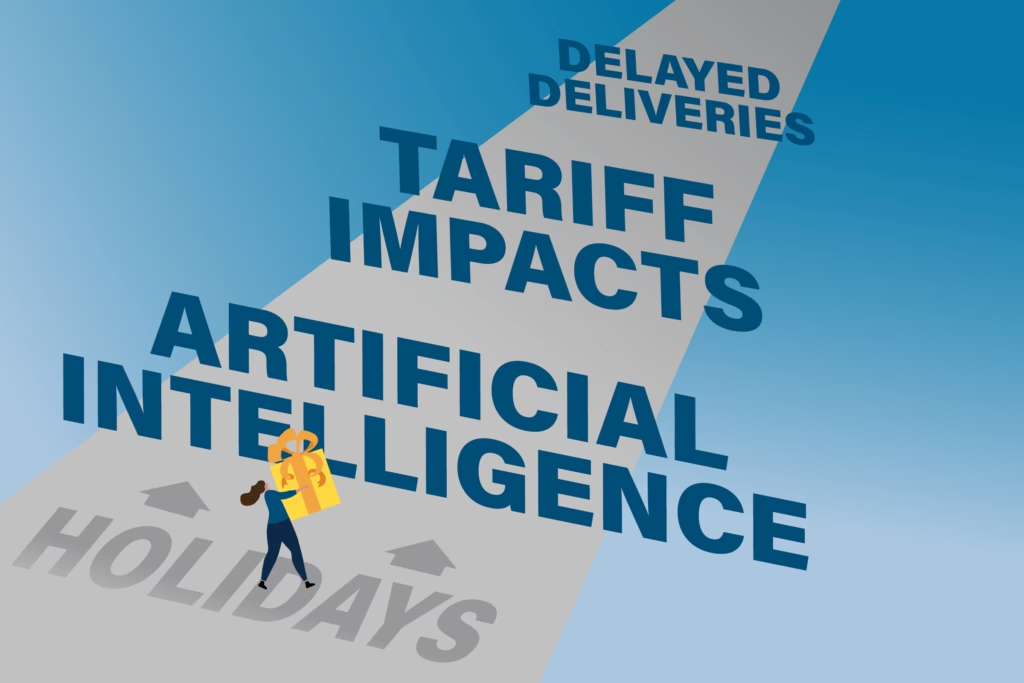
Tariffs, artificial intelligence, and delayed deliveries are shaping up to make this holiday season among the most complex yet for retailers and the supply chain. Wisconsin School of Business faculty from the Grainger Center for Supply Chain Management, the Department of Marketing, and the Department of Operations and Information Management share their thoughts on what shoppers might expect this holiday season.
Tim Buhl
Senior lecturer, marketing
Capacity balancing and time-bound delivery expectations have become a holiday tradition! Given the intense challenges multiple supply chains are burdened with during the holiday season, we will have a unique opportunity to test the impact of AI. Stressed systems will quickly reveal the improvements as well as limitations associated with AI.
Kaitlin Daniels
Assistant professor, operations and information management
In September, the Department of Transportation (DOT) adopted new rules restricting eligibility for commercial driver’s licenses (CDLs) among non-citizens. The changes exclude several groups previously eligible to drive commercially, including asylum seekers, refugees, and Deferred Action for Childhood Arrivals (DACA) recipients. According to a Federal Motor Carrier Safety Administration audit, up to 200,000 current drivers could be affected. The policy rollout has coincided with increased enforcement activity targeting non-citizen truckers, including reports of Immigration and Customs Enforcement (ICE) detentions at weigh stations in Florida and Oklahoma. The DOT’s rule is being challenged in court, creating uncertainty about the timing and outcome of a final ruling and leaving truckers and shippers in limbo in the run up to the holiday season.
Jake Dean
Director, Grainger Center for Supply Chain Management
The “supply chain issues” that we all heard about during and coming out of the COVID-19 pandemic were largely driven by shifts in consumer demand: The supply chain couldn’t keep up with goods consumption. The ones we’re likely to hear about this season have more to do with supply. Tariffs raise import costs, so many companies made a best guess on holiday season demand earlier than normal in an attempt to beat tariffs. If they guessed low, shelves could be bare at the end of the season—don’t shop last-minute!
Tarun Kushwaha
Professor, marketing
Irwin Maier Professor of Business
These are both interesting and uncertain times. At one end of the spectrum, AI investments and its promise to revolutionize business is keeping financial markets red hot. At the other end, the uncertainty about the economy, impact of tariffs, looming car payment crisis, and AI-fueled job market changes are keeping the consumer sentiment low. These competing forces are affecting consumer segments differently.
At the top-end, wealthy Americans, buoyed by gains of the stock and real-estate markets, are splurging. Their holiday spending is expected to increase compared to 2024. However, for the middle- and lower-income consumers, the expected spending is going to be lower than last year. This means higher-end retailers—producers of luxury brands, exotic holiday destinations, and expensive theme parks—will see strong demand. Other mainstream retailers should focus on stocking value-for-money offerings and be prepared for consumers seeking exceptional deals.
Xiaoyang Long
Associate professor, operations and information management
Wisconsin Naming Partners Professor
With tariffs and the end of the de minimis exemption, gifts may become more expensive—from Walmart to your favorite Etsy shop. Think about shopping vintage or secondhand. It’s better for the earth and you may find some special items!
Pete Lukszys
Distinguished lecturer, Grainger Center for Supply Chain Management
Compared with the post-COVID disruption years, I anticipate this year’s holiday season supply chain will be considerably more stable. That said, I see a few areas of risk.
First, UPS has announced about 48,000 layoffs this year. Of the 48,000 reported, 34,000 are drivers and warehouse employees. UPS and FedEx were already operating near full capacity, so these layoffs could cause service issues and less flexibility during the holiday delivery surge. Second, many retailers front-loaded their imports to avoid potential tariff hikes on toys and electronics. It’s possible inventories could run low late in the season, creating an environment with a higher risk of stockouts for popular items.
Overall, I anticipate 2025 will be far smoother than the pandemic years, but my advice to shoppers is: shop and ship early!
Jordan Tong
Chair, Department of Operations and Information Management
Wisconsin Naming Partners Professor
In response to tariffs and tariff uncertainty, many retailers not only reduced their holiday imports but also shifted them earlier. That meant making tough quantity, assortment, and pricing decisions under greater uncertainty. It’s simply harder to forecast demand when you have to commit earlier—and when several changes are happening at once.
As a result, I predict shoppers will see higher prices and more product scarcity on average, but also greater variability: some items will be scarce and expensive, others overstocked and unexpectedly discounted. So, while prices are likely to be higher overall, flexible shoppers may still find good deals this holiday season.
Tags: